Physical Address
304 North Cardinal St.
Dorchester Center, MA 02124

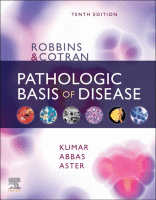
Children are not merely little adults, and their diseases are not merely variants of adult diseases. Many childhood conditions are unique to, or at least take distinctive forms in, this stage of life and so are discussed separately in this chapter. Diseases originating in the perinatal period are important in that they account for significant morbidity and mortality. The chances for survival of infants improve with…
Many diseases are caused or influenced by environmental factors. Broadly defined, the term environment encompasses the various indoor, outdoor, and occupational settings in which human beings live and work. In each of these settings, the air people breathe, the food and water they consume, and the toxic agents they are exposed to are major determinants of health. The environmental factors that influence our health pertain to…
General Principles of Microbial Pathogenesis Despite the availability of effective vaccines and antibiotics, infectious diseases remain a major health problem throughout the world. In the United States and other high-income countries, infectious diseases are particularly important causes of death among older adults and in people who are immunosuppressed or who suffer from debilitating chronic diseases. In lower-income nations inadequate access to medical care and malnutrition contribute…
Cancer is the second leading cause of death in the United States; only cardiovascular diseases exact a higher toll. Even more agonizing than the mortality rate is the emotional and physical suffering inflicted by cancers. Patients and the public often ask, “When will there be a cure for this scourge?” The answer to this simple question is difficult because cancer is not one disease but many…
The immune system is vital for survival because it protects us from infectious pathogens that abound in the environment and from the development of cancer. Predictably, immune deficiencies render individuals easy prey to infections and increase the incidence of certain cancers. But the immune system is itself capable of causing tissue injury and disease. Examples of disorders caused by immune responses include reactions to environmental substances…
Genes and Human Diseases In Chapter 1 , we discussed the architecture of the normal human genome. Here we build on that knowledge to discuss the genetic basis of human diseases. Genetic disorders are far more common than is widely appreciated. The lifetime frequency of genetic diseases is estimated to be 670 per 1000. Furthermore, the genetic diseases encountered in medical practice represent only the tip…
The health of cells and tissues depends on the circulation of blood, which delivers oxygen and nutrients and removes wastes generated by cellular metabolism. Under normal conditions, as blood passes through capillary beds, proteins in the plasma are retained within the vasculature, and there is little net movement of water and electrolytes into the tissues. This balance is often disturbed by pathologic conditions that alter endothelial…
Overview of Inflammation: Definitions and General Features Inflammation is a response of vascularized tissues that delivers leukocytes and molecules of host defense from the circulation to the sites of infection and cell damage in order to eliminate the offending agents. Although in common medical and lay parlance, inflammation suggests a harmful reaction, it is actually a protective response that is essential for survival. It serves to…
Introduction to Pathology Pathology is the study of the structural, biochemical, and functional changes in cells, tissues, and organs that underlie disease. By the use of morphologic, microbiologic, immunologic, and molecular techniques, pathology attempts to explain the whys and wherefores of the signs and symptoms manifested by patients while providing a rational basis for clinical care and therapy. It thus serves as the bridge between the…
Pathology literally translates as the study of suffering (Greek pathos = suffering, logos = study); more prosaically, and as applied to modern medicine, it is the study of disease. Virchow was prescient in asserting that disease originates at the cellular level, but we now appreciate that cellular pathologies arise from perturbations in molecules (genes, proteins, and metabolites) that influence cell survival and behaviors. Thus the foundation…
Chapter 1 Figure 1.17 Courtesy Dr. M. Elizabeth H. Hammond, University of Utah. Figures 1.20 and 1.49 Courtesy Department of Pathology, University of Hong Kong. Figure 1.33 Courtesy Dr. Walter H. Henricks, Cleveland Clinic Foundation. eFigure 1.8 Courtesy Dr. Richard Conran, Uniformed Services University. Chapter 2 Figure 2.11 Courtesy Dr. Mary Ann Sens, University of North Dakota. Figures 2.7 and 2.8 Used with permission of GE…
You’re Reading a Preview Become a Clinical Tree membership for Full access and enjoy Unlimited articles Become membership If you are a member. Log in here
You’re Reading a Preview Become a Clinical Tree membership for Full access and enjoy Unlimited articles Become membership If you are a member. Log in here
You’re Reading a Preview Become a Clinical Tree membership for Full access and enjoy Unlimited articles Become membership If you are a member. Log in here
You’re Reading a Preview Become a Clinical Tree membership for Full access and enjoy Unlimited articles Become membership If you are a member. Log in here
You’re Reading a Preview Become a Clinical Tree membership for Full access and enjoy Unlimited articles Become membership If you are a member. Log in here
You’re Reading a Preview Become a Clinical Tree membership for Full access and enjoy Unlimited articles Become membership If you are a member. Log in here
You’re Reading a Preview Become a Clinical Tree membership for Full access and enjoy Unlimited articles Become membership If you are a member. Log in here
You’re Reading a Preview Become a Clinical Tree membership for Full access and enjoy Unlimited articles Become membership If you are a member. Log in here
You’re Reading a Preview Become a Clinical Tree membership for Full access and enjoy Unlimited articles Become membership If you are a member. Log in here