Physical Address
304 North Cardinal St.
Dorchester Center, MA 02124

To avoid ambiguity and confusion, anatomical terms of position and movement are defined according to an internationally accepted convention. This convention defines the anatomical position as one in which the human body stands erect with the feet together and the face, eyes and palms of the hands directed forwards ( Fig. 1.1 ).

With the subject in the anatomical position, three sets of planes, mutually at right angles, can be defined.
Vertical (or longitudinal) planes are termed either coronal or sagittal. Coronal (or frontal) planes ( Fig. 1.2 ) pass from one side to the other, while sagittal planes ( Fig. 1.3 ) pass from front to back. One particular sagittal plane, the median sagittal (midsagittal) plane, lies in the midline and divides the body into right and left halves ( Fig. 1.4 ).


Horizontal (or transverse) planes ( Fig. 1.5 ) transect the body from side to side and front to back.

Sections cut at right angles to the long axis of an organ or parts of the body are also known as transverse. Similarly, longitudinal sections are cut parallel to the long axis.
The terms medial and lateral are used to indicate the position of structures relative to the median sagittal plane. For example, the ring finger lies lateral to the little finger but medial to the thumb. The front and back of the body are usually termed the anterior (or ventral) and posterior (or dorsal) surfaces, respectively ( Fig. 1.1 ). Thus one structure is described as anterior to another because it is placed farther forwards.
Superior and inferior are terms used to indicate the relative head/foot positions of structures ( Fig. 1.1 ). Those lying towards the head (or cranial) end of the body are described as superior to others, which are inferior (or caudal). Thus the heart lies superior to the diaphragm; the diaphragm is inferior to the heart. In the limbs, the terms proximal and distal have comparable meanings. For example, the elbow joint is proximal to the wrist but distal to the shoulder. These terms are also used to indicate the physiological direction of flow in tubes, such as the oesophagus is proximal to the stomach.
The terms superficial and deep indicate the location of structures in relation to the body surface. Thus the ribs lie superficial to the lungs but deep to the skin of the chest wall ( Fig. 1.5 ).
Movements at joints are also described by specific terms. From the anatomical position, forward movement of one part in relation to the rest of the body is called flexion. Extension carries the same part posteriorly ( Fig. 1.6 ). However, because in the fetus the developing upper and lower limbs rotate in different directions, the movements of flexion and extension in all joints from the knee downwards occur in opposite directions to the equivalent joints in the upper limb. In abduction, the structure moves away from the median sagittal plane in a lateral direction, whereas adduction moves it towards the midline ( Fig. 1.7 ). For the fingers and toes, the terms abduction and adduction are used in reference to a longitudinal plane passing along the middle finger or the second toe, respectively. Movement around the longitudinal axis of part of the body is called rotation. In medial (or internal) rotation, the anterior surface of a limb rotates medially, while lateral (or external) rotation turns the anterior surface laterally ( Fig. 1.8 ). Movements that combine flexion, extension, abduction, adduction and medial and lateral rotation (for instance, the ‘windmilling’ action seen at the shoulder joint) are known as circumduction.


Skin ( Fig. 1.9 ) is a protective covering for the surface of the body and comprises a superficial layer, called the epidermis, and a deeper layer, the dermis. The epidermis is an epithelium consisting of a surface layer of dead cells, which are continually shed and replaced by cells from its deeper germinal layer. The dermis is a layer of connective tissue containing blood vessels, lymphatics and nerves. In most areas of the body, the skin is thin and mobile over the underlying structures. Specializations of the skin include fingernails and toenails, hair follicles and sweat glands. On the palms of the hands and soles of the feet (and corresponding surfaces of the digits), hair follicles are absent and the epidermis is relatively thick. The skin in these regions is also firmly anchored to the underlying structures, reducing its mobility during gripping and standing.  Lines of tension (Langer's lines) occur within skin and are of importance to surgeons. Scars following surgical incisions made along these lines tend to be narrower than those made across the lines of tension.
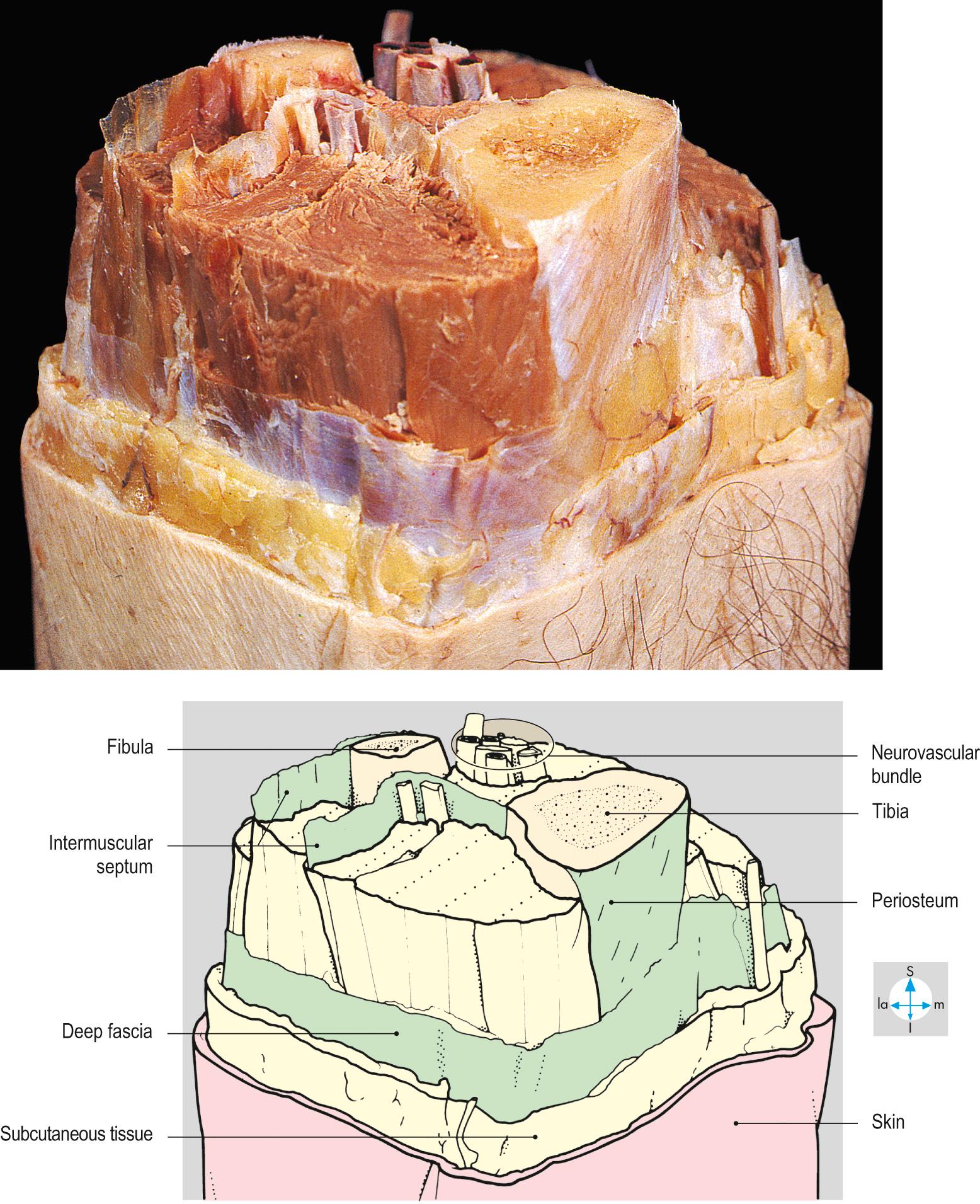
Skin is usually well vascularized and receives blood from numerous subcutaneous vessels. Knowledge of this vascular supply is important when operations that involve the use of skin flaps are undertaken. Skin has a rich nerve supply, responding to touch, pressure, heat, cold, vibration and pain. In certain areas, such as the fingertips, the skin is especially sensitive to touch and pressure. Skin is innervated by superficial (cutaneous) branches of spinal or cranial nerves. The area of skin supplied by each cranial or spinal nerve is known as a dermatome ( Figs 1.37 & 1.38 ).
Immediately deep to the skin is a layer of loose connective tissue, the subcutaneous tissue ( Fig. 1.9 ), which contains networks of superficial veins and lymphatics and is traversed by cutaneous nerves and arteries. It also contains fat, which varies considerably in thickness from region to region and between individuals. For example, over the buttock the fat is particularly thick, while on the back of the hand it is relatively thin. Over the lower abdomen this tissue is subdivided into two layers, a superficial fatty layer and a deeper membranous layer.
The deep fascia ( Fig. 1.9 ) consists of a layer of dense connective tissue immediately beneath the subcutaneous tissue. Although thin over the thorax and abdomen, it forms a substantial layer in the limbs (e.g. fascia lata; p. 260 ) and neck (e.g. investing fascia; p. 324 ). Near the wrist and ankle joints, the deep fascia is thickened to form retinacula, which maintain the tendons in position as they cross the joints. Deep fascia also provides attachment for muscles and gives anchorage to intermuscular septa, which separate the muscles into compartments.  Bleeding and swelling within muscle compartments due to crushing injuries or fractures may raise the pressure so much that it compresses blood vessels and reduces blood flow. The resulting ischaemia may be followed by scarring and deformity with contracture of muscles.
Muscle is a tissue in which active contraction shortens its component cells and/or generates tension along their length. There are three basic types: smooth muscle, cardiac striated muscle, voluntary striated muscle. Striated and smooth describe the microscopic appearance of the muscle.
Smooth muscle is present in the organs of the alimentary, genitourinary and respiratory systems and in the walls of blood vessels. Capable of slow, sustained contraction, smooth muscle is usually controlled by the autonomic nervous system (p. 22) and by endocrine secretions (hormones).
Cardiac striated muscle (myocardium) is confined to the wall of the heart and is able to contract spontaneously and rhythmically. Its cyclical activity is coordinated by the specialized conducting tissue of the heart and can be modified by the autonomic nervous system.
Skeletal muscle (voluntary striated muscle) is the basic component of those muscles that produce movements at joints. These actions are controlled by the somatic nervous system (p. 20) and may be voluntary or reflex. Each muscle cell (fibre) has its own motor nerve ending, which initiates contraction of the fibre. Muscles may be attached to the periosteum of bones either directly or by fibrous connective tissue in the form of deep fascia, intermuscular septa or tendons. Direct fleshy attachment can be extensive but tendons are usually attached to small areas of bone. Muscles with similar actions tend to be grouped together, and in limbs these groups occur in compartments (e.g. extensor compartment of the forearm).
Usually, each end of a muscle has an attachment to bone. The attachment that remains relatively fixed when the muscle performs its prime action is known as the origin, whereas the insertion is the more mobile attachment. However, in some movements, the origin moves more than the insertion; therefore, these terms are of only limited significance.
The muscle fibres within voluntary muscle are arranged in differing patterns, which reflect the function of the muscle. Sometimes they are found as thin flat sheets (as in external oblique; Figs 1.10 & 1.11 ). Strap muscles (such as sartorius; Fig. 1.12 ) have long fibres that reach without interruption from one end of the muscle to the other.

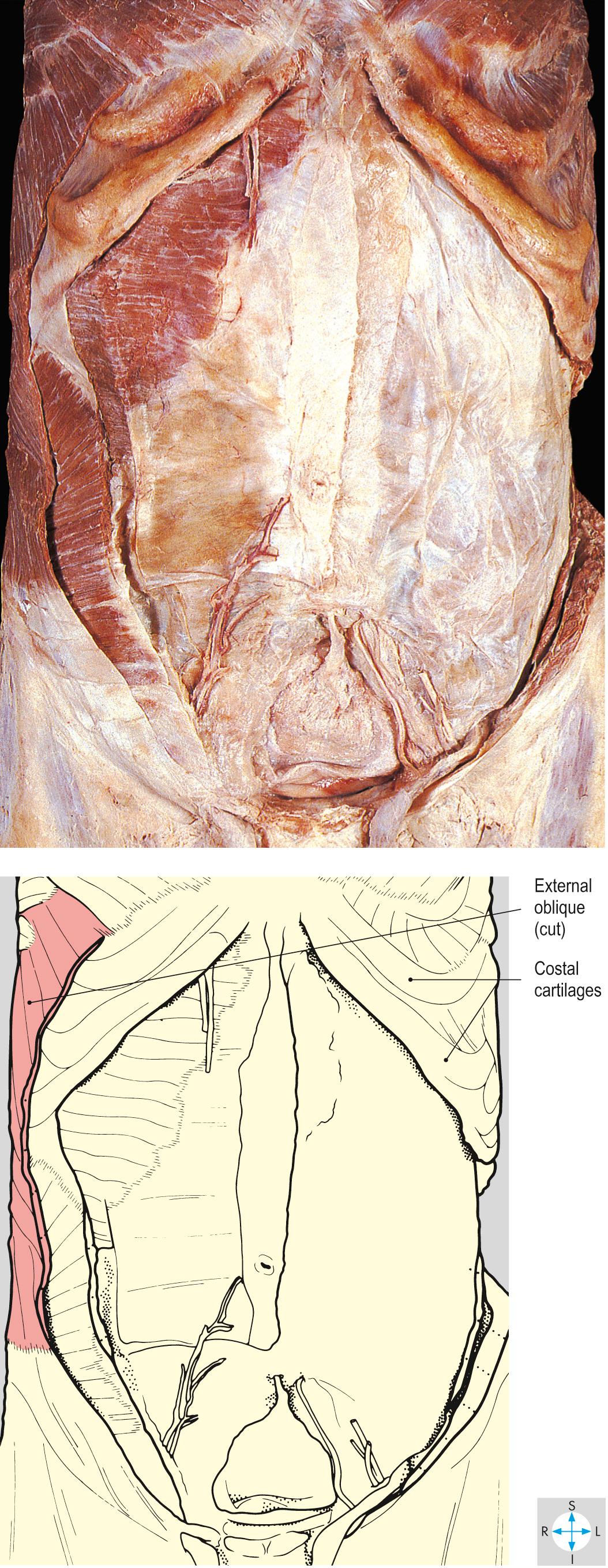

Pennate muscles are characterized by fibres that run obliquely. Unipennate muscles (e.g. flexor pollicis longus; Fig. 1.13 ) have fibres running from their origin to attach along only one side of the tendon of insertion. In bipennate muscles (such as dorsal interossei; Fig. 1.14 ) the fibres are anchored to both sides of the tendon of insertion.


Multipennate muscles (e.g. subscapularis; Fig. 1.15 ) have several tendons of origin and insertion with muscle fibres passing obliquely between them. Some muscles, for instance digastric, have two fleshy parts (bellies) connected by an intermediate tendon ( p. 348 ).

Most tendons are thick and round or flattened in cross-section, although some form thin sheets called aponeuroses ( Fig. 1.10 ). When tendons cross projections or traverse confined spaces, they are often enveloped in a double layer of synovial membrane to minimize friction. Where they cross joints, tendons are often held in place by bands of thick fibrous tissue, which prevent ‘bowstringing’ when the joints are moved. Examples include the retinacula at the wrist and ankle joints, and tendon sheaths in the fingers and toes ( Figs 1.16 & 1.17 ).


The nerve supply to a skeletal muscle contains both motor and sensory fibres, which usually enter the fleshy part of the muscle. Groups of muscles with similar actions tend to be supplied by nerve fibres derived from the same spinal cord segments.
As very metabolically active tissue, muscle has a rich arterial blood supply, usually carried by several separate vessels. The contraction and relaxation of muscles in the limbs compresses the veins in each compartment. As the veins contain unidirectional valves, this muscle pump action assists the return of venous blood from the limbs to the trunk.
Become a Clinical Tree membership for Full access and enjoy Unlimited articles
If you are a member. Log in here

