Physical Address
304 North Cardinal St.
Dorchester Center, MA 02124

By Daniel Merkel, Chemical Researcher, 5+ Years. Reviewed by Josh Quick, Editor. Last updated: September 2026
A research peptide is only as good as the proof that came with it, which varies from vendor to vendor. Finnrick, an independent testing group, published more than 10,405 HPLC lab results across roughly 1,884 vendors, and the grades range from A to F. This means two vials wearing the same “99% pure” claim on the label can be nothing alike inside.
So choosing a supplier comes down to what you can verify: a six-point check covering
Before you look at a single product, work out who you’re dealing with. Confirm the vendor has a real business name and legal entity, a physical address, working contact details, and clear website policies. Look for an address you could drop into a map. Clear shipping, returns, and research-use policies are a quiet sign someone sweated the details.
Then check whether they manufacture the material or resell it, and whether they disclose where it’s made. A manufacturer synthesizes the material itself. A reseller buys it and adds its own label. Reselling isn’t a red flag, but be cautious about who stands behind the testing.
Key Question: Can you clearly know who you’re buying from? If that part is fuzzy, it could be your first red flag.
Once the company checks out, the paperwork does the heavy lifting. The most important document is the Certificate of Analysis, or COA. Think of it as the receipt confirming what’s in the vial.
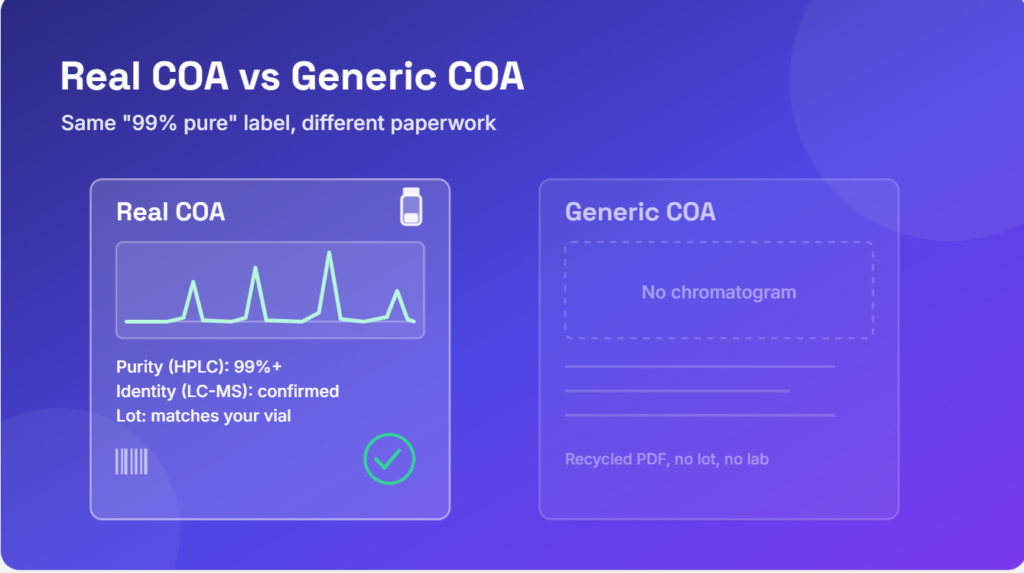
Generally, it’s tied to a specific batch. It should show the compound name, the purity result, the identity result, the testing date, the lot or batch number, and the lab that ran the tests.
A full COA answers three separate questions:
| Question | What it tells you | How it’s measured |
| Identity: is this the right molecule? | Confirms you got the compound on the label | Mass spectrometry, mass within about ±1 Da of expected |
| Purity: how much is the target compound? | Shows target peptide versus byproducts | HPLC, as a percentage (98%+ is the common floor) |
| Safety: anything else in there? | Flags contaminants a purity number misses | Endotoxin (LAL), plus sterility or heavy-metals tests where relevant |
HPLC, short for high-performance liquid chromatography, measures purity. It shows how much of the sample is your target peptide versus leftover bits from synthesis. Mass spectrometry checks identity. It weighs the molecule and confirms the compound is what you ordered. Purity without identity means you could have a very clean batch of the wrong compound.
Testing only counts if you can trace it back to your vial.
The strongest setup is independent, third-party testing from an accredited lab, with a lot number on the COA that matches your vial. “Accredited” labs follow the ISO/IEC 17025 standard, which assures lab competence. It’s a sign-off that a lab can produce valid results when checking a sample.
In-house testing can be honest, but the seller also has a stake in the result, so outside verification carries more weight.
Why does this matter in practice: remember the Finnrick data discussed above: 10,000-plus HPLC tests? Grades run from A to F because results vary by vendor and by batch. A COA cuts through that, but only if you can tie it to the vial you received.
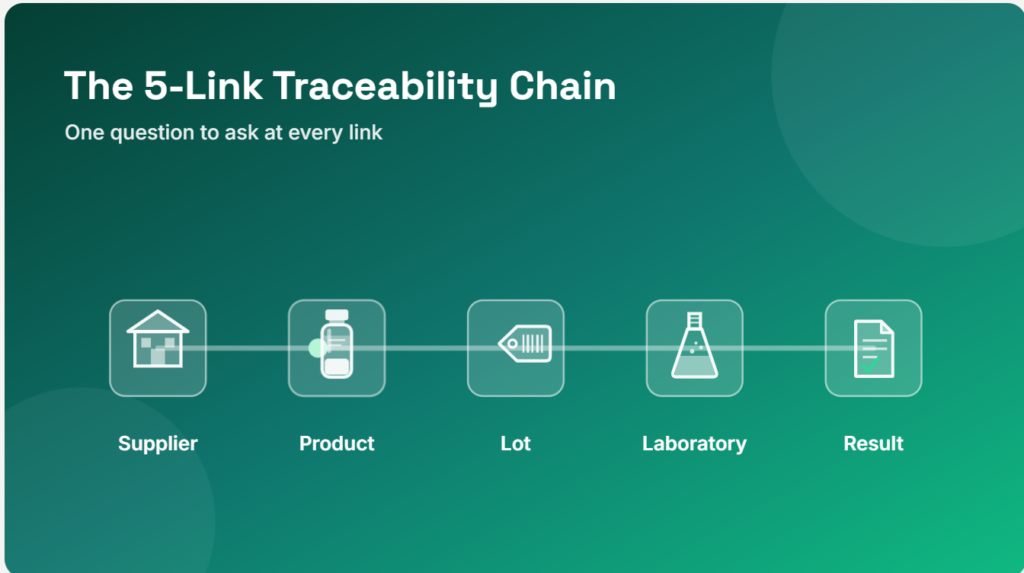
An easy way to picture it is as a chain, where every link connects to the next: Supplier to Product to Lot to Laboratory to Result. When every link holds, you’ve got records you can stand behind later.
The product page says a lot about how a supplier runs. You want specifics.
The product description, for instance, must list the exact compound and its CAS number, the quantity, purity info, storage guidance, clear research-use positioning, and easy COA access, ideally before you buy. Shipping, returns, and contact details should be one click away.
Run down this list as you read:
Price matters, but buying on price alone has a catch. If a vial is cheap because it’s underfilled or the compound isn’t what the label claims, it soon costs you more when the work you planned around it fails. So weigh price against documentation and service.
| Criteria | Kylo Peptides | Budget vendor | Premium reseller |
| Price | Published, with a member price | Cheapest, varies by batch | Published, premium pricing |
| COA access | Public, lot-matched | On request, rarely lot-matched | Public, not always lot-matched |
| Independent testing | ISO/IEC 17025 lab | In-house or not stated | Third-party, lab not always named |
| HPLC data (purity) | ≥99% | Claimed, no report shown | 98%+, report provided |
| LC-MS data (identity) | Yes | Not stated | Sometimes included |
| Lot traceability | Lot-matched COA | Limited | Partial |
| Product information | Compound, CAS, storage | Minimal | Detailed |
| Shipping | Free over $200, same-day before 2 PM CT | Varies, often paid | Standard, paid |
| Customer support | Listed contact, plus guarantees | Limited | Contact listed |
Kylo leads on the documentation and traceability rows and on value. The budget profile wins only on raw price, and the premium reseller is respectable on product info and testing but costs more.
6. Why Kylo Peptides Is a Priority to Consider
Kylo Peptides lines up with the checklist above, point for point.
Unlike the shady vendors that want you to take their word for it, you can verify whatever Kylo claims. You can open a lot-matched COA, read the HPLC and mass-spec results, confirm the lot against your vial, and check the shipping and refund terms before you order.
On documentation, watch for a missing COA, a generic COA reused across every product, no named testing lab, no lot information, or purity claims with no report behind them. These red flags make verification harder. On the business side, unclear company identity, missing contact info, absent policies, or vague sourcing leave less to check.
On marketing, try to spot therapeutic or disease-related language on the vial label or catalog. Research materials are sold for lab use only. In September 2023, the FDA moved a group of peptides, including BPC-157, into Category 2 of its 503A bulk substances list, citing concerns like immunogenicity and impurities.
You don’t need an afternoon to vet a supplier. Ten minutes will do it.
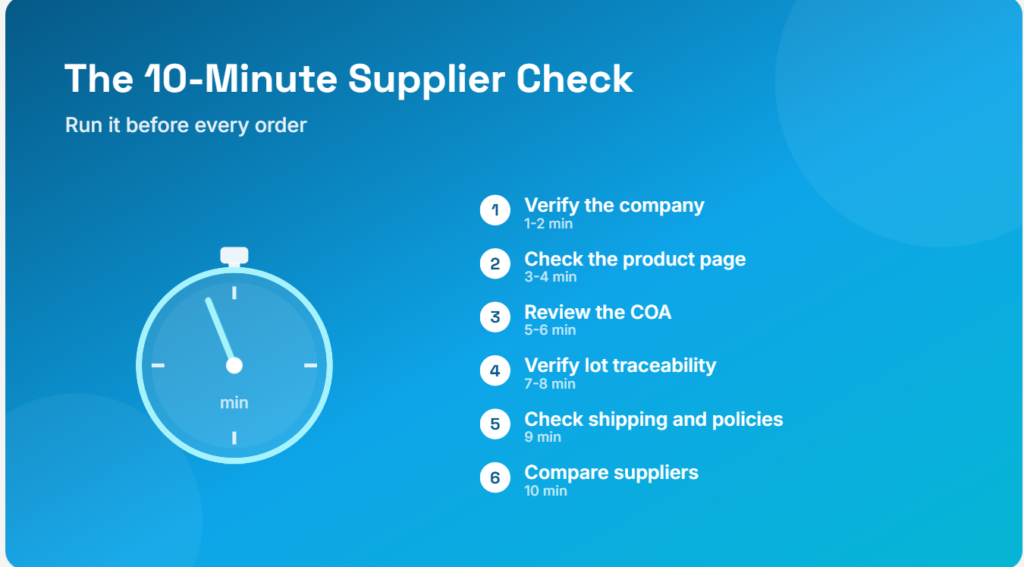
Final checklist for right before you buy:
Yes. A reputable supplier will share a lot-specific COA, and often more analytical detail, before you buy. If a COA is only “available on request” and then never quite appears, that tells you something on its own.
Pause and ask the supplier to explain the gap. A mismatch in the stated purity, compound, or lot can be a simple listing error, or a sign the documents don’t belong to that product. Either way, get it cleared up before ordering.
Match the lot or batch number on the COA to the number printed on the vial or its label. Better still, use a supplier whose lab offers a public verification portal, where you enter the report or lot number and confirm the result at the source.
Yes. One consistent checklist, covering company, documentation, testing, traceability, pricing, and policies, is the only way to compare fairly. Different yardsticks make the comparison meaningless. Keep the criteria fixed and let the answers talk.
Save the COA, the lot or batch number, the compound name, the testing date, the lab, and your order details. A screenshot of the product page helps too. Good records let you trace any result back to the exact material you used.
Re-check with each new batch, and any time a COA is dated, missing, or hard to tie to your vial. Suppliers can change labs, sourcing, or quality over time. A quick re-run of the ten-minute check keeps a good supplier honest and your records clean.
The right research peptide supplier is the one whose claims hold up to the checks above: a public, lot-matched COA, named independent testing, and clear policies, all confirmable before you place an order. Slick sites and low prices come and go. Verifiable documentation lasts and drives every repeat order.
Disclaimer: Research Peptides are meant for lab work only, not for human or veterinary use. This article covers documentation and quality standards for research materials. It makes no claim about the effect, application, or outcome of any compound, and it is not medical advice.
