Physical Address
304 North Cardinal St.
Dorchester Center, MA 02124

Netter: 442–469
McMinn: 154–169
Gray's Atlas: 426–429, 440–456
Flex and extend your digits, noting the movements of the tendons beneath the skin. On the dorsal side of your hand, identify the tendons of the extensor digitorum muscle. At the flexor aspect of the palm, note the distal skin crease (crease between wrist and forearm), marking the proximal edge of the flexor retinaculum ( Fig. 9.1 ).
At the ulnar side of the distal skin crease, palpate the pisiform bone. At the radial side of the distal skin crease, palpate the scaphoid bone. Immediately beneath the radial and ulnar sides of the distal skin crease, palpate the radial and ulnar styloid processes , respectively.
By flexing the closed fist against resistance, you should be able to identify several tendons at the anterior wrist, from medial to lateral: the flexor carpi ulnaris, flexor digitorum superficialis, palmaris longus, and flexor carpi radialis. However, the most prominent tendons are those of the palmaris longus, lying at the midline, and the flexor carpi radialis, lying in the radial side. Lateral to the tendon of the flexor carpi radialis, you can palpate the radial artery. The pulsations of the ulnar artery are more difficult to detect but usually are felt about 3 cm proximal to the pisiform bone, lateral to the flexor carpi ulnaris muscle. Note the thenar and hypothenar eminences, which contain muscles of the 1st digit and the 5th digit, respectively.

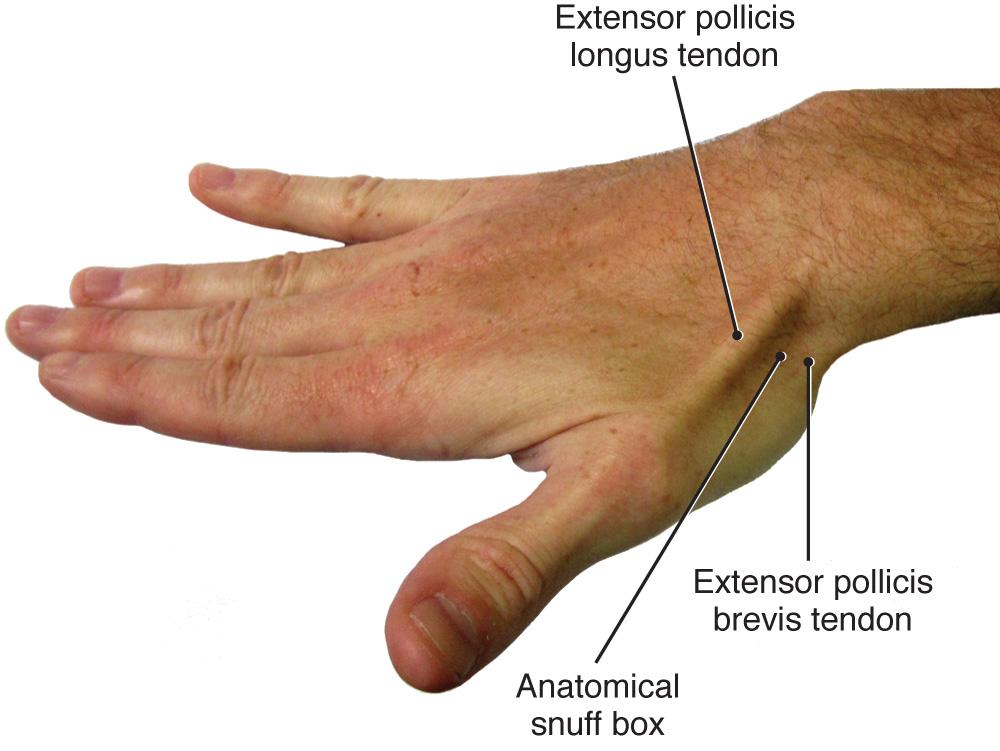
On the dorsum surface of the hand, extend the 1st digit, noting the tendons of the abductor pollicis longus (to base of 1st metacarpal bone), the extensor pollicis brevis (to base of 1st phalanx), and the extensor pollicis longus muscles (to base of distal phalanx of 1st digit) forming the “anatomic snuffbox” ( Fig. 9.2 ). This anatomic area is important because the radial artery lies on the scaphoid bone and passes to reach the dorsum of the 1st digit.
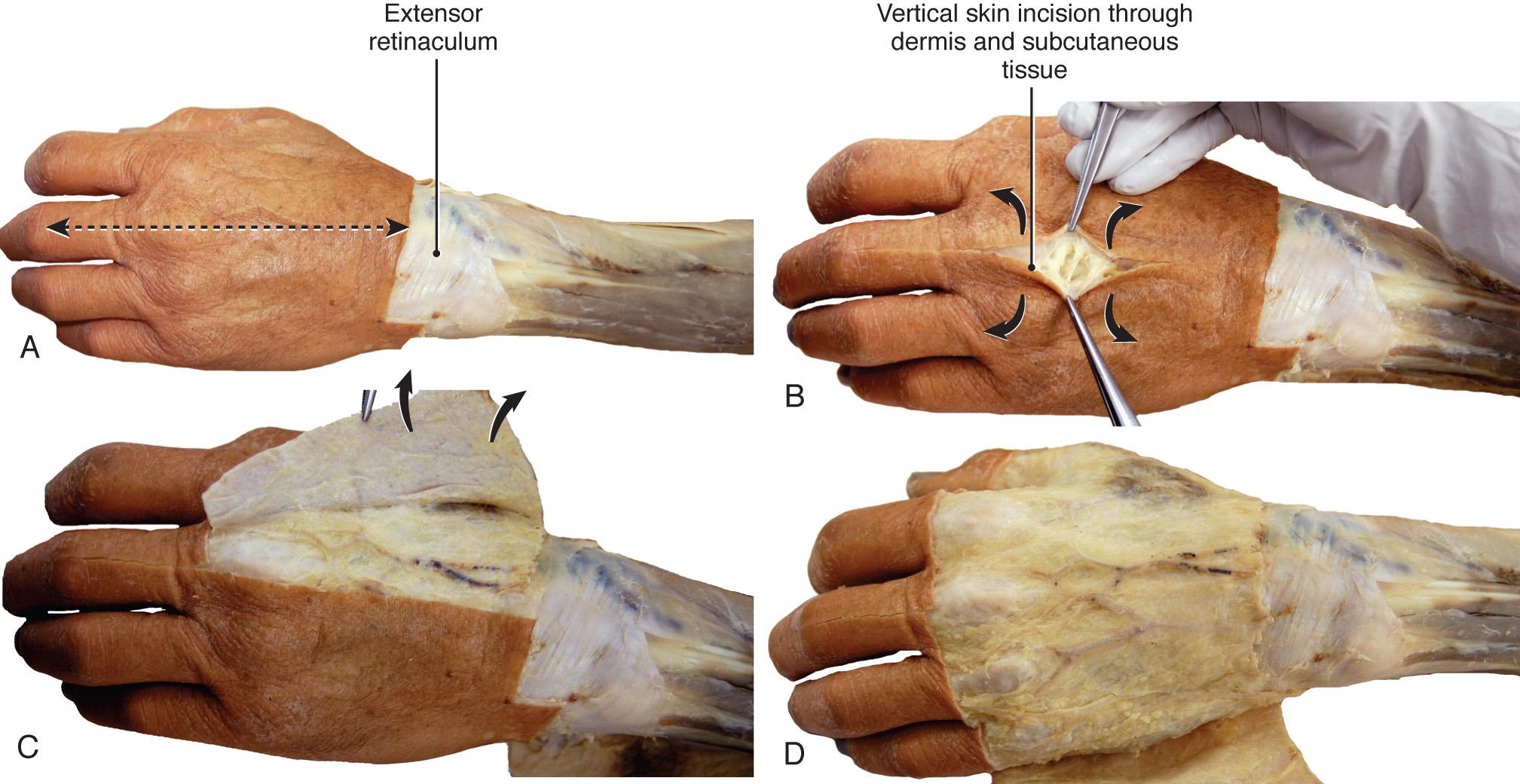
If the dorsum of the hand has not been dissected already on your cadaver as it was in Chapter 8 , then refer to Chapter 8 , Fig. 8.12, Fig. 8.13, Fig. 8.14, Fig. 8.15, Fig. 8.16 before proceeding to the palmar dissection ( Fig. 9.3 ).
Make a similar midline incision on the palmar surface, starting from the distal palmar crease to the base of the 3rd digit ( Fig. 9.4 ). Make a second midline incision on the palmar surface of each digit. Join these with transverse incisions at the bases of the digits.

With additional incisions as necessary, reflect and remove the skin from the hand ( Fig. 9.5 ).

The skin on the dorsum of the hand is very thin, whereas the skin on the palmar surface is thick and tightly bound to the underlying palmar aponeurosis. Make a shallow incision on the dorsum of the hand, and with the aid of dissecting scissors, separate the skin from the underlying tissues. Make a deeper incision on the palmar surface of the hand, using the palmaris longus muscle as a guide to remove the skin with sharp dissection.
After removal of the skin on the palmar surface of the hand, trace the continuation of the palmaris longus muscle to the palmar aponeurosis (see Fig. 9.5 ).
Note the thenar eminence with the flexor pollicis brevis and abductor pollicis muscles ( Fig. 9.6 ).

Lift the palmar aponeurosis ( Fig. 9.7 ) and with the aid of dissecting scissors separate it from the underlying structures ( Fig. 9.8 ).
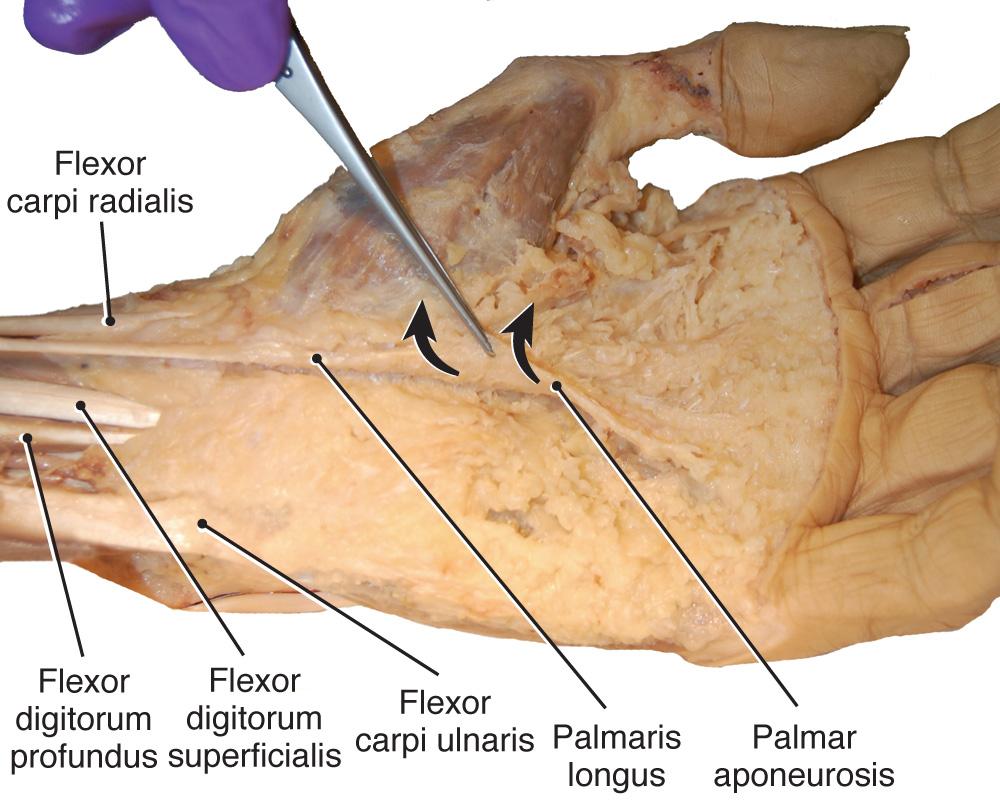

The palmar aponeurosis is composed of longitudinal and transversely oriented fibers of dense connective tissue. The longitudinal fibers form digital bands that attach to the bases of the proximal phalanges and become continuous with the fibrous digital sheaths (ligamentous tubes enclosing synovial sheaths).
With scissors, cut the attachments of the longitudinal bands from the bases of the proximal phalanges. Reflect the palmaris longus muscle and the palmar aponeurosis toward the forearm ( Fig. 9.9 ).

The removal of the palmar aponeurosis takes time. Pay special attention to using the scalpel as little as possible so as not to injure the palmar digital nerves and the superficial palmar arch. These structures travel deep to the palmar aponeurosis.
After removal of the palmar aponeurosis, start exposing the superficial palmar arch ( Figs. 9.10 and 9.11 , Plate 9.1 ).


The superficial palmar arch is the termination of the superficial branch of the ulnar artery, which gives rise to three common palmar digital arteries. These arteries anastomose with the palmar metacarpal branches from the deep palmar arterial arch. The common palmar digital arteries then divide into a pair of proper digital arteries, supplying the adjacent sides of the 2nd to 4th digits.
The superficial palmar arch is related to the superficial venous arch, as well as with common palmar digital branches of the median nerve. With scissors, separate the nerves from the superficial palmar arch (see Figs. 9.10 to 9.12 ). Also, remove any venous structures from this area.
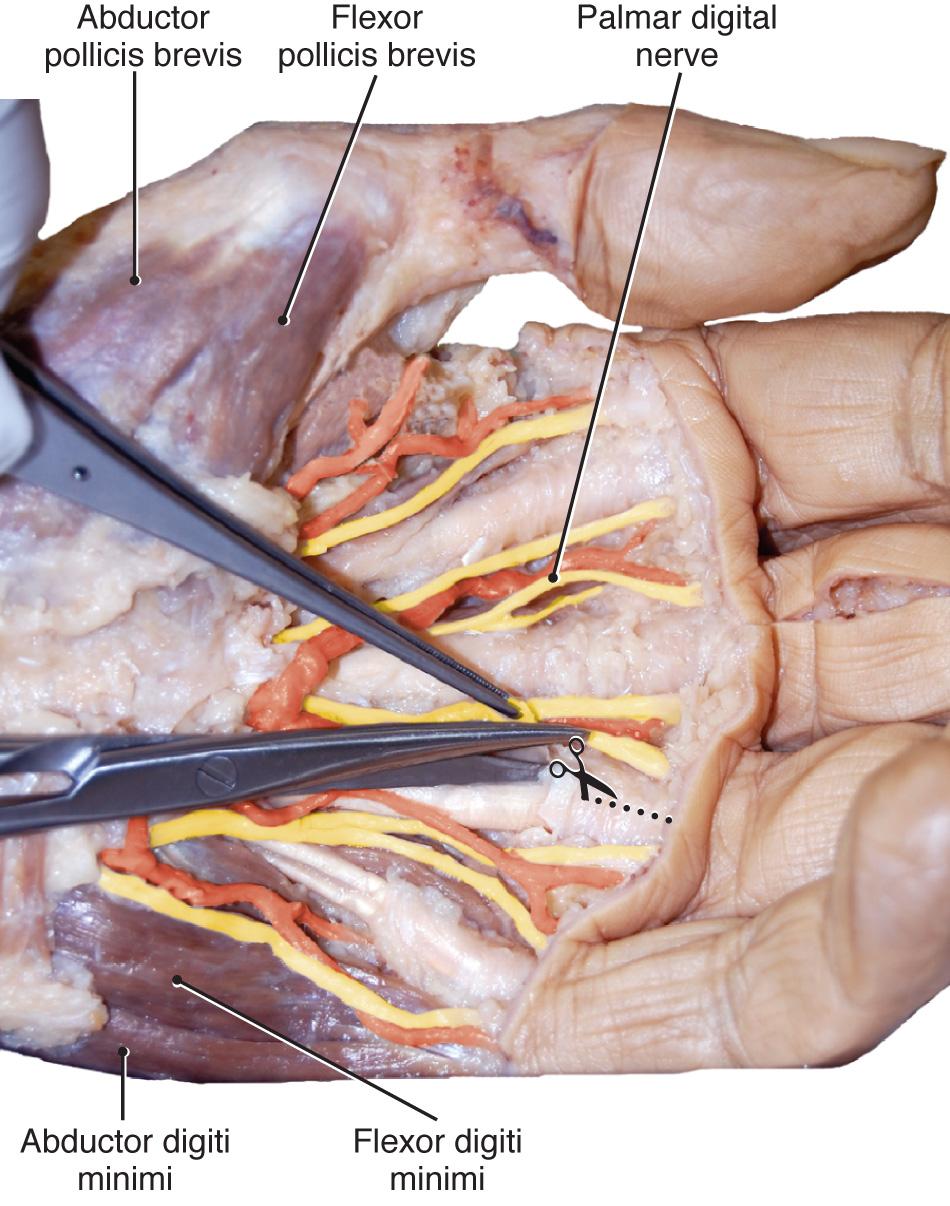
Immediately after its passage through the carpal tunnel, the median nerve gives rise to several smaller branches: the recurrent branch of the median nerve and the common palmar digital branches. At this point in the dissection, identify the common palmar digital branches of the median nerve running alongside the common palmar digital arteries ( Fig. 9.13 , Plate 9.2 ).

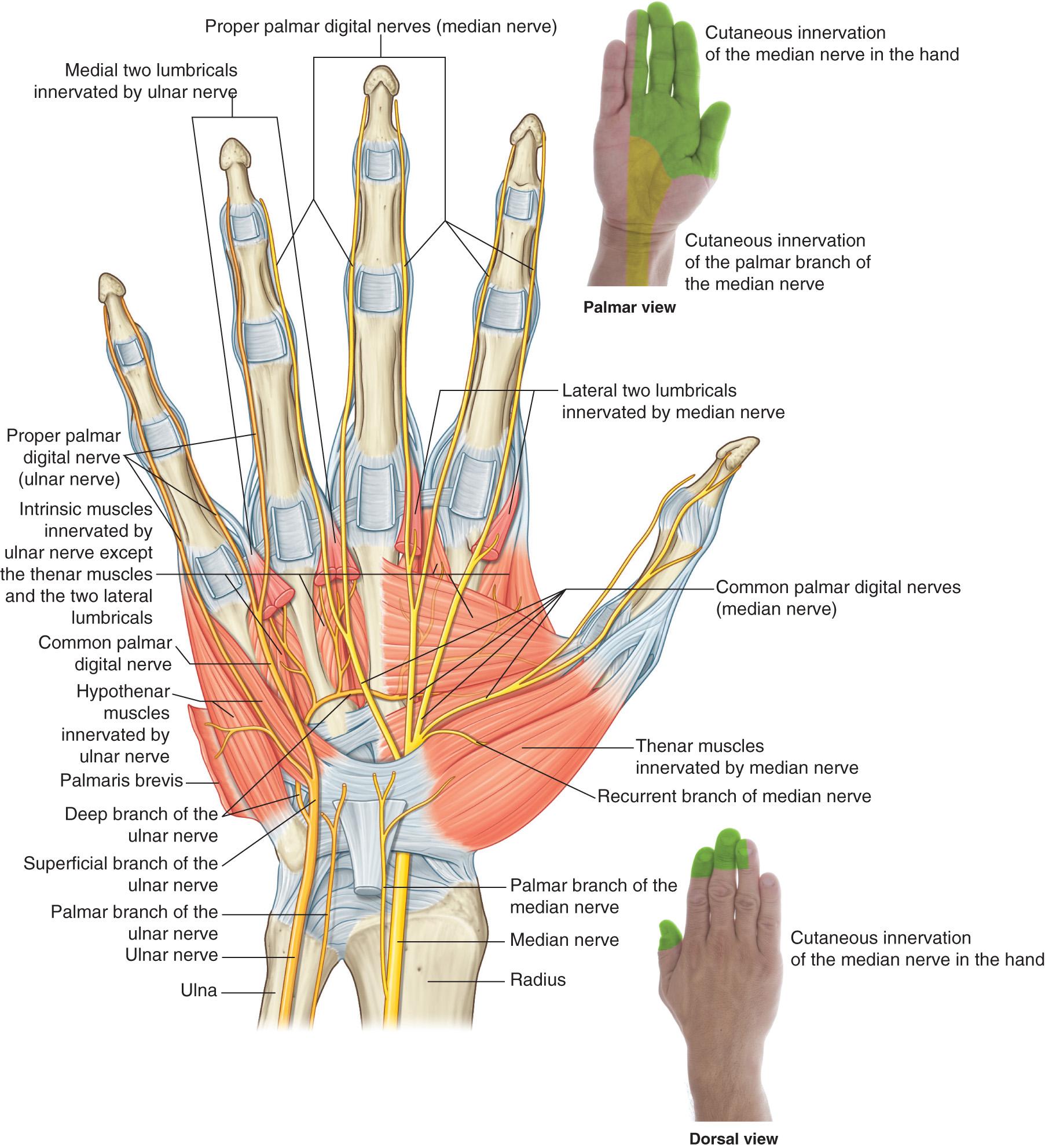
Continue the dissection toward the phalanges, and expose the separation of the common palmar digital branches of the median nerve into proper palmar digital nerves of the digits.
Similarly, expose the site at which the common palmar digital arteries give rise to palmar digital arteries ( Fig. 9.14 ).

Clean away the fascia investing the abductor and flexor digiti minimi muscles over the hypothenar region.
Continue the removal of fat and remnants of the palmar aponeurosis at the medial aspect of the palm, the hypothenar eminence (see Fig. 9.8 ). Identify the flexor digiti minimi and the abductor digiti minimi muscles (see Fig. 9.12 ). Expose the palmar digital branches to the 5th digit and medial half of the 4th digit (see Fig. 9.14 ).
The most superficially placed muscle in the hypothenar eminence is the palmaris brevis . This muscle is extremely thin and often blended with adipose tissue, arising from the palmar aponeurosis to insert into the skin. It is rather difficult to expose the palmaris brevis, because it is detached during removal of the palmar aponeurosis and skin.
In about 65% of hands, a communication between the ulnar and median nerves exists distal to the flexor retinaculum.
Trace the palmar digital branches to the 5th digit and medial half of the 4th digit toward their origin from the superficial branch of the ulnar nerve ( Fig. 9.15 ).

Remove the deep fascia at the ulnar side of the wrist, and using scissors ( Fig. 9.16 ), expose the superficial branch of the ulnar nerve ( Fig. 9.17 ). The ulnar artery and nerve travel lateral to the pisiform bone to enter the palm.


This point is referred to as Guyon's canal (or tunnel) and is formed by the pisiform bone, the flexor retinaculum, and an extension of the deep fascia of the forearm (palmar carpal ligament).
Expose the superficial ulnar artery and nerve toward the pisiform bone ( Fig. 9.18 ).

Clean the adipose tissue and remnants of the palmar aponeurosis surrounding the superficial palmar arch distally to the carpal tunnel and flexor retinaculum (see Fig. 9.18 ).
The primary contributor to the superficial palmar arch is the ulnar artery.
Expose the ulnar artery and clean the surface of the flexor retinaculum ( Fig. 9.19 ).

The tendons of the flexor digitorum superficialis and flexor digitorum profundus muscles are enclosed by a synovial sheath, the ulnar bursa. The tendon of the flexor pollicis longus is also enclosed by a synovial sheath, the radial bursa .
To free up the superficial palmar arch and nerve structures from the underlying long flexor tendons, use scissors to incise the fibrous tendinous sheaths longitudinally. Identify tendons of flexor digitorum superficialis and profundus muscles ( Fig. 9.20 ).

Immediately distal to the pisiform bone and lateral to the flexor retinaculum, expose the division of the ulnar artery and nerve into deep and superficial branches ( Fig. 9.21 ).

The deep branches dive deeply between the abductor and flexor digiti minimi muscles of the 5th digit.
The palmar cutaneous branch of the median nerve is often cut during routine dissection. The median nerve is seen at the distal forearm between the tendons of the palmaris longus and flexor carpi radialis and supplies the skin over the central portion of the palm.
The flexor retinaculum is a dense connective tissue band that helps create a tunnel (carpal tunnel) for the tendons of the flexor digitorum superficialis, flexor digitorum profundus, flexor pollicis longus, and the median nerve to reach the palm.
Carefully expose the flexor retinaculum and identify its borders. Look for the palmar cutaneous branch of the median nerve ( Fig. 9.22 ).

Pass a probe or scissors underneath the flexor retinaculum in the carpal tunnel ( Fig. 9.23 ).

Leave the probe within the carpal tunnel and with scissors divide the flexor retinaculum on top of the probe ( Fig. 9.24 ). This retinaculum is transected by inserting the scissors into the carpal tunnel upwardly, cutting in a proximal-to-distal manner.

Remove the probe, and retract the flexor retinaculum to expose the median nerve and tendons of the flexor digitorum superficialis ( Figs. 9.25 and 9.26 ).


Remove the connective tissue sheath over the median nerve and the underlying flexor digitorum superficialis muscle ( Fig. 9.27 ).

Continue exposing the median nerve within the carpal tunnel. Identify the recurrent branch of the median nerve ( Fig. 9.28 ). Finish the exposure of the common palmar digital branches of the median nerve.

The recurrent branch of the median nerve usually travels deep to the thenar muscles, and tracing its course anteriorly may be difficult. In such cases, gently retract the median nerve (within exposed carpal tunnel) laterally, and identify the recurrent branch of the median nerve. You also may dissect between the flexor pollicis brevis and the underlying adductor pollicis muscle to trace the recurrent branch of the median nerve.
In some cases, branches of the superficial palmar arch travel close to the common palmar digital branches or penetrate them. Use special care when you dissect these structures ( Fig. 9.29 ).

With forceps, retract the abductor digiti minimi muscle laterally, and expose the flexor digiti minimi brevis and the opponens digiti minimi muscles ( Fig. 9.30 ).

You may cut and reflect the abductor digiti minimi near its origin to expose the underlying opponens digiti minimi muscle.
In the majority of the specimens, the flexor digiti minimi muscle is difficult to separate from the abductor digiti minimi muscle. Follow the deep branch of the ulnar nerve to the hypothenar muscles. This nerve runs between the flexor digiti minimi and abductor digiti minimi muscles, facilitating their identification. The deepest of the hypothenar muscles is the opponens digiti minimi muscle.
Trace the superficial palmar arch laterally in the space between the 1st digit and the 2nd digit.
There is usually an anastomosis between the superficial palmar arch and a branch of the radial artery, the radialis indicis, and a branch to the 1st digit, the princeps pollicis ( Fig. 9.31 ).

Identify the abductor pollicis brevis muscle, lying at the lateral side of the base of the 1st phalanx of the 1st digit (see Fig. 9.31 ).
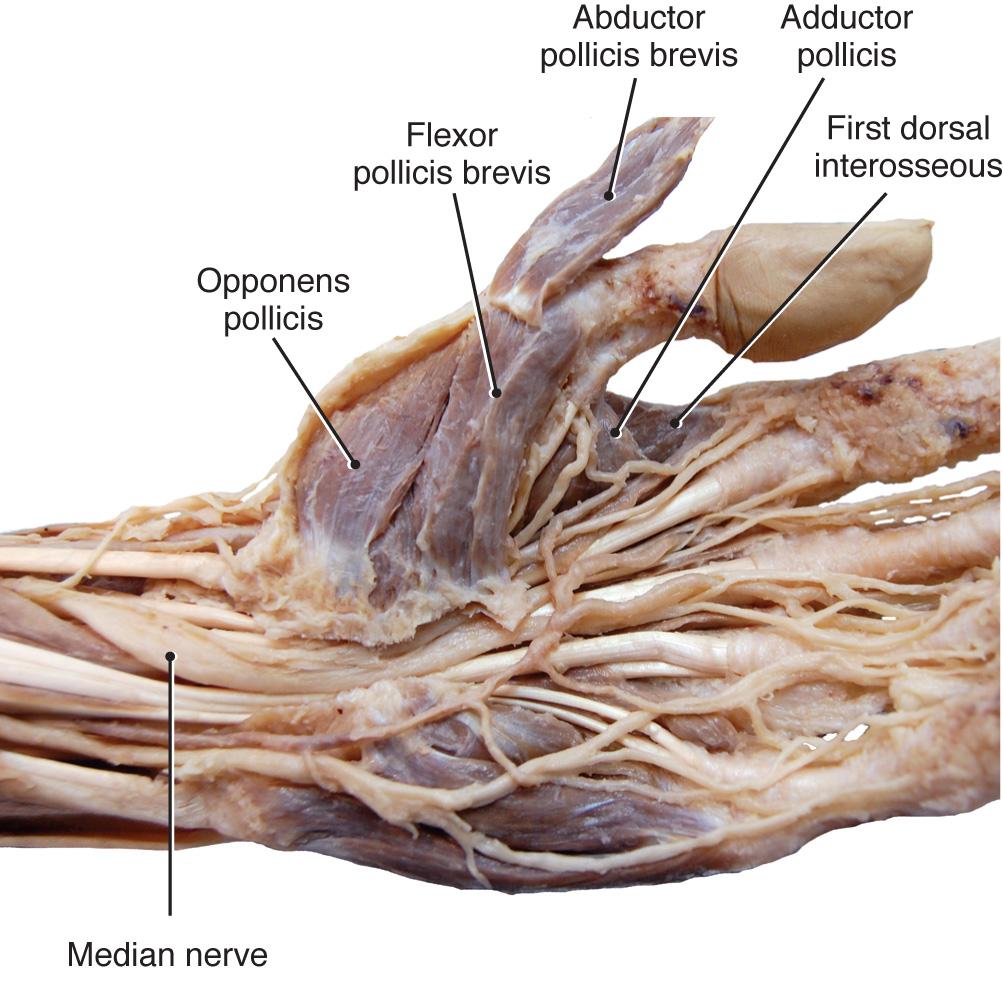
Medial and next to the abductor pollicis brevis muscle, identify the flexor pollicis brevis muscle, which is passing along the radial side of the tendon of the flexor pollicis longus muscle. Retract the abductor pollicis brevis muscle laterally from the flexor pollicis brevis muscle, and identify the opponens pollicis muscle ( Fig. 9.32 ). Flexor pollicis brevis has two heads. Its deep head can be mistaken for the opponens pollicis brevis. Reflect both heads.

Finally, identify the adductor pollicis muscle, which can be seen between the base of the 2nd and 1st digits.
You may also transect the abductor pollicis brevis and identify the opponens pollicis muscle just underneath it ( Fig. 9.33 ). Another way to distinguish the opponens pollicis brevis muscle from the abductor pollicis brevis and the flexor pollicis muscles is its insertion point. The opponens pollicis brevis muscle inserts alongside the 1st metacarpal.
On the dorsum of the hand, clean and expose the tendinous insertions of abductor pollicis longus, the extensor pollicis brevis, and the extensor pollicis longus ( Fig. 9.34 ).

The tendons of these three muscles (abductor pollicis longus, the extensor pollicis brevis, and the extensor pollicis longus) form the boundaries of the anatomic snuffbox, through which the radial artery passes to reach the dorsum of the 1st digit.
Identify the radial artery and trace it as it passes between the two heads of the 1st dorsal interosseous muscle (see Fig. 9.34 ).
Observe the radial side of the 2nd digit. At the level of the proximal interphalangeal joint, note the extensor mechanism splitting into three parts. Note that one of these parts, the lateral bands, to which the extensor tendons contribute, eventually unite with the transverse metacarpal ligament ( Fig. 9.35 ).

At the palmar side of the digits, observe the fibrous synovial sheaths surrounding the tendons of the long flexor muscles ( Fig. 9.36 ).

These fibrous sheaths are thin at the interphalangeal joints (cruciate fibers) and thick over the phalanges (anular fibers/ligament).
Become a Clinical Tree membership for Full access and enjoy Unlimited articles
If you are a member. Log in here

