Physical Address
304 North Cardinal St.
Dorchester Center, MA 02124

Adnexal torsion is easily missed on initial presentation and should be considered in any patient with known risk factors, even if symptoms are subtle or atypical.
Doppler ultrasound is the preferred initial imaging study for suspected adnexal torsion.
An ultrasound examination may distinguish among the various types of ovarian cysts and identify associated complications, such as torsion, hemorrhage, and malignancy. Most ovarian cysts are simple follicular cysts that resolve without pharmacologic or surgical intervention.
Abnormal uterine bleeding (AUB) has many structural, hormonal, and coagulopathic causes. Selected imaging and laboratory testing, based on a careful history and physical examination, can often lead to determination of the cause. Combined oral contraceptive pills can help to regulate the cycle and alleviate AUB.
Emergency contraception is a safe, effective option to prevent an undesired pregnancy. Levonorgestrel and ulipristal are both effective oral medications and are associated with fewer side effects than the traditional combined contraceptive method. Intrauterine devices should also be considered for emergency contraception if a patient desires a long-term contraceptive option.
Many women present to the emergency department (ED) with pelvic pain or vaginal bleeding. After the possibility of pregnancy-related diagnoses has been eliminated, the primary goal is to recognize the presence of conditions that warrant urgent intervention, such as adnexal torsion , versus those that can be managed as an outpatient, such as new postmenopausal uterine bleeding. Most patients also benefit from symptom relief and reassurance. This chapter specifically addresses the ED management of adnexal torsion, ovarian cysts, abnormal uterine bleeding (AUB), and emergency contraception. The general approach to vaginal bleeding is discussed in Chapter 30 , complications of pregnancy are discussed in Chapter 173 , and sexually transmitted disease is discussed in Chapter 84 .
The bilateral adnexal structures consist of the ovaries and fallopian tubes. Torsion accounts for approximately 3% of gynecologic emergencies and refers to the twisting of the ovary and/or fallopian tube on the axis between the utero-ovarian and infundibulopelvic ligaments. Although most commonly both structures are involved in this process, isolated ovarian torsion and, more rarely, isolated fallopian tube torsion may occur. In the early phases of torsion, venous and lymphatic obstruction initially occur, followed subsequent congestion and edema of the adnexal structures, which then progress to ischemia and necrosis.
In addition to loss of tubal or ovarian function, torsion left untreated can progress further to hemorrhage, peritonitis, and infection. Because of the dual blood supply of the ovary from the uterine and ovarian arteries, total arterial obstruction is rare but can develop ( Fig. 86.1 ).

Ovarian torsion can occur at any age but is most common in the reproductive years due to the regular development of a corpus luteal cyst during the menstrual cycle. Torsion may be a complication of pregnancy, more likely to occur in the first and early second trimesters. A history of tubal ligation is a risk factor for ovarian torsion. A predominance of torsion on the right side has been noted in approximately a 2:1 ratio to cases on the left, likely related to the stabilizing effect of the fixed sigmoid colon.
In premenarchal patients, torsion frequently occurs despite normal ovarian size, thought to be secondary to the excessive mobility of the adnexa due to relatively longer supporting ligaments and the smaller size of the uterus. ,
Most cases of torsion in the postmenarchal population are associated with an enlarged ovary with a diameter greater than 5.0 cm as the result of a benign neoplasm or cysts, which can be the result of ovulation induction, hyperstimulation syndrome, or polycystic ovarian syndrome. Masses prone to developing adhesions and therefore restricting mobility of adnexal structures, such as malignant tumors, endometriomas, or tubo-ovarian abscesses, are less likely to develop torsion than benign lesions.
Despite advances in imaging modalities, the definitive preoperative diagnosis rate of ectopic pregnancy approaches only 40%, making clinical assessment the primary driver of management decisions. The classic symptoms of ovarian torsion are severe, sharp, unilateral lower abdominal pain accompanied by nausea and vomiting; however, these elements are not consistently present in all cases. The presence of known risk factors, such as an ovarian mass or recent assisted reproductive treatments, may suggest the diagnosis in postmenarchal patients.
Patients typically report pain lasting from several hours to days, sometimes with intermittent resolution likely owing to spontaneous detorsion. Rarely, patients report pain for weeks to months in duration, most likely due to intermittent or chronic torsion. Nausea and vomiting are present in approximately 60% to 70% of cases. Fever is a an uncommonly reported finding, typically seen late in the course of disease and likely secondary to ischemia and necrosis of adnexal tissue.
Most patients will have unilateral tenderness on abdominal palpation, but peritoneal signs are rare, especially in early presentations. Only 50% of patients will have a palpable adnexal mass on pelvic examination; a palpable mass is more common in adults than pediatric patients with torsion. Predictive scoring systems for adnexal torsion—typically involving a combination of clinical elements and imaging or laboratory findings—have been developed but have not yet been shown to be generalizable to all populations and therefore cannot be recommended at this time. , Clinical signs of isolated tubal torsion are indistinguishable from those of ovarian or full adnexal torsion.
The differential diagnosis of adnexal torsion includes appendicitis, ruptured ovarian cyst, cystitis or pyelonephritis, nephrolithiasis, pelvic inflammatory disease, uterine leiomyoma, diverticulitis, bowel obstruction, and ectopic pregnancy. A pregnancy test, physical examination, and imaging with ultrasound, computed tomography (CT), or magnetic resonance imaging (MRI), if necessary, can typically distinguish among these possibilities.
No specific laboratory tests are routinely used in the diagnosis of adnexal torsion, although preoperative labs should be drawn on all patients suspected of torsion. A negative pregnancy test may exclude ectopic pregnancy from the differential, but importantly a positive test does not rule out adnexal torsion. Leukocytosis and elevated C-reactive protein (CRP) are occasionally associated with torsion but both are nonspecific and cannot be used as reliable predictors.
Small studies on serum interleukin-6 (IL-6) and D-dimer levels have revealed moderate sensitivity and specificity for detection of ovarian torsion, especially when coupled with findings suggestive of torsion on ultrasonography. , These tests in combination may eventually prove to be useful if early findings are confirmed by larger trials, but neither is considered a routine test at this time.
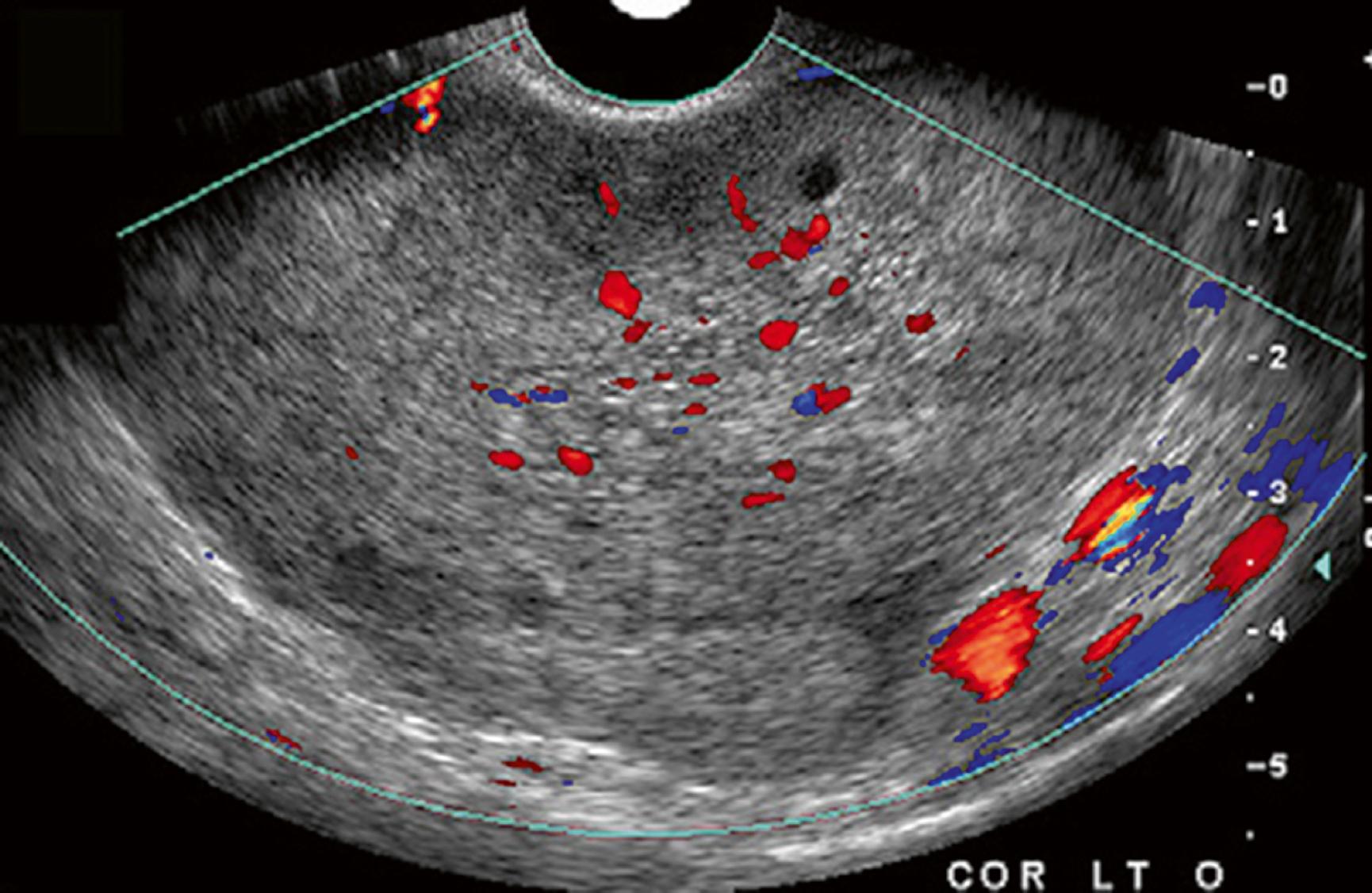
Ultrasound examination is the optimal initial imaging test in the evaluation of patients with pelvic pain highly suggestive of torsion, but findings can vary depending on timing and duration of symptoms. Asymmetric enlargement of the ovary is the most common finding. Enlargement of an ovary with a heterogeneous stroma secondary to edema along with small, peripherally displaced follicles is the classic ultrasound appearance of torsion but is often absent, particularly in the setting of prolonged ischemia. Ultrasound may also reveal a discrete ovarian mass, evidence of hemorrhage, or free pelvic fluid ( Fig. 86.2 ). Hemorrhagic cysts and other nonneoplastic masses frequently are associated with torsion; these may appear fluid filled, exhibit a complex pattern with debris and septations, or be visualized as a solid mass. The characteristic appearance of torsion may be difficult to appreciate if the ovary is obscured by an associated mass. In isolated tubal torsion, tubal lesions such as hydrosalpinx or a tubo-ovarian abscess may be seen.

Doppler ultrasound findings are inconsistent in the definitive diagnosis of adnexal torsion. Up to 60% of surgically proven cases have ovarian blood flow on the preceding Doppler examination ( Fig. 86.3 ). These findings may vary depending on the time of the examination because torsion may occur intermittently, and clinical symptoms commonly precede arterial compromise. If a large adnexal mass is present, the examination may also be technically difficult to perform. Despite these limitations, the Doppler examination is still useful, as recognition of ovarian enlargement or masses, as well as detection of abnormal venous flow is particularly important in early cases of torsion ( Fig. 86.4 ). Absence of arterial flow is highly specific for torsion, with a positive predictive value nearing 100%. Visualization of the twisting of the pedicle and coiled vessels is referred to as a “whirlpool sign” and has a 90% positive predictive value for torsion.

When alternative abdominal pathologies are strong considerations in the differential diagnosis of a patient’s acute pelvic pain, abdominopelvic CT may be the best initial study, particularly in patients who have a presentation less typical for torsion. In ovarian torsion, CT findings include asymmetric ovarian enlargement or asymmetric adnexal enhancement following intravenous (IV) contrast, fallopian tube thickening, twisted vascular pedicle, fat stranding surrounding the affected adnexa, and uterine deviation to the affected side. Pelvic free fluid can also be seen, especially in cases of hemorrhagic infarction.
Multiple studies show that patients with ultrasonographic or surgically confirmed torsion have evidence of at least one abnormal finding on CT. This suggests that a completely normal contrast-enhanced CT scan of the abdomen and pelvis—including the absence of ovarian enlargement or masses in addition to the aforementioned findings—may be sufficient to rule out ovarian torsion. Negative CT imaging findings should be interpreted with caution when clinical suspicion is high, but with lower suspicion, normal-appearing pelvic structures on a CT scan is reassuring and potentially sufficient imaging.
MRI may also demonstrate findings consistent with torsion. It is particularly helpful when the diagnosis is unclear, such as in patients who present with intermittent pain over days, or for pregnant patients when the history is suggestive of torsion but ultrasound findings are inconclusive or equivocal and CT scans are not preferred. Findings on MRI suggestive of torsion are similar to those on CT ( Box 86.1 ).
Enlargement of the ovary
Associated ovarian mass
Loss of enhancement
Edema
Free pelvic fluid
Loss of venous waveforms
Loss of arterial waveforms
Enlargement of the ovary
Associated ovarian mass
Thickening of the fallopian tube
Free pelvic fluid
Edema of the ovary
Deviation of the uterus to the affected side
Associated hemorrhage
Become a Clinical Tree membership for Full access and enjoy Unlimited articles
If you are a member. Log in here
