Physical Address
304 North Cardinal St.
Dorchester Center, MA 02124

The multiple birth rate has increased by 76% in the past three decades; however, it has recently started to stabilize or even decline.
Increased utilization of assisted reproductive technologies and women delaying childbearing are the main contributors to the high rate of multiples.
Multiple gestations are at high risk for both maternal and fetal morbidity and mortality, which increase as fetal number increases.
Most neonatal complications in multiple gestations are sequelae of prematurity, including low birthweight, respiratory distress syndrome, neonatal intensive care unit (NICU) admission, intraventricular hemorrhage, and necrotizing enterocolitis.
Up to 80% of women with multiple gestations experience antepartum complications, which include preterm labor, preterm premature rupture of membranes (PPROM), and placental abruption.
Strategies for decreasing the rate of multiples resulting from assisted reproductive technology (ART) include increasing the number of single embryo transfers performed in in vitro fertilization (IVF) and using “low and slow” protocols for superovulation cycles with gonadotropins.
There are multiple factors influencing the increase in multiple births in the United States in the past half-century. The incidence of multiples was stable through the 1970s at 2% of all births. We then began to see an “epidemic of multiples,” with the twin birth rate increasing by 76% from 1980 to 2009. The overall proportion of total national births that were multiples increased from 1.8% in 1971 to 3.30% in 2019. Recently, twin birth has started to decline, and from 2014 to 2019, the twin birth rate declined 5%. In 2019, the lowest number of twin births was reported since 2002.
Twins continue to account for the vast majority of multiple pregnancies, comprising 97% in 2019. The growing use of assisted reproductive technology (ART), in addition to delayed childbearing until age-related fertility issues become apparent, has contributed greatly to multiple birth rates. The rate of women delaying childbearing has dramatically increased, with women over the age of 30 accounting for 20% of births in 1980, compared with more than 45% in 2019. Increased maternal age is associated with increased rates of twinning, and compared to mothers under 20, mothers aged 30 to 39 are twice as likely and mothers aged 40 and over are three times as likely to have a twin birth. Between 1980 and 2009, the twin birth rate increased by 100% in women 30 to 35 years old and by more than 200% in women aged 40 and older. On the other hand, recent declines in twin births have been limited to mothers aged 30 and older, and mothers aged 40 and over had a 23% decline in twinning from 2014 to 2018. Despite the decline in twinning rate, in 2018, more than 5% of births to women aged 40 or older were multiple births. Spontaneous twinning is more common as women age, perhaps related to higher follicle-stimulating hormone (FSH) levels in the follicular phase leading to ovulation of more than one oocyte, with a peak at age 37. However, the increasing age of childbearing women is estimated to account for only one-third of the rise in twinning, with ART responsible for the remainder. Since the birth of the first in vitro fertilization (IVF) baby in 1978, the numbers of IVF clinics, ovarian stimulation cycles, and live births from ART have all steadily increased. In 2017, ART contributed to the births of 1.9% of total infants, 14.7% of multiple birth infants, and 17.3% of triplet and higher order multiple (HOM–four or more) infants. About 3.4% of all US births are multiples, yet in 2017, the ART twin birth rate was 26%, and the ART HOM birth rate was 0.9%.
It is important to note that since 1997, IVF has not been the leading contributor to the multiple birth rate, contributing to under 15% of multiple births in 2017. Non-IVF treatment options, including ovulation induction with oral medications and superovulation with injectable gonadotropins, were responsible for 19% of twins and 45% of triplets or HOMs in 2011. These modalities involve less monitoring and are subject to less control than IVF and thus less susceptible to efforts to decrease the multiples rate. The proportion of triplet or HOM births arising from medically assisted conceptions has been declining in recent years: from 84% in 1998 to 77% in 2011. The incidence of triplet and HOM births increased by a factor of 6.7 from 1971 to 1998 but has since decreased by 29% from 1998 to 2013. This is largely due to a decrease in the number of embryos transferred per cycle of IVF and to the reticence of providers to use superovulation with injectable gonadotropins.
Given the maternal, perinatal, and neonatal complications associated with multiples, the goal of infertility treatment is one healthy child. Multifetal pregnancies drastically affect individuals, families, and public health systems. Of particular importance in both maternal and fetal outcomes are fetal number and placentation.
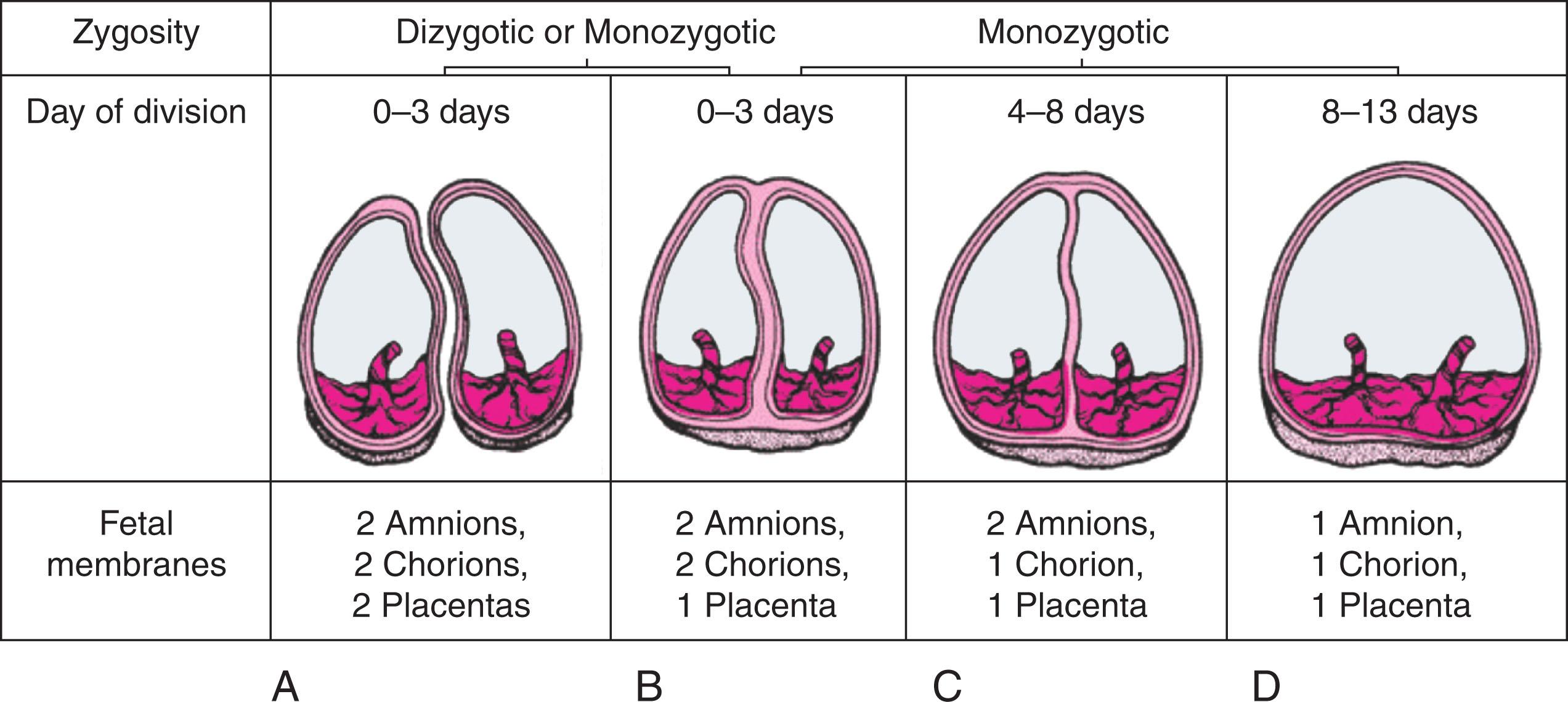
Zygosity refers to the number of oocytes and spermatozoa involved in conception while chorionicity refers to the type of placentation. Determining zygosity and chorionicity is important medically, genetically, and psychosocially for the individual and family. The chorion–amnion arrangement is crucial to antepartum management, as it determines risks of complications such as twin-twin transfusion syndrome (TTTS), intrauterine growth restriction (IUGR), growth discordance, congenital anomalies, and cord accidents. Chorionicity also guides next steps in cases of one fetal demise or desired selective reduction. Dizygotic twins result from fertilization of two separate ova by two spermatozoa, and these comprise 67% of spontaneous twins. Monozygotic twins (MZTs) are identical and result from fertilization of a single ovum with one spermatozoon and subsequent postzygotic division. The timing of this division-splitting determines the number of fetuses, chorionic plates, and amniotic sacs.
To determine zygosity, we can use prenatal determination of fetal gender and, more recently, single-nucleotide polymorphism-based noninvasive prenatal testing has been used to evaluate fetal genome components at as early as 9 weeks’ gestation. In the postnatal period, fetal blood typing and DNA analysis can be used to determine zygosity. Diagnosing chorionicity is possible using ultrasound markers, including the number of placental sites, thickness of the dividing membrane, and the lambda sign. The lambda sign indicates dichorionicity and is a triangular projection of tissue that extends beyond the chorionic surface of the placenta.
A first trimester screening ultrasound is essential in diagnosing multiple pregnancy. In a large randomized trial, in the cohort of women that did not have a screening ultrasound, 37% were not diagnosed as having a twin pregnancy until 26 weeks, and 13% were not diagnosed until the time of delivery. Current ultrasonographic technology is very effective at diagnosing chorionicity, and amnionicity and first trimester ultrasounds are most accurate. In one study, the reported sensitivity, specificity, and positive and negative predictive values for ultrasonography at less than 14 weeks gestation for chorionicity were 89.8%, 99.5%, 97.8%, and 97.5%, respectively. Overall, chorionicity was correctly diagnosed antenatally in 95% of cases.
Chorionicity and placentation greatly affect fetal morbidity and mortality in multifetal pregnancies. Dizygotic twins (DZTs), with few exceptions, lead to a dichorionic, diamniotic (DCDA) arrangement in which the placenta can be separate or fused. Rare cases of dizygotic, monochorionic, diamniotic (MCDA) twins have been reported. Theories as to the etiology of this include fusion of two genetically distinct zygotes or fertilization of a binovular follicle.
The highest rates of spontaneous twinning are in Nigeria, where 1 out of every 12 persons is a member of a twin pair, and the lowest twinning rates are seen in China, where 1 in every 70 persons is a member of a twin pair. North American and European countries are considered to have an intermediate prevalence of spontaneous dizygotic twinning. Risk factors for DZT include advancing maternal age, increased parity, female relatives with DZT, taller height, and higher body mass index. Historically, a seasonal trend in DZT has been seen, with higher rates among conceptions in the summer and autumn months.
The true incidence of MZTs is difficult to ascertain because of its rarity, inaccuracies in diagnosis, and lack of confirmatory studies at birth, but spontaneous MZT rates are estimated to occur in 0.3% to 0.5% of all pregnancies and in less than 30% of all twins. This rate was geographically constant prior to the advent of ART, Unlike DZT, it is unclear whether MZT is related to genetics or environment. Familial association has been seen but is very rare.
Chorionicity in monozygotic gestations is determined by the timing of the embryonic division ( Figs. 5.1 and 5.2 ). In 18% to 36% of MZTs, the zygote divides within 72 hours of fertilization, resulting in a DCDA gestation (the placenta can be separate or fused); 60% to 75% split between days 4 and 8, leading to an MCDA unit; and 1% to 2% separate between days 8 and 13, leading to a monochorionic, monoamniotic (MCMA) pregnancy. Embryonic division after day 13 results in conjoined twins that are MCMA.
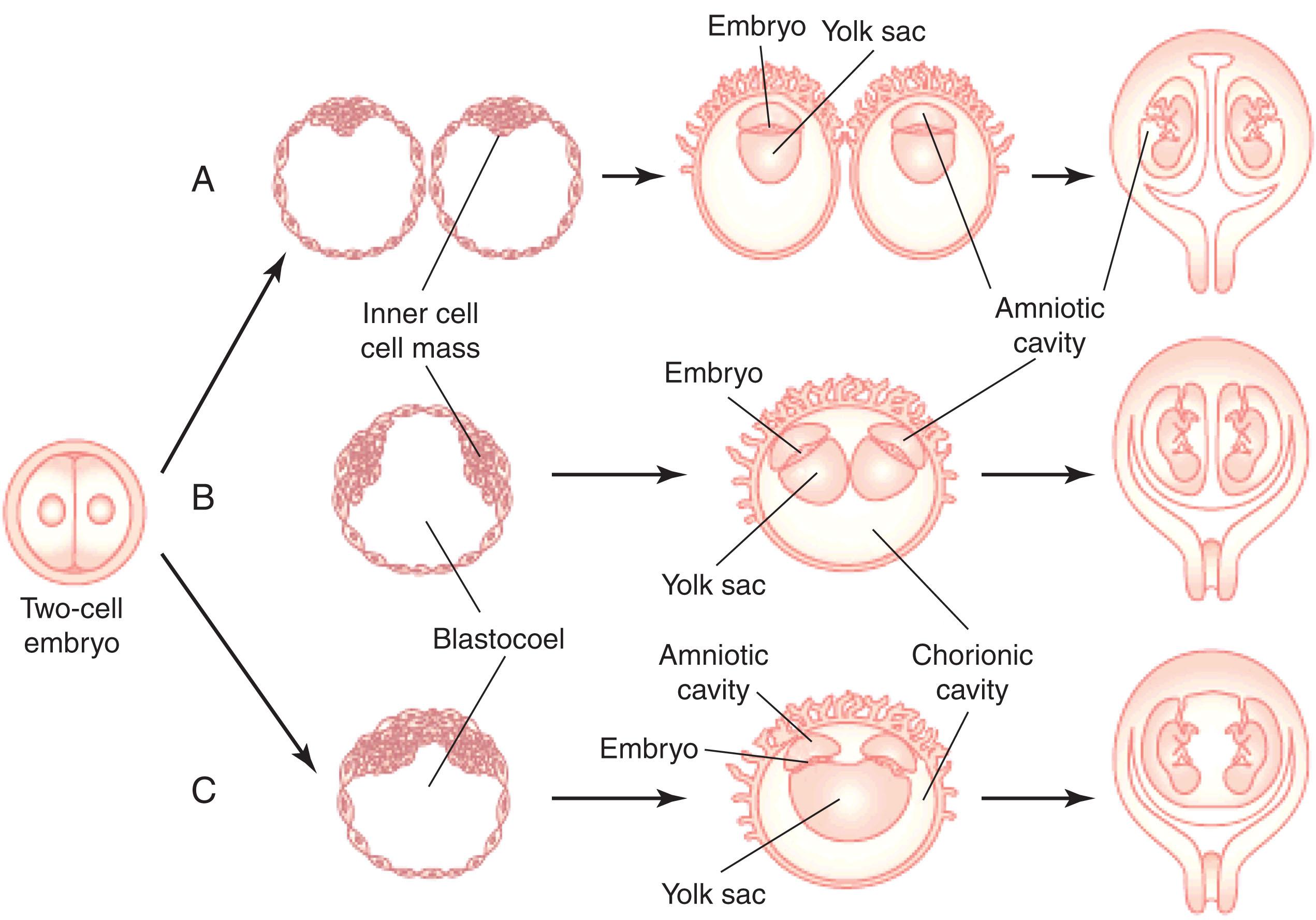
There are no naturally occurring animal models of MZT with the exception of armadillos. Models of MZT can be induced in laboratory animals by exposure to toxins or manipulation of the zona pellucida. The cause of spontaneous monozygotic twinning in humans is unknown. An uneven sex ratio has been noted, with 0.484 male:female pairs in all monozygotic twins and 0.231 in monoamniotic twins, leading to the theory that skewed X inactivation may play a role. The development of two inner cell masses (ICM) at the blastocyst stage can lead to MZT, either from damage or through immune-mediated cell-to-cell crosstalk.
Although the majority of ART MZTs are MCDA, any of the three monozygotic, placental arrangements can transpire after ART, implying that the timing and mechanism of embryonic splitting are variable.
The first reported association between ART and MZT preceded numerous accounts of similar findings. The majority (>90%) of ART twins are dizygotic secondary to transferring multiple embryos; however, the rate of MZTs per pregnancy after fertility treatment is higher (0.7% to 2%) versus the general population (0.3% to 0.5%). A recent population-based study found a 60% higher risk of MZT for ART conceptions compared to natural conceptions. It is also suspected that the incidence of MZT in ART may be underestimated because DCDA gestations after transfer of more than one embryo are often assumed to be dizygotic, and genetic analysis is rarely performed postnatally. Several theories to explain the mechanism responsible for elevated MZTs with ART have been proposed. There follows a discussion of those theories.
Age
As mentioned previously, spontaneous dizygotic twinning increases with advancing maternal age, but the connection between age and MZTs is controversial. Some studies report trends toward elevated MZT rates in older women, whereas others found no association with increasing maternal age and MZT. A recent meta-analysis found that the MZT risk following IVF is significantly higher in women younger than 35 years, while other studies have found no association between MZT risk and age. Overall, the correlation between age and MZT in ART remains unclear.
The zona pellucida (ZP), an acellular protein surrounding the ovum, provides a species-specific sperm barrier and decreases polyploidy by inhibiting penetration by multiple sperm. It has been shown that the thickness and hardness of the ZP can vary in relation to stimulation protocol, elevated FSH or estradiol (E2) levels, and culture conditions. There is debate as to whether ZP manipulations performed during IVF affect MZT risk. Manipulation of the ZP in IVF occurs via both intracytoplasmic sperm injection (ICSI) and assisted hatching. The injection of one sperm into a mature oocyte (i.e., ICSI) is most commonly performed for male factor infertility. AH is achieved with an artificial breach in the ZP by laser, chemical, or mechanical methods and has been shown to increase clinical pregnancy rates, although not live birth rates, in patients with a poor prognosis. A Cochrane review demonstrated that AH is associated with an increase in multiple pregnancy, with an odds ratio of 1.39. However, the increase in MZT with AH was not statistically significant, and this was confirmed in other large studies. However, the data are conflicting, with a retrospective review of over 35,000 IVF cycles showing a threefold risk of MZT with AH, a finding also demonstrated in a recent meta-analysis. Similarly, there are mixed data regarding the association between ICSI and the risk of MZT. One study noted ICSI to be an independent predictor of MZT with an odds ratio of 2.42, with an even higher risk of MZT when ICSI was combined with day 5 embryo transfer. However, more recent data have called this into question, with a recent study examining twinning after single embryo transfer finding a decrease in rates of MZT with ICSI. The defect created in the ZP for ICSI is much smaller than for AH, lending plausibility to other recent studies that have shown no association.
Become a Clinical Tree membership for Full access and enjoy Unlimited articles
If you are a member. Log in here
