Physical Address
304 North Cardinal St.
Dorchester Center, MA 02124

Septic/vasodilatory shock
First choice
Norepinephrine
Additional choices
Epinephrine may be added to or replaced the Norepinephrine.
Vasopressin
Low-dose vasopressin may be added to decrease requirements for other adrenergic agents.
It is not recommended as a single agent.
Recommended in patients unresponsive to catecholamines or in the presence of acidosis/hypoxia
Dopamine
May be considered in patients with bradycardia or in patients without risk for or presence of tachyarrhythmias
Dobutamine
Norepinephrine with Dobutamine can be used in patients with myocardial dysfunction resulting in low cardiac output.
Phenylephrine
May be considered in patients with serious tachyarrhythmias due to norepinephrine
May be considered in patients with persistent hypotension with high cardiac output
Cardiogenic shock with myocardial infarction (MI)
First choice
Norepinephrine
Patients with severe hypotension (systolic blood pressure [SBP] <70 mm Hg)
Dopamine (Intropin)
Patients with SBP between 70–100 mm Hg
May increase the risk of arrhythmias
Additional choice
Dobutamine
May be given to improve cardiac output, but not recommended for patients with hypotension
Agent of choice in low output with increased afterload
Anaphylactic shock
First choice
Epinephrine
Cardiopulmonary resuscitation (CPR)
First choice
Epinephrine
Additional choice
Vasopressin for refractory pulseless cardiac arrest
Neurogenic shock
First choice
Phenylephrine
Commonly used
Causes peripheral vasoconstriction due to alpha-1 effect
May cause reflex bradycardia due to lack of beta activity and unopposed vagal tone
Additional choice
Norepinephrine
Preferred in patients with hypotension and bradycardia due to its alpha and beta activities
Epinephrine
May be considered in refractory hypotension
Alpha-1 adrenergic receptors
Peripheral arterial and venous vasoconstriction
Constriction of gastrointestinal and urinary sphincters
Alpha-2 adrenergic receptors
Reduce central and peripheral sympathetic outflow
Mainly found in the brain
Beta-1 adrenergic receptors
Increase the strength of cardiac contractions (inotropic effect)
Increase heart rate (chronotropic effect)
Beta-2 receptors
Mainly located in bronchioles and skeletal muscles
Causes vasodilation and bronchodilation
Dopamine receptors
Renal and splanchnic vasodilation
Vasopressin receptors
V-1
Causes vascular smooth muscle contraction leading to vasopressor effect
V-2
Located primarily in the kidney, causing water retention due to its antidiuretic effect
V-3:
Located in the central nervous system, modulates corticotrophin secretion
| Agents | Alpha-1 effect | Beta-1 effect | Beta-2 effect | Dopamine effect | Heart Rate | Mean Arterial Pressure (MAP) | Cardiac Output | Systemic Vascular Resistance |
|---|---|---|---|---|---|---|---|---|
| Epinephrine | +++ | ++++ | +++ | - | ++ | ++ | +++ | ++ |
| Norepinephrine | ++++ | +++ | - | - | +/- | +++ | - | +++ |
| Dopamine | ++ | ++++ | ++ | ++++ | -/+/++ | -/+ | +/++ | -/+ |
| Dobutamine | + | ++++ | ++ | - | + | + | + | - |
| Phenylephrine | ++++ | - | - | - | - | + | +/- | + |
| Vasopressin | - | - | - | - | - | + | - | ++ |
Alpha, beta-1, and beta -2 effects
Cardiovascular effects
Increase in heart rate (HR)
Increase in mean arterial pressure (MAP)
Increase in cardiac output (CO)
Increase in systemic vascular resistance (SVR)
Effects are dose dependent.
Increasing the dose is predominantly associated with the alpha effect.
Dose
Shock
Starting dose 0.1 μg/kg/min, titrated to achieve the target effect
Cardiopulmonary resuscitation (CPR):
Dose: 1 mg intravenous (IV) or intraosseous (IO), predominantly alpha effects
Shockable rhythm: ventricular fibrillation/primary ventricular fibrillation (VF/pVF)
First should be given after the second defibrillation
Nonshockable rhythm: pulseless electrical activity (PEA; asystole)
First dose should be given at the onset of cardiac resuscitation.
Continued 1 mg IV/IO every 3–5 min until return of the circulation
Side effects
Increase in myocardial oxygen demand
Mesenteric ischemia
More common than other vasopressors
Increase in lactate regardless of hypoxia/hypoperfusion
Increase in adenosine triphosphatase (ATPase)
Increase in adenosine triphosphate (ATP) production from glycolysis for the ATPase activity.
Glycolysis produces lactic acid.
Vasoconstriction of the uteroplacental vasculature leading to placental hypoperfusion and fetal hypoxia; should be avoided in pregnancy
Alpha and beta-1 effects
A low dose stimulates both alpha- and beta-adrenergic receptors, causing:
an increase in MAP.
an increase in HR.
an increase in SVR.
A high dose predominantly stimulates alpha receptors, causing:
minimal effect on the HR.
bradycardia.
an increase in SVR.
a reduction in cardiac output due to increase in afterload.
Dose
Starting dose
0.05 μg/kg/min, titrated to achieve the target effect
Low dose
2.5–5 mcg/min
High dose
>5 mcg/min
Side effects
Inadvertent boluses may precipitate profound hypertension that may cause myocardial infarction and cerebral ischemia.
Tachycardia is uncommon in adequately resuscitated patients.
Reflex bradycardia
Renal ischemia resulting in decreased urine output
Mesenteric ischemia
Increase in blood glucose
Extravasation of norepinephrine may cause tissue necrosis.
Treated with phentolamine 5–10 mg in 10 mL of normal saline injection into the area of extravasation within 12 hr
Vasoconstriction of the uteroplacental vasculature leading to placental hypoperfusion and fetal hypoxia. It should be avoided in pregnancy.
Dopaminergic, alpha-1, and beta-1 effects
Not the first-line agent for the alpha effect
Dose
Range
2–25 μg/kg/min
Beta dose
5–10 mcg/kg/min, titrated to target HR, BP, or cardiac output
Alpha dose
>10 mcg/kg/min, titrated to target BP
Low dose (dopaminergic)
Does have renal protection effect
Does not improve renal function
May have some diuretic effect
Side effects
Tachycardia
Arrhythmias
Wide QRS
Increase in myocardial oxygen consumption
Decrease in peripheral perfusion
Acute kidney injury (doses >20 hlsug/kg/min)
Mesenteric ischemia
Increase in blood glucose
Fixed, dilated pupils
Extravasation of dopamine (Intropin) can cause tissue necrosis.
Treated with injection of phentolamine 5–10 mg in 10 mL of normal saline injection into the area of extravasation within 12 hr
Synthetic catecholamine, which is similar in structure to dopamine
Beta-1, beta-2, and ± alpha adrenergic effects
No dopaminergic effect
More prominent inotropic effects than chronotropic effects
Beta-2 vasodilator effect dominates over the alpha-1 constrictor effect in higher doses, causing reduction in SVR.
Increase CO due to:
positive inotropic effect.
decrease in peripheral resistance from vasodilatory effect.
Dose
Initial infusion: 1–2 mcg/kg/min, titrated to the response
Maximum does: 20 mcg/kg/min
Side effects
Significant tachycardia and hypertension
Hypotension in inadequately resuscitated patients
Ectopic heartbeats
Extravasation causes local blanching, tissue ischemia, or necrosis. It is treated with phentolamine.
Alpha-adrenergic effect
May be used in patients with hypotension due to vasodilation and adequate cardiac output
It causes the following:
Increase in MAP
Increase in SVR
Increase in central venous pressure (CVP)
Dose
Shock
0.1–0.5 mg as slow IV direct injection every 10–15 min (or 1–10 mg intramuscular/subcutaneous every 1–2 hr)
Paroxysmal supraventricular tachycardia (PSVT)
0.5–1 mg as rapid intravenous injection every 60–90 sec
Side effects
Bradycardia
Arrhythmias
Increase in myocardial oxygen consumption
Peripheral or mesenteric ischemia
V-1 receptors effect
Vasoconstriction of the systemic, splanchnic, renal, and coronary vessels via noradrenergic pathway
Increase in MAP
Increase in SVR
V-2 receptors effect
Antidiuretic effect in the kidney causing water retention
V-3 receptors effect
Modulates corticotropin secretion in the central nervous system
Dose
Shock
0.03 U/min; titrate to response
Septic shock:
0.9–1.8 U/hr, run at a fixed rate
Refractory pulseless cardiac arrest
40 units IV X 1 dose
Side effects
GI ischemia
Cardiac effects
Coronary ischemia
Bradycardia
Arrhythmias
Decrease in cardiac output
Fluid retention
Phosphodiesterase inhibitor acts by causing an increase in intracellular cyclic adenosine monophosphate (cAMP) and calcium.
Effects
Improves cardiac output due to inotropic effect, and reduces afterload
Improves right heart function due to:
diastolic relaxation leading to right heart filling.
reduction in right atrial pressure and mean pulmonary artery pressure.
dilation of coronary arteries.
Pulmonary vasodilator
Uses
To improve cardiac output in patients with:
adrenergic receptors dysfunction due to downregulation or desensitization from chronic heart failure or use of beta blockers.
pulmonary hypertension.
severe congestive heart failure (CHF) refractory to other medical therapy.
Due to risk of worsening outflow obstruction, it is not recommended in patients with:
hypertrophic cardiomyopathy.
significant aortic valve disorder.
significant pulmonary valve disorder.
Dose
Hemodynamic effects are dose related.
50 mcg/Kg bolus over 10 min, followed by an infusion, or an infusion without a bolus
Infusion: 0.25–0.75 mcg/kg per min
Side effects
Ventricular arrhythmias
Supraventricular arrhythmias
Hypotension due to decreased peripheral vascular resistance
Hypokalemia
Thrombocytopenia
An alpha receptors agonist causing vasoconstriction
Given orally
Side effects
Bradycardia
Fainting
Dizziness
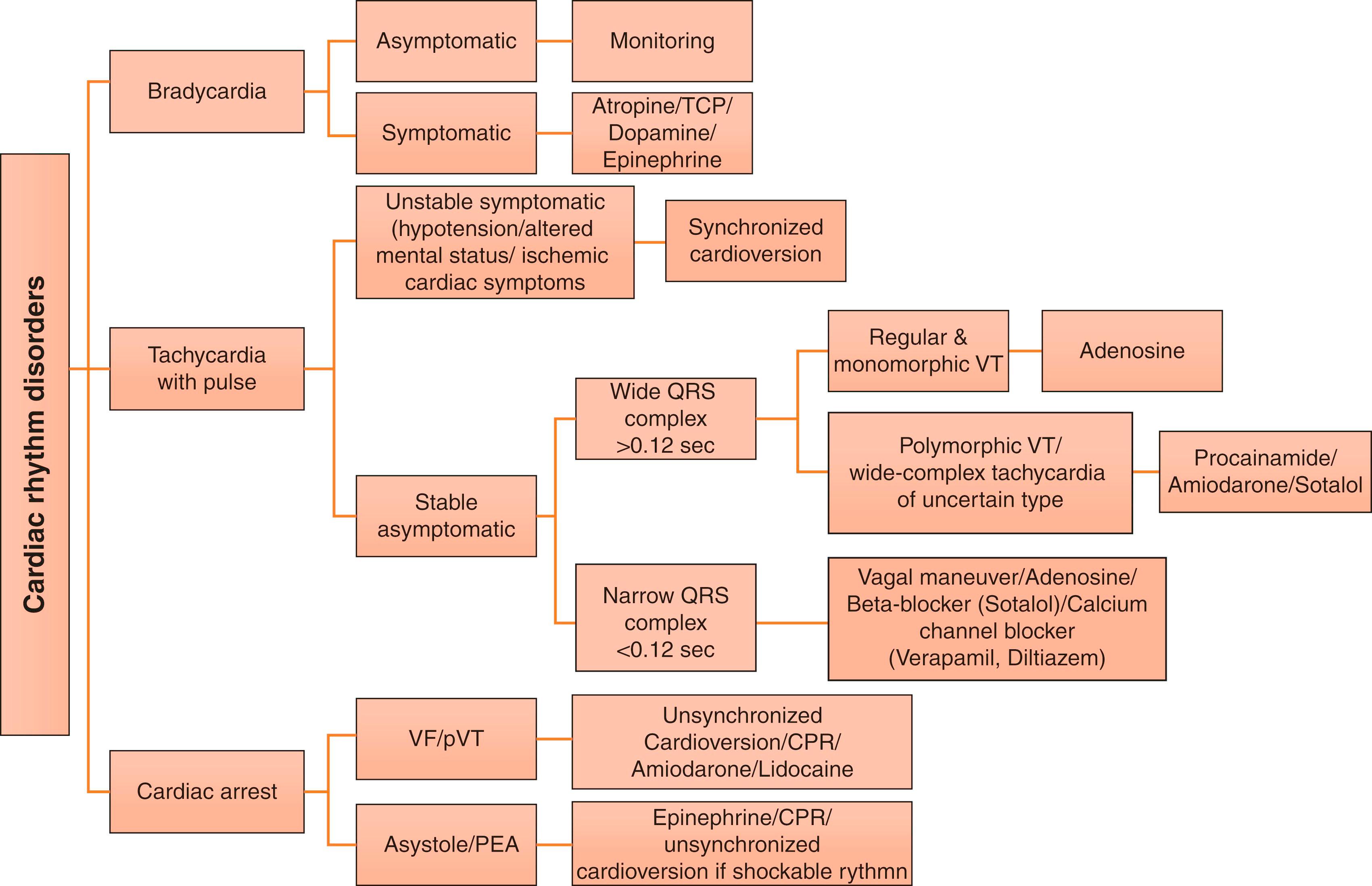
Bradycardia
Tachycardia
Narrow QRS complex (<0.12 sec) supraventricular tachycardia
Regular rhythm
Sinus tachycardia
Atrial flutter
AV nodal reentry
Irregular rhythm
Atrial fibrillation (AF)
Atrial flutter with variable block
Atrial tachycardia with variable block
Multifocal atrial tachycardia
Wide QRS complex (≥0.12 sec) tachycardia
Regular rhythm
Monomorphic ventricular Tachycardia (VT)
Supraventricular tachycardia (SVT) with aberrancy
Irregular rhythm
AF with aberrancy
Preexcited AF (AF + Wolff-Parkinson-White syndrome [WPW])
Polymorphic VT
Torsades de pointes
Ventricular fibrillation (VF)
Asymptomatic
Unstable patients with acute signs/symptoms
Ischemic chest discomfort
Hypotension
Cardiogenic shock
Acute heart failure
Acute cardiac arrest
VF
Pulseless ventricular tachycardia (pVT)
Asystole
Pulseless electrical activity (PEA)
Atropine
First choice
Dose: 1 mg IV bolus, repeated every 3–5 min until maximum dose of 3 mg
Mechanism of action
Anticholinergic (parasympatholytic) drug
Inhibits muscarinic acetylcholine receptors
Dopamine
May be used if atropine does not work
May be considered with or without transcutaneous pacemaker
Dose: 5–20 mcg/min infusion, titrated to patient response, tapered slowly
Mechanism of action
Chronotropic effect
Epinephrine
May be used if atropine does not work
May be considered with or without transcutaneous pacemaker (TCP)
Dose: 2–10 mcg/min infusion, titrated to patient response
Mechanism of action
Chronotropic effect
Become a Clinical Tree membership for Full access and enjoy Unlimited articles
If you are a member. Log in here