Physical Address
304 North Cardinal St.
Dorchester Center, MA 02124

Laser technology has allowed for enhanced surgical treatment for a wide variety of otolaryngology indications, including those in otology, laryngology, bronchoesophagology, and facial plastic surgery.
Every surgeon should have basic knowledge of laser physics and laser-tissue interactions to choose the proper laser and laser settings to minimize unnecessary tissue injury.
The choice of surgical laser depends on several factors: target tissue, available modes of delivery, and desired tissue effects, among others.
Safe and proper laser use requires an established laser safety protocol at each institution and should include separate credentialing for each laser to be used by an individual surgeon.
Laser light is the brightest monochromatic (single color) light known to exist. In addition to being a standard tool in the research laboratory, the laser is currently used in communications, surveying, manufacturing, diagnostic medicine, and surgery. Bar-code scanners, lecture pointers, laser printers, and optical discs bring laser technology into everyday life. This same basic technology has enhanced the options available to the otolaryngologist in treating a variety of disorders of the head and neck.
This chapter reviews the principles, applications, and safety considerations associated with the use of lasers in the head and neck. The material presented provides a foundation for the otolaryngologist to safely and effectively apply this technology.
Laser is a word derived from the acronym for l ight a mplification by the s timulated e mission of r adiation. Einstein postulated the theoretic foundation of laser action, stimulated emission of radiation, in 1917. In his classic journal article, “Zur Quantem Theorie der Strahlung” (“The Quantum Theory of Radiation”), he discussed the interaction of atoms, ions, and molecules with electromagnetic radiation. He specifically addressed absorption and spontaneous emission of energy and proposed a third process of interaction: stimulated emission. Einstein postulated that the spontaneous emission of electromagnetic radiation from an atomic transition has an enhanced rate in the presence of similar electromagnetic radiation. This “negative absorption” is the basis of laser energy. Many attempts were made in the following years to produce stimulated emission of electromagnetic energy, but it was not until 1954 that this was successfully accomplished. In that year, Gordon and others reported their experiences with stimulated emission of radiation in the microwave range of the electromagnetic spectrum. This represented the first maser — m icrowave a mplification by the s timulated e mission of r adiation—and paved the way for the development of the first laser. In 1958, Schawlow and Townes published “Infrared and Optical Masers,” in which they discussed stimulated emission in the microwave range of the spectrum and described the desirability and principles of extending stimulated emission techniques to the infrared and optical ranges of the spectrum. Maiman expanded on these theoretic writings and built the first laser in 1960. With synthetic ruby crystals, this laser produced electromagnetic radiation at a wavelength of 0.69 µm in the visible range of the spectrum. Although the laser energy produced by Maiman's ruby laser lasted less than a millisecond, it paved the way for explosive development and widespread application of this technology.
Commercial lasers were being sold for laboratory use within a year of being invented. Partially reacting to the recently discovered dangers of radiographs, scientists were concerned about the safety of lasers and how laser light might damage living tissue. This concern over the safety of laser light prompted much of the early transition of the laser from the scientific laboratory to the medical clinic. In 1962, Zaret and others published one of the first reports of laser light interacting with tissue. They measured the damage caused by lasers on rabbit retina and iris. In 1964, the argon and neodymium:yttrium-aluminum-garnet (Nd:YAG) lasers were developed. Excited by ophthalmologists’ progress in using the laser as a therapeutic tool, dermatologist and surgeon, Dr. Leon Goldman, used his medical laser laboratory to look at the hazards of the laser and to consider the potential uses of lasers in medicine. Two important advances allowed the laser to be useful in otolaryngology: in 1965, the carbon dioxide (CO 2 ) laser was developed, and in 1968, Polanyi developed the articulated arm to deliver infrared radiation from the CO 2 laser to remote targets. He combined his talents with those of otolaryngologist Geza Jako and used the articulated arm and the CO 2 laser in laryngeal surgery. Simpson and Polanyi described the series of experiments and the new instrumentation that made this work possible.
A laser is an electrooptical device that emits organized light, rather than the random-pattern light emitted from a light bulb, in a very narrow and intense beam by a process of optical feedback and amplification. Because the explanation for this organized light involves stimulated emission, a brief review of quantum physics is necessary.
In the semiclassic picture of the atom, each proton is balanced by an electron that orbits the nucleus of the atom in one of several discrete shells or orbits. Shells correspond to specific energy levels, which are characteristic of each different atom or molecule. The smaller shells, where the electron is closer to the nucleus, have a lower energy level than the larger shells, where the electron is farther from the nucleus. Electrons of a particular atom can only orbit the nucleus at these shells or levels. Radiation of energy does not occur while the electrons remain in any of these shells.
Electrons can change their orbits, thereby changing the energy state of the atom. During excitation, an electron can make the transition from a lower energy level to a higher energy level. Excitation that comes from the electron interacting with light (a photon) is termed absorption . The atom always seeks its lowest energy level (i.e., the ground state); therefore, the electron will spontaneously drop from the higher energy level back to the lowest energy level in a very short time (typically 10 −8 s). As the electron spontaneously drops from the higher energy level to the lower energy level, the atom must give up the energy difference and emits the extra energy as a photon of light in a process termed the spontaneous emission of radiation ( Fig. 59.1 ).

Einstein postulated that an atom in a high energy level could be induced to make the transition to a lower energy state even faster than in the spontaneous process if it interacted with a photon of the correct energy. This process can be imagined as a photon colliding with an excited atom, which results in two identical photons—one incident and one produced by the decay—that leave the collision. The two photons have the same frequency and energy and travel in the same direction in the spatial and temporal phase. This is a process Einstein called stimulated emission of radiation, the underlying principle of laser physics (see Fig. 59.1 ).
All laser devices have an optical resonating chamber (cavity) with two mirrors. The space between these mirrors is filled with an active medium, such as argon, neodymium:yttrium-aluminum-garnet, or CO 2 . An external energy source, such as an electric current, excites the active medium within the optical cavity. This excitation causes many atoms of the active medium to be raised to a higher energy state. A population inversion occurs when more than half of the atoms in the resonating chamber have reached a particular excited state, and spontaneous emission is taking place in all directions: light (photons) emitted in the direction of the long axis of the laser is retained within the optical cavity by multiple reflections off the precisely aligned mirrors; one mirror is completely reflective, and the other is partially transmissive ( Fig. 59.2 ). Stimulated emission occurs when a photon interacts with an excited atom in the optical cavity, which yields pairs of identical photons of equal wavelength, frequency, and energy that are in phase with each other. This process occurs at an increasing rate with each passage of the photons through the active medium.

The mirrors serve as a positive feedback mechanism for the stimulated emission of radiation by reflecting the photons back and forth. The partially transmissive mirror emits some of the radiant energy as laser light. The radiation that leaves the optical cavity through the partially transmissive mirror quickly reaches equilibrium with the pumping mechanism's rate of replenishing the population of atoms in the high energy state. (In the preceding discussion, the term atom refers to the active material; in reality, the active material can consist of molecules, ions, atoms, semiconductors, or even free electrons in an accelerator. These other systems do not require the bound electron to be excited but may instead use different forms of excitation, including molecular vibrational excitation or the kinetic energy of an accelerated electron.)
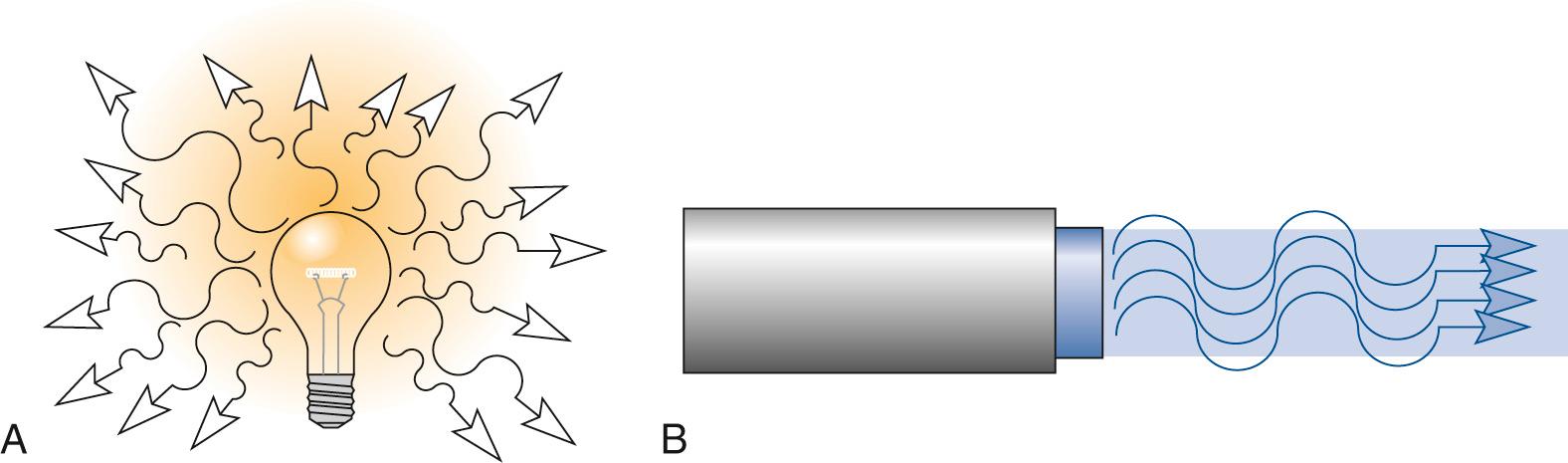
The radiant energy emitted from the optical cavity is of the same wavelength (monochromatic), is extremely intense and unidirectional (collimated), and is temporally and spatially coherent. The term temporal coherence refers to the waves of light that oscillate in phase over a given time, whereas spatial coherence means that the photons are equal and parallel across the wave front. These properties of monochromaticity, intensity, collimation, and coherence distinguish the organized radiant energy of a laser light source from the disorganized radiant energy of a light bulb or other light source ( Fig. 59.3 ).
After the laser energy exits the optical cavity through the partially transmissive mirror, the radiant energy typically passes through a lens that focuses the laser beam to a very small diameter, or spot size, that ranges from 0.1 to 2 mm. For certain lasers such as the CO 2 and Nd:YAG, whose wavelengths are not in the visible spectrum, the lens system is constructed to allow another type of laser that is visible to be used as an aiming beam. A helium-neon beam is often used in this coplanar manner. The optical properties of each focusing lens determine the focal length or distance from the lens to the intended target tissue for focused use.
With most surgical lasers, the physician can control three variables: (1) power , measured in watts; (2) spot size, measured in either square millimeters or square centimeters; and (3) exposure time, measured in seconds. The development of the central pattern generator (CPG) has provided enhanced control over the delivery of the laser energy by optimizing these parameters beyond simple spot delivery.
Of power, spot size, and exposure time, power is the least useful variable and may be kept constant with widely varying effects, depending on the spot size and the duration of exposure. For example, the relationship between power and depth of tissue injury becomes logarithmic when the spot size and exposure time are kept constant and the power is varied. Irradiance is a more useful measure of the intensity of the beam at the focal spot than power is, because it considers the surface area of the focal spot. Specifically, irradiance is expressed (in W/cm 2 ) as power in the focal spot divided by the focal spot area.
Power and spot size are considered together, and a combination is selected to produce the appropriate irradiance. If the exposure time is kept constant, the relationship between irradiance and depth of injury is linear as the spot size is varied. Irradiance is the most important operating parameter of a surgical laser at a given wavelength; therefore, surgeons should calculate the appropriate irradiance for each procedure to be performed. These calculations allow the surgeon to control, in a predictable manner, the tissue effects when changing from one focal length to another (e.g., from 400 mm for microlaryngeal surgery to 125 mm for handheld laser surgery). Irradiance varies directly with power and inversely with surface area. This relationship of surface area to beam diameter is important when evaluating the power density, because the larger the surface area, the lower the irradiance; conversely, the smaller the surface area, the higher the irradiance. Surface area ( A ) is expressed as:
where r is the beam radius and d is the beam diameter ( d = 2 r ).
Surface area and irradiance vary with the square of the beam diameter. Doubling the beam diameter (e.g., from d to 2d) increases the surface area fourfold and reduces irradiance to one fourth. Halving the beam diameter (e.g., from d to d/2) yields only one-fourth of the area and increases irradiance by a factor of 4.
Current CO 2 lasers emit radiant energy with a characteristic beam intensity pattern. This beam pattern ultimately determines the depth of tissue injury and vaporization across the focal spot; therefore, the surgeon should be aware of the characteristic beam pattern of the laser. Transverse electromagnetic mode (TEM) refers to the distribution of energy across the focal spot and determines the shape of the laser's spot. The most fundamental mode is TEM 00 , which appears circular on cross-section. The power density of the beam follows a Gaussian distribution: the greatest amount of energy is at the center of the beam and the amount of energy diminishes progressively toward the periphery. TEM 01 and TEM 11 are less fundamental modes that have a more complex distribution of energy across their focal spot, which causes predictable variations in tissue vaporization depth. Additionally, their beams cannot be focused to as small a spot size as TEM 00 lasers at the same working distance.
Although simple ray diagrams normally show parallel light focused to a point, the actual situation is a bit more complicated. A lens focuses a Gaussian beam to a beam waist of a finite size. This beam waist is the minimum spot diameter (d) and can be expressed as:
where f is the focal length of the lens, λ is the wavelength of light, and D is the diameter of the laser beam incident on the lens ( Fig. 59.4 ). The beam waist occurs over a range of distances, termed the depth of focus , which can be expressed as:
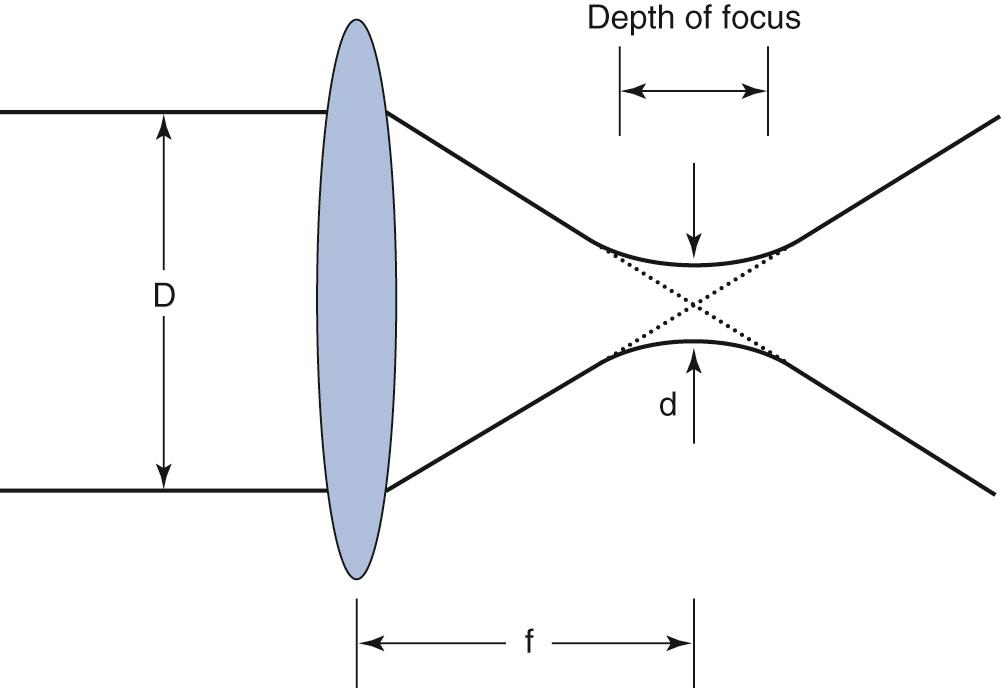
Depth of focus is realized when a camera is focused. With a camera, a range of objects is in focus, which can be set without carefully measuring the distance between the object and the lens. The preceding equations show that a lens with a long focal length leads to a large beam waist, which also translates as a greater depth of focus.
The size of the laser beam on the tissue (spot size) can, therefore, be varied in two ways:
Because the minimum beam diameter of the focal spot increases directly with increasing focal length of the laser-focusing lens, the surgeon can change the focal length of the lens to obtain a particular beam diameter. As the focal length decreases, a corresponding decrease occurs in the size of the focal spot. Also, the smaller the spot size is for any given power output, the greater the corresponding power density will be.
The surgeon can also vary the spot size by working in or out of focus. The smallest beam diameter and highest power concentration occur at the focal plane, where much of the precise cutting and vaporization is carried out ( Fig. 59.5A ). As the distance from the focal plane increases, the laser beam diverges or becomes unfocused (see Fig. 59.5B ). The cross-sectional area of the spot increases and, thus, lowers the power density for a given output. The size of the focal spot depends on the focal length of the laser lens and whether the surgeon is working in or out of focus.

Fig. 59.6 shows these concepts using arbitrary ratios accurate for a current model TEM 00 CO 2 laser. The laser lens setting (focal length) and working distance (focused/unfocused) combinations determine the size of the focal spot. The height of the various cylinders represents the amount of tissue vaporized (depth and width) after a 1-s exposure at the three focal lengths.

The surgeon can vary the amount of energy delivered to the target tissue by varying the exposure time. Fluence refers to the amount of time (measured in seconds) that a laser beam irradiates a unit area of tissue at a constant irradiance. Fluence is a measure, then, of the total amount of laser energy per unit area of exposed target tissue and is expressed (in J/cm 2 ) as Fluence = Power density × Time. Fluence varies directly with the length of the exposure time, which can be varied by working in the pulsed mode (duration, 0.05 to 0.5 s) or in the continuous mode .
A laser beam pattern generator modulates and scans a laser beam onto a substrate to generate a pattern on the substrate. The pattern generator comprises a handpiece; a chopping system, which splits the incident laser beam; a position sensor; and two mirrors.
With the continuous wave CO 2 laser, for example, the magnitude of the provided pulse is based on the duration of the operator's push on the trigger, which results in great variability and depth of ablation. A similar laser with a CPG affixed will in contrast provide accurate and discrete CO 2 patterns for each push on the trigger, which thereby enhances the reproducibility of the pulse and consistency of ablation from pulse to pulse. Simulations using a CPG system, such as the Digital Acublade (Lumenis), have shown that computer-controlled laser incisions can result in a reduction of as much as 75% in the distance of lateral thermal tissue damage from the target incision. This is due to the rapid speed of laser pulses provided by the computer to allow improved cumulative temperature dissipation.
When electromagnetic energy (incident radiation) interacts with tissue, the tissue reflects, absorbs, transmits, and scatters portions of the light. The surgical interaction of this radiant energy with tissue is caused only by that portion of light that is absorbed (i.e., the incident radiation minus the sum of the reflected and transmitted portions).
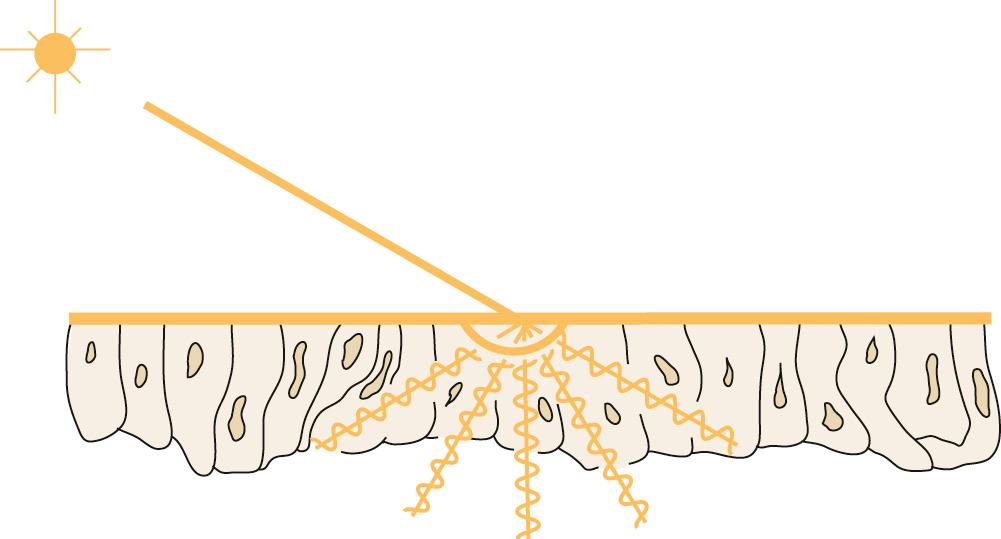
The actual tissue effects produced by the radiant energy of a laser vary with the wavelength of the laser. Each type of laser exhibits different characteristic biologic effects on tissue and is, therefore, useful for different applications. However, certain similarities exist regarding the nature of laser light's interaction with biologic tissue. The lasers used in medicine and surgery today can be ultraviolet, meaning the interactions are a complex mixture of heating and photodissociation of chemical bonds. The more commonly used lasers emit light in the visible or infrared regions of the electromagnetic spectrum, and their primary form of interaction with biologic tissue leads to heating. Therefore, if the radiant energy of a laser is to exert its effect on the target tissue, it must be absorbed by the target tissue and must be converted to heat ( Fig. 59.7 ). Scattering tends to spread the laser energy over a larger surface area of tissue, but it limits the penetration depth ( Fig. 59.8 ). The shorter the wavelength of light, the more it is scattered by the tissue. If the radiant energy is reflected from or transmitted through the tissue ( Figs. 59.9 and 59.10 ; see also Fig. 59.7 ), no effect will occur. To select the most appropriate laser system for a particular application, the surgeon should thoroughly understand these characteristics of the interaction of laser light with biologic tissue.



The CO 2 laser creates a characteristic wound ( Fig. 59.11 ). When the target absorbs a specific amount of radiant energy to increase its temperature to between 60°C and 65°C (140°F to 149°F), protein denaturation occurs. Blanching of the tissue surface is readily visible, and the deep structural integrity of the tissue is disturbed. When the absorbed laser light heats the tissue to approximately 100°C (212°F), vaporization of intracellular water occurs, which causes vacuole formation, craters, and tissue shrinkage. Carbonization, disintegration, smoke, and gas generation with destruction of the laser-radiated tissue occur at several hundred degrees centigrade. In the center of the wound is an area of tissue vaporization, where just a few flakes of carbon debris are noted. Immediately adjacent to this area is a zone of thermal necrosis about 100 µm wide. Next to that is an area of thermal conductivity and repair, which is usually 300 to 500 µm wide. Small vessels, nerves, and lymphatics are sealed in the zone of thermal necrosis. The minimal operative trauma, combined with the vascular seal, probably accounts for the absence of postoperative edema that is characteristic of laser wounds.

Comparison animal studies have been performed on the histologic properties of healing and the tensile strength of the healing wound after laser- and scalpel-produced incisions. Several studies noted impaired wound healing with the CO 2 laser incision when compared with the scalpel-produced incision. Other studies of the healing properties of laser-induced incisions concluded that laser incisions have equivalent or better healing results than surgical knife wounds. Buell and Schuller compared the rate of tissue repair after CO 2 laser and scalpel incisions on hogs. In this study, the tensile strength of the laser incisions was less than that of similar scalpel incisions during the first 3 weeks after surgery. After this time, the tensile strength of both wounds rapidly increased at a similar rate.
Regardless of which studies accurately depict the effects of the CO 2 laser on wound healing, the incidental, collateral thermal damage is indisputable. To minimize lateral thermal damage from thermal diffusion, the tissue should be ablated with a short laser pulse.
To understand how a pulsed laser reduces thermal diffusion, consider the analogy of filling a large bucket with a hole in the bottom. If a narrow stream of water is used to fill the bucket, the filling process will take a long time and a considerable amount of water will leak out of the hole during the filling process. Instead, if the bucket is filled in one quick dump from an even larger bucket, the water will have little time to leak out of the hole during the filling process.
This analogy can also be used to understand the ablation process. In ablation, the water represents laser energy and the filled bucket represents sufficient energy deposited in the tissue to cause ablation. The hole in the bottom of the bucket represents the thermal diffusion of heat away from the ablation site while the energy is being deposited. A low-intensity, continuous laser beam is similar to the narrow stream of water. The short-pulsed, high-peak power laser is similar to the larger bucket in that it quickly dumps energy into the ablation site.
Several types of lasers are commonly used in otolaryngology. They include argon and argon tunable dye lasers; Nd:YAG, potassium-titanyl-phosphate (KTP); CO 2 lasers; pulsed dye lasers; and thulium (Tm:YAG) lasers. The potential clinical applications of these surgical lasers are mainly determined by wavelength and specific tissue-absorptive characteristics. To achieve the surgical objective with minimal morbidity and maximal efficiency, the surgeon must consider the properties of each wavelength when choosing a particular laser ( Table 59.1 ). Clinical applications are also limited by the available modes of delivery for the various lasers. It is also important to know that the applications listed can, in many cases, be addressed with nonlaser techniques.
| Laser | Second-Choice Laser | Anatomic Site | Lesion | Reason |
|---|---|---|---|---|
| Argon | Ear | Lysis of middle ear adhesions | Optic fiber delivery; hemoglobin absorption | |
| Argon pumped dye laser | Photodynamic therapy | Can tune the laser to maximum absorption of photosensitizer | ||
| CO 2 , in-office PDL or KTP | Vocal fold | Polyps | Microspot precision; nonlaser options available | |
| CO 2 , in-office PDL or KTP | Vocal fold | Reinke edema | Microspot precision; microflap technique preferred | |
| CO 2 | Vocal fold | T1 midfold SCC with no anterior commissure involvement | Hemostasis, precision; nonlaser options available | |
| CO 2 | KTP | Larynx | Laryngoceles, saccular cysts | Excision with hemostasis; hands-off technique |
| CO 2 | Larynx | Laryngomalacia | Aryepiglottic fold division; precision; and coagulation | |
| CO 2 | Larynx | Stenoses (glottic, posterior, and subglottic) | Radial excision and dilation; nonlaser options available | |
| CO 2 | Lingual tonsils | Recurrent tonsillitis, hypertrophy | Minimal edema with complete vaporization | |
| CO 2 | Oral cavity | Carcinoma (verrucous, superficial T1) | Less pain and edema; covers a large area | |
| CO 2 | Oral cavity | Premalignant (leukoplakia, erythroplakia) | Vaporization, excision; can cover a large area | |
| CO 2 | KTP | Glottis | Bilateral vocal cord paralysis | Laser cordotomy; coagulation |
| CO 2 , in-office PDL, or KTP | Larynx | Recurrent respiratory papilloma | Lesion excision/ablation with CO 2 vs. vascular effect with in-office lasers | |
| CO 2 | KTP | Larynx | Suprahyoid supraglottic T1 SCC | Excision with frozen section control |
| CO 2 | KTP | Oral cavity | Tongue T1 and limited T2 cancer | Less pain and edema; precision; and coagulation |
| CO 2 | KTP or argon | Ear | Stapedotomy | Minimal trauma |
| CO 2 | KTP or Nd:YAG | Oral cavity | Lymphangioma | Minimal edema and coagulation |
| CO 2 | KTP or Nd:YAG | Oropharynx | T1 and T2 SCC | Precision; coagulation; less edema; and contact tip with Nd:YAG |
| CO 2 | Nd:YAG | Nose | Turbinate hypertrophy | Coagulation; less scabbing and scarring |
| CO 2 | Nd:YAG | Subglottis | Hemangioma | Defocused beam; shrinkage; and coagulation |
| PDL | Port wine stains | Selective photothermolysis | ||
| KTP | Nose | Polyps, concha bullosa | Debulking for visualization; coagulation | |
| KTP | CO 2 | Larynx | Obstructing SCC | Debulking airway, staging, and coagulation |
| KTP | CO 2 | Oropharynx | Sleep apnea (uvulopalatopharyngoplasty) | Coagulation |
| KTP | CO 2 | Palatine tonsils | Recurrent tonsillitis and obstructive apnea | Possible coagulation; less postoperative pain |
| KTP | Nd:YAG | Nose | Epistaxis | Fiber delivery and coagulation; hands-off technique |
| Nd:Y AG | KTP | Nose | Hereditary hemorrhagic telangiectasias | Coagulation; hands-off technique |
| Nd:Y AG | KTP or CO 2 | Trachea | Obstructing malignant lesions | Debulking; coagulation; and fiber delivery |
Argon lasers produce blue-green light in the visible range of the electromagnetic spectrum, with primary wavelengths of 0.488 and 0.514 µm. The radiant energy of an argon laser may be strongly absorbed, scattered, or reflected, depending on the specific biologic tissues with which it interacts. Its extinction length—that is, the thickness of water necessary to absorb 90% of the incident radiation in pure water—is about 80 m. Therefore, the radiant energy from an argon laser is readily transmitted through clear aqueous tissues (e.g., cornea, lens, and vitreous humor) and is absorbed and reflected to varying degrees by tissues that are white in color (e.g., skin, fat, and bone). Light from an argon laser is absorbed by hemoglobin and pigmented tissues. A localized thermal reaction occurs within the target tissue and causes protein coagulation. The clinician uses this selective absorption of light from the laser to photocoagulate pigmented lesions such as port wine stains, hemangiomas, and telangiectasias. The heat produced destroys the epidermis and upper dermis. The surgeon should, therefore, minimize the amount of laser energy delivered to the vascular cutaneous lesion to decrease the tendency of scarring in the overlying skin.
When the beam of the argon laser is focused on a small focal spot, its power density increases sufficiently to vaporize the target tissue. This characteristic allows otologists to perform stapedotomy in patients with otosclerosis. Because bone, being a white tissue, reflects most of the incident radiation from an argon laser, it is necessary to place a drop of blood on the stapes to initiate absorption of the laser energy.
The argon tunable dye laser works on the same principle as the argon laser: it makes a high-intensity beam that is focused on dye that continuously circulates in a second laser optically coupled with the argon laser. The laser beam energizes the dye, which causes it to emit laser energy at a longer wavelength than the pump beam. By varying the type of dye and using a tuning system, different wavelengths can be obtained. The laser energy from this dye laser can be transmitted through flexible fiberoptics and delivered through endoscopic systems or inserted directly into tumors. The major clinical use of this laser is with selective photodynamic therapy for malignant tumors after the intravenous injection of the photosensitizer, hematoporphyrin derivative.
After injection, the hematoporphyrin derivative disseminates to all of the cells of the body, rapidly moving out of normal tissue but remaining longer in neoplastic tissue. After a few days, a differential in concentration exists between the tumor cells and the normal cells. When the tumor is exposed to red light (630 nm), the dye absorbs the light, which causes a photochemical reaction. Toxic oxygen radicals such as singlet oxygen are produced within the exposed cells, which causes selective tissue destruction and cell death. Because healthy tissues contain less photosensitizer, a much less severe reaction or no reaction occurs. Long-term tumor control has been achieved using photodynamic therapy for recurrent nasopharyngeal cancer. The overall potential and the place of maximum value of this form of management remain to be established.
Become a Clinical Tree membership for Full access and enjoy Unlimited articles
If you are a member. Log in here
