Physical Address
304 North Cardinal St.
Dorchester Center, MA 02124

Modern orthodontic treatment still follows a familiar sequence: diagnosis, planning, appliance placement, and adjustment over time.
What is changing is how early parts of that sequence are being supported. A growing focus in clinical practice is whether tooth movement can be modeled in advance using digital tools before treatment begins.
At SMILE-FX® Orthodontic Studio in South Florida, this approach is implemented through a workflow known as the AI Braces™ system. It combines cone beam computed tomography (CBCT), artificial intelligence, and digital simulation to support treatment planning prior to appliance placement.
CBCT imaging has expanded orthodontic diagnostics by providing three-dimensional views of teeth, roots, and surrounding bone structures. Compared to traditional imaging, it allows for a more complete understanding of spatial relationships.
Within the AI Braces™ workflow, this imaging data is used to build a digital representation of the patient’s dentition.
That model can then be used to simulate potential tooth movement under different treatment approaches. This gives clinicians a way to review possible outcomes before treatment begins, rather than relying only on staged changes after appliances are placed.
These simulations are used as planning references alongside clinical evaluation.
Artificial intelligence in this setting is used to analyze imaging data and identify patterns related to alignment, spacing, and expected movement over time.
The outputs are reviewed by the orthodontist and incorporated into treatment planning when appropriate. Clinical decisions remain fully practitioner-led, with AI functioning as a structured support tool that helps organize and interpret complex data.
A practical application of this approach is patient communication. Staged visualizations can help explain how treatment may progress over time, which supports clearer discussions during consultations.

After a treatment plan is confirmed, digital workflows often extend into execution.
In this setting, 3D-printed guides or trays may be used to transfer the planned setup into bracket placement. This connects the digital model with physical treatment and supports consistency at the start of orthodontic care.
All cases also include remote monitoring between visits. Patients submit at home Video Scans with their smart phones which are further analyzed by Ai algorithms and finally reviewed by a board certified orthodontist to track progress and identify any clinical emergencies, deviations from the expected treatment path, and allowing early and proactive treatment interventions to support successful and predictable treatment outcomes.
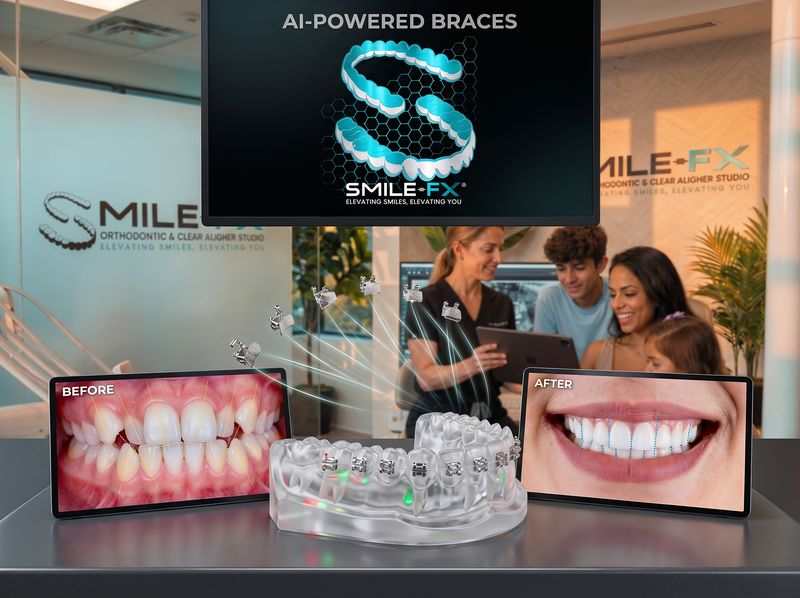
AI-assisted orthodontic planning through this workflow is applied across a range of cases, from mild crowding to more complex bite-related concerns or retreatment cases.
In simpler cases, it helps clarify sequencing and reduces uncertainty in early planning.
In more complex cases, it allows different treatment strategies to be reviewed before a final decision is made.
Even with these tools, orthodontic outcomes still depend on biological factors such as bone response, growth patterns, and patient compliance. These variables remain central to treatment progression in practice.
For that reason, simulations are used to support planning rather than define fixed outcomes.
The use of AI in orthodontics reflects a broader shift in how digital tools are being integrated into dental care. Over recent years, technologies such as intraoral scanners, aligner systems, and virtual setups have already changed how treatment is designed and delivered.
The AI Braces™ workflow at SMILE-FX® Orthodontic Studio builds on this by introducing simulation into the planning stage. Instead of relying only on sequential adjustments during treatment, clinicians can review projected movement patterns before treatment begins.
This allows for a more flexible planning process where different approaches can be compared earlier in the workflow.
At the same time, these systems are still developing, and their clinical performance continues to be evaluated as more cases are treated and reviewed over time.
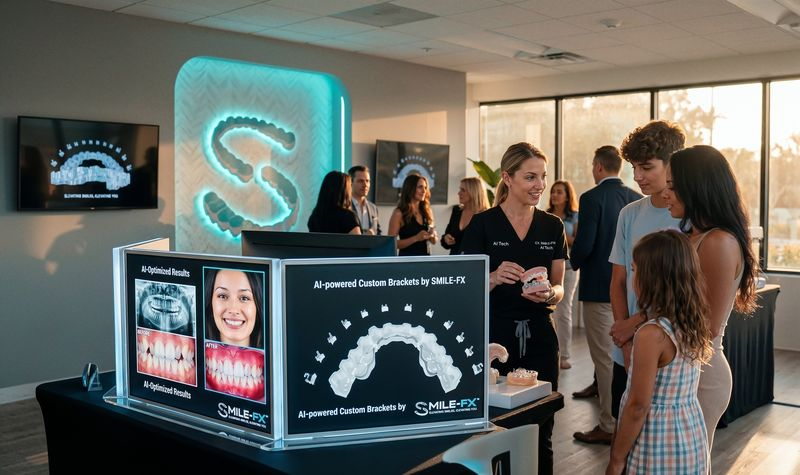
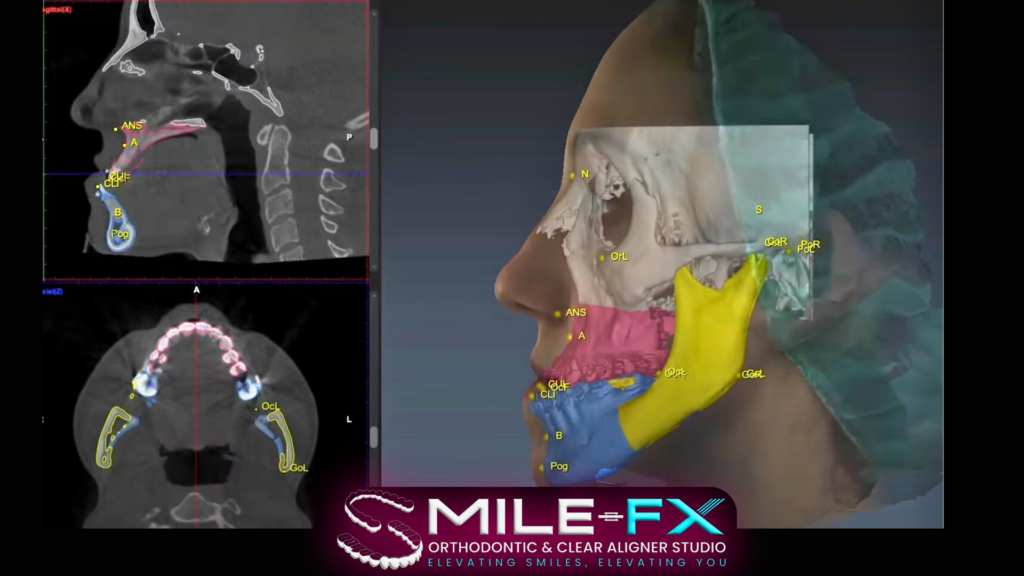
Artificial intelligence is adding a predictive layer to orthodontic planning by supporting how treatment is visualized before it begins.
Through CBCT imaging, digital modeling, and simulation, workflows such as the AI Braces™ system allow clinicians to review potential treatment pathways during planning.
This reflects a gradual shift toward more forward-looking orthodontic care, where planning tools support clinical judgment while remaining grounded in individual patient biology.
