Physical Address
304 North Cardinal St.
Dorchester Center, MA 02124

This chapter includes a discussion of anatomic, biomechanical, and kinematic aspects of wrist function and diagnostic methods, treatment options, and procedures for various wrist conditions. A considerable body of information on the wrist has developed in recent years. No attempt is made to resolve all controversies or to define narrowly the place of new procedures or technologies.
The wrist is the anatomic region between the forearm and the hand. For the purposes of this discussion, the wrist includes the distal radioulnar, radiocarpal, and ulnocarpal joints and the eight carpal bones and their proximal and distal articulations and attached ligaments.
The eight carpal bones include the scaphoid, lunate, triquetrum, and pisiform in the proximal row and the trapezium, trapezoid, capitate, and hamate in the distal row ( Fig. 69.1 ). They vary in size from the smallest, the pisiform and trapezoid, to the largest, the capitate, and in the amount of articular cartilage allowing for articulation, with one bone by the pisiform (the triquetrum) to seven bones by the capitate. Viegas emphasized the considerable variation found in the fourth carpometacarpal articulation and in the scaphotrapeziotrapezoid, capitolunate, and hamatolunate articulations. Awareness of these variations may lead to better understanding of the normal kinematics of the wrist and the various injury patterns that are encountered.

The radiocarpal joints are formed by the articulation of the distal radius with the scaphoid and lunate through their respective concave facets on the distal radius and the triquetrum on the triangular fibrocartilage. The distal concave articular surfaces of the proximal carpal row form the midcarpal articulations with the distal row. The distal row articulates with the metacarpals, allowing mobility in the thumb, stability in the index and long finger metacarpals, and increased mobility in the ring and little finger metacarpals.
The distal ulnar convexity articulates at the lesser sigmoid notch of the distal radius. The sigmoid notch articular surface accommodates the ulnar head through two thirds of its arc. There is about a 20-degree inclination of the distal ulna at its articulation with the radius. The ulnar styloid lies dorsal to the ulnar head and extends distally. The triangular fibrocartilage attaches to the base of the ulnar styloid and separates the hyaline cartilage–covered ulnar head from the styloid ( Fig. 69.2 ).

The chondroligamentous supports attaching the distal radius and ulnar side of the carpus to the distal ulna are designated as the triangular fibrocartilage complex (TFCC). Attaching to the ulnar margin of the lunate fossa of the radius, these supports include the ulnar collateral ligament, the dorsal and volar radioulnar ligaments, the articular disc, the meniscal homologue, the extensor carpi ulnaris sheath, and the ulnolunate and ulnotriquetral ligament. Additional ligaments are found in two locations: (1) between the carpal bones (interosseous intrinsic ligaments) connecting the carpal bones in the proximal and distal carpal rows and (2) extending from the radius and ulna distally across the carpal rows (extrinsic ligaments). The interosseous ligaments include the scapholunate and lunotriquetral interosseous ligaments connecting the proximal carpal row and the ligaments connecting the trapezium to the trapezoid, the trapezoid to the capitate, and the capitate to the hamate in the distal carpal row. The extrinsic or crossing ligaments include the radial collateral ligament from the radial styloid to the scaphoid waist, the ulnar collateral ligament from the base of the ulnar styloid attaching to the pisiform, and the transverse carpal ligament. The volar extrinsic or crossing ligaments also include the radioscaphocapitate ligament, the radiolunotriquetral ligament, and the radioscapholunate ligament on the radial side and the ulnolunate and ulnotriquetral components of the TFCC on the ulnar side. On the palmar side of the carpus, between the radiolunotriquetral ligament and the radioscaphocapitate ligament, is a relatively thin area, the space of Poirier, overlying the palmar surface of the lunate ( Fig. 69.3 ).
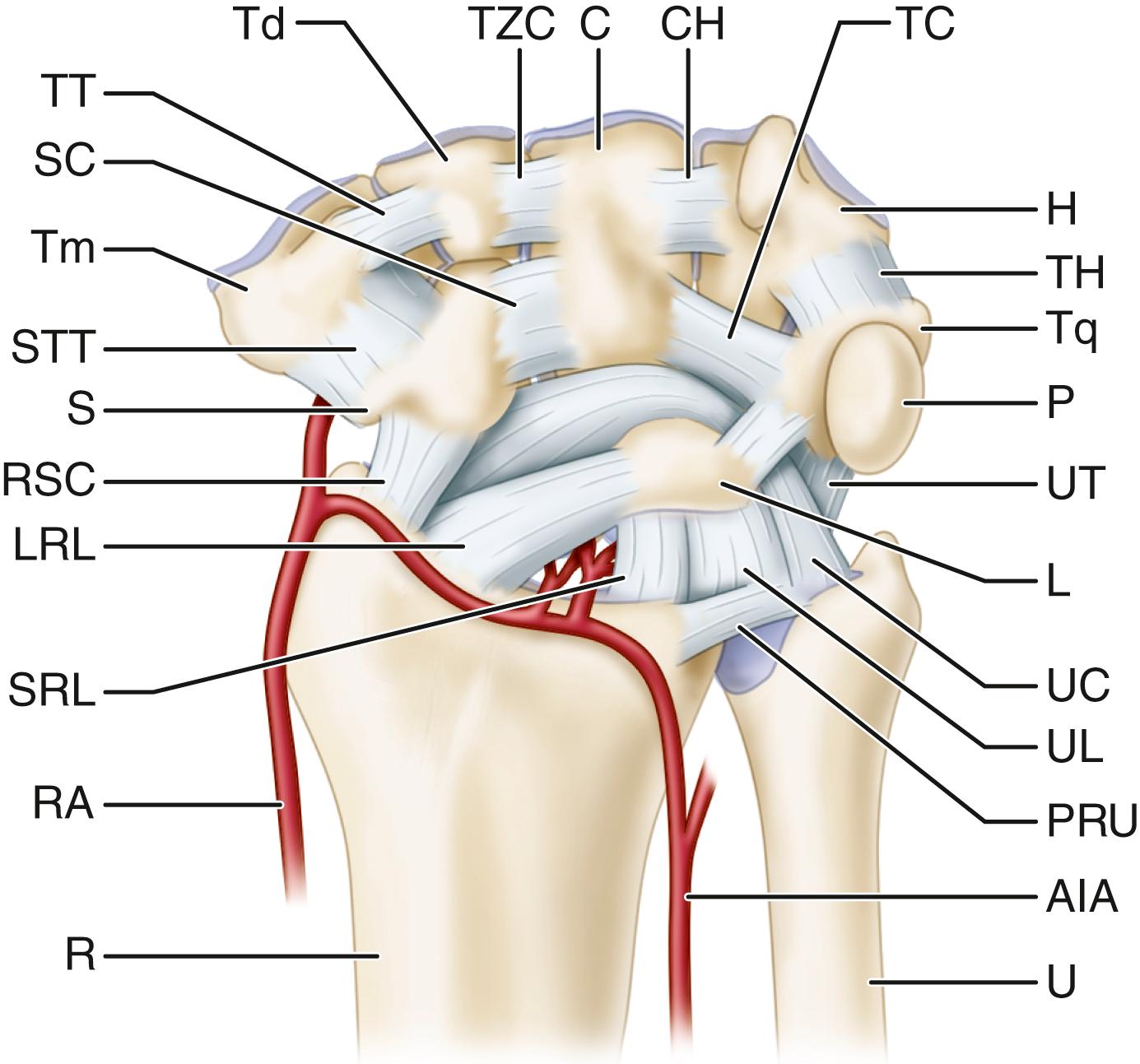
Dorsally, the identifiable extrinsic ligaments include the dorsal radiocarpal and the dorsal intercarpal ligaments. The trapezoidal dorsal radiocarpal ligament attaches along the dorsal radial articular margin of the lunate fossa, from the Lister tubercle to the lesser sigmoid notch. It spans the lunotriquetral joint and inserts on the dorsal surface of the triquetrum. There are four types of dorsal radiocarpal ligaments ( Fig. 69.4 ). The dorsal intercarpal ligament, which is attached to the distal, dorsal surface of the triquetrum, passes across the midcarpal joint to attach to the dorsal surfaces of the scaphoid waist and the trapezoid. The dorsal intercarpal ligaments have variations in thickness and attachments ( Fig. 69.5 ). The laminated structure of the dorsal intercarpal ligament allows for changing shape with wrist movement ( Fig. 69.6 ).


The terminal branches of the radial, ulnar, and anterior interosseous arteries provide extraosseous blood supply to the carpus through three dorsal and three palmar transverse arterial arches with longitudinal connections ( Fig. 69.7 ). The dorsal arches are (1) the dorsal radiocarpal at the radiocarpal joint, supplying the lunate and triquetrum; (2) the dorsal intercarpal (the largest) between the proximal and distal carpal rows, supplying the distal carpal row and, through anastomoses with the radiocarpal arch, the lunate and triquetrum; and (3) the basal metacarpal arch at the base of the metacarpals (the most variable) to supply the distal carpal row. The palmar arches are (1) the palmar radiocarpal at the level of the radiocarpal joint to the palmar surfaces of the lunate and triquetrum, (2) the intercarpal arch between the proximal and distal carpal rows, which is the most variable and does not contribute to nutrient vessels in the carpus, and (3) the deep palmar arch at the level of the metacarpal bases, which is consistent and communicates with the dorsal basal metacarpal arch and the palmar metacarpal arteries. Additional descriptions of the intraosseous circulation of certain carpal bones (especially the scaphoid, lunate, and capitate) are found with the discussions of afflictions of those bones and in the references listed at the end of the chapter.

The stability of the wrist during motion and interrelated motions depends on capsuloligamentous integrity and contact surface contours of the carpal bones. The center of rotation for most wrist motions generally is considered to be located in the proximal capitate. During flexion and extension, most motion occurs at the radiocarpal joint, with some occurring through the midcarpal area. Using ultrafast CT in vivo kinematic studies, the radiocarpal and midcarpal joints were found to contribute equally to wrist flexion and the midcarpal joint contributed more to extension. During radial-to-ulnar deviation, the proximal carpal row rotates dorsally and the proximal row translocates or shifts radially at the midcarpal and radiocarpal joints, with motion occurring at the radiocarpal and intercarpal joints. During ulnar-to-radial deviation, the proximal carpal row tends toward palmar rotation, with most of the motion occurring in the intercarpal joints. The proximal carpal row is considered to be an intercalated segment in the forearm-to-hand connection, with the scaphoid functioning to stabilize the wrist.
For purposes of understanding the ways in which forces are transmitted and motions and positions of the carpal bones are controlled by ligaments and contact surface contours, the concept of a wrist consisting of three columns was popularized by Novarro: the central (force-bearing) column, the radial column, and the ulnar (control) column. The central column includes the distal articular surface of the radius, the lunate, and the capitate, and some would add the proximal two thirds of the scaphoid, the trapezoid, and the articulations with the second and third metacarpal bases. The radial column includes the radius, the scaphoid, the trapezium, the trapezoid, and the thumb carpometacarpal joint. The ulnar column includes the triangular fibrocartilage (articular disc), the hamate, the triquetrum, and the articulations of the carpometacarpal joints of the ring and little fingers. Taleisnik proposed that the central column includes the entire distal row and the lunate. According to his concept, the scaphoid is included as the lateral column and the triquetrum as a rotary medial column ( Fig. 69.8A ). Lichtman proposed a ring concept of wrist kinematics ( Fig. 69.8B ). According to this concept, the interosseous ligaments stabilize the semirigid proximal and distal carpal rows. Limited mobility occurs between the scaphotrapezial joints and the triquetrohamate joints. Bone or ligament disruption of the ring creates instability deformities, with the lunate tilting either dorsally (dorsal intercalated segmental instability) or toward the volar aspect (volar intercalated segmental instability).

Studies of transmission of forces suggest that the distal carpal row may bear more than 10 times the force applied to the fingertips. About 55% to 60% of the load on the distal row is transmitted through the capitate, scaphoid, and lunate. At the radiocarpal level, the load on the radioscaphoid joint varies from 50% to 56%; on the radiolunate joint, 29% to 30%; and on the ulnolunate joint, 10% to 21%.
The usual historical information is documented, including age, hand dominance, occupation, hobbies, date of injury or onset of symptoms, correlation of symptoms with activities and modifying factors (e.g., medications, cold, heat), and previous injury or surgery. Current work status and the existence of various legal concerns (e.g., lawsuits, workers’ compensation, or disability claims) are helpful in assessing the overall situation.
When obtaining the history of traumatic conditions, the mechanism of injury frequently is unknown. The various carpal injuries represent a spectrum of injury. The extent of injury depends on (1) loading in three dimensions, (2) duration and amount of forces, (3) hand position at impact, and (4) mechanical properties of the ligaments and bones. A pattern can be seen in which carpal dislocations result from ulnar deviation and intercarpal supination, and scaphoid fractures result from wrist extension with the dorsal articular margin of the radius serving as a fulcrum ( Fig. 69.9 ). Flexion and pronation injuries, conversely, may contribute more to ligament injuries on the ulnar side of the wrist, especially the lunotriquetral ligament. It is important to be able to document swelling, bruising, local areas of pain, point tenderness, and sensations of grating, popping, and crunching.

For long-standing problems, it is important to correlate the problem with the factors that cause worsening or improvement. The relationship to work and recreational activities; the presence and location of swelling and aching with mechanical symptoms, such as clicking, popping, snapping, and grating; and the response to treatment are important. Other joint involvement and the possible presence of various arthritides in the patient or family members also should be considered.
A careful, detailed examination is conducted with the forearm and hand supported whether the examination is done immediately after injury or for chronic problems. In addition to the usual assessment of motor, sensory, and circulatory integrity, it is important to try to correlate the patient’s complaints with the underlying muscles, tendons, tendon sheaths, bones, joints, ligaments, and capsules. Scars, bruises, and other skin findings and the ranges of active and passive motion should be documented and compared with the uninjured side.
The underlying anatomy can be correlated with easily identified and palpable bony structures, including the radial styloid, Lister tubercle, ulnar styloid, pisiform, and scaphoid tuberosity. Overlying superficial tenosynovitis, such as that seen in the first dorsal compartment (de Quervain), must be differentiated from conditions related to deeper structures or problems related to ligamentous and bony structures (e.g., thumb carpometacarpal arthritis; tenosynovitis in the extensor compartments, the flexor carpi radialis tunnel, and the carpal tunnel; masses such as ganglions; and underlying compression neuropathies of the radial, median, and ulnar nerves in their respective areas of compression).
After the history and physical examination, radiographic evaluation is helpful in determining the diagnosis, prognosis, and management of wrist problems. Gilula et al. proposed a useful algorithm detailing one approach to the radiographic assessment of a painful wrist ( Fig. 69.10 ). MRI should be added for evaluation of the triangular fibrocartilage; the distal radioulnar joint (DRUJ); and vascularity of the various carpal bones, extrinsic ligaments, joint surfaces, and surrounding soft tissues to confirm clinical suspicion and correlate with physical examination findings. A high rate of false-positive findings on MR images of normal subjects has been reported. A dedicated wrist coil provides enhanced resolution of wrist structures.
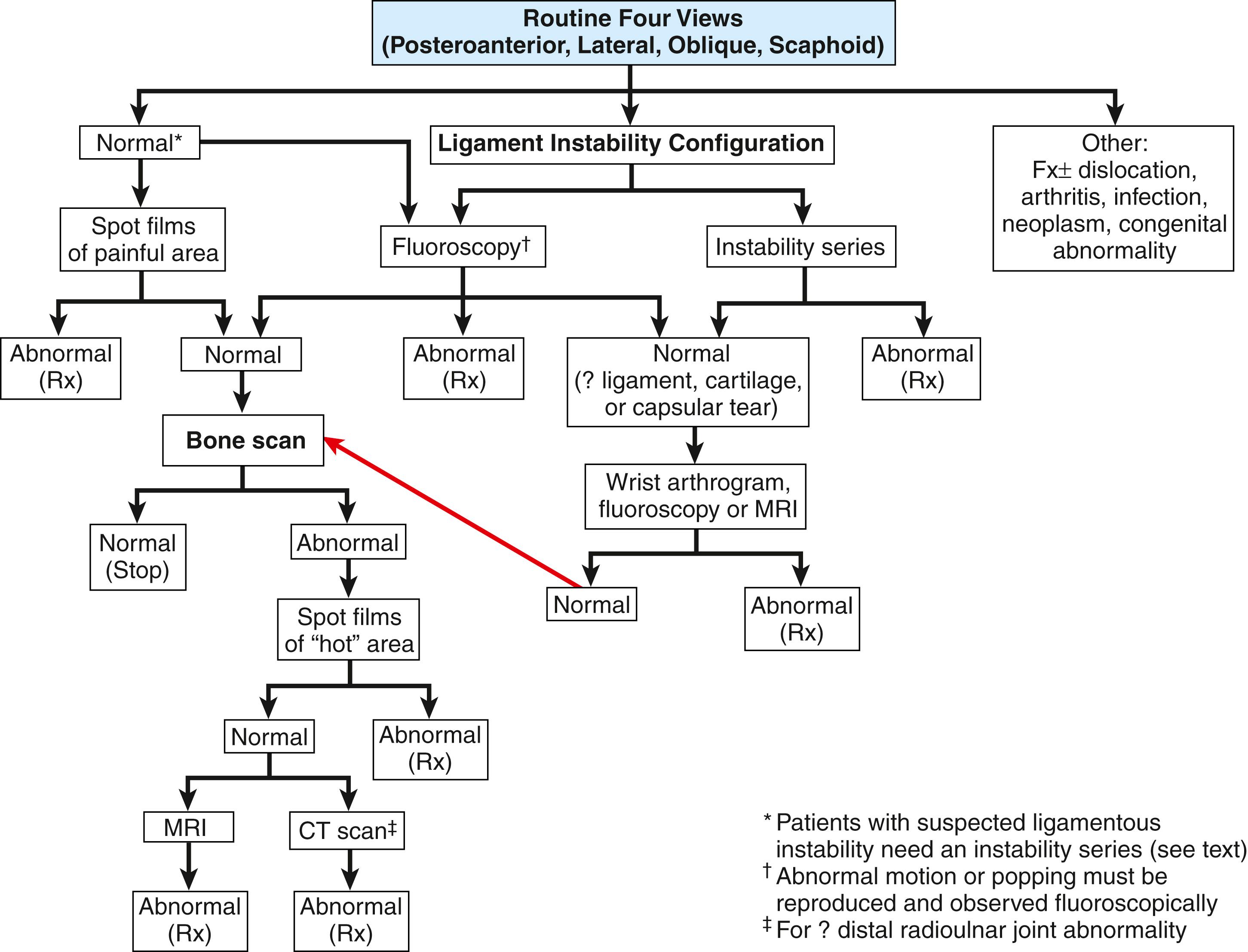
Various radiographic techniques useful in evaluating a painful wrist include the following:
Routine radiographic series consisting of four views
Posteroanterior
Lateral
Oblique
Ulnar-deviated posteroanterior scaphoid view
Spot views of the carpal bones for detail (carpal tunnel view) ( Fig. 69.11 )

Fluoroscopic spot views of the wrist ( Fig. 69.12 )

Series of views for instability
Anteroposterior clenched fist
Posteroanterior in neutral, radial, and ulnar deviation
Lateral in neutral and full flexion and extension
Semipronated oblique 30 degrees from the postero-anterior
Semisupinated oblique 30 degrees from the lateral
Diagnostic ultrasound
Cine or video fluoroscopy
Bone scanning
Arthrography of the wrist (triple injection when indicated) ( Fig. 69.13 )

CT
MRI
Other radiographic techniques relevant to specific problems are discussed later.
Other clinical methods for determining the specific anatomic location of a problem include (1) differential local anesthetic injection, (2) wrist arthroscopy, and (3) various other operative procedures. If the specific structure causing the pain cannot be precisely identified (e.g., extensor carpi ulnaris versus underlying ulnocarpal joint), it is sometimes useful to inject a small amount (<3 mL) of local anesthetic into the most likely site. This helps in the localization of the pain. Sterile technique is used, and the patient is always advised of the benefits and risks.
From a mostly diagnostic tool, wrist arthroscopy has developed into an effective therapeutic tool, useful for the treatment of a variety of wrist disorders from arthritis to acute fractures. It has produced new arthroscopic classifications of disorders such as Kienböck disease, TFCC injuries, and interosseous ligament tears that can help guide treatment. Arthroscopic assessment of intercarpal ligament injuries and instability is considered by many the “gold standard” for evaluation of these conditions, as well as for examination of patients who have wrist pain of unknown origin.
Indications for wrist arthroscopy include the evaluation of ligamentous injuries, examination of joint articular surfaces, removal of loose bodies, biopsy of synovium, irrigation and debridement of joints, and confirmation and supplementation of wrist arthrography. Arthroscopy has been found to be more accurate than arthrography in identifying the location and size of triangular fibrocartilage and interosseous ligament injuries and more accurate than triple-injection cinearthrography in detecting tears of the scapholunate and lunotriquetral ligaments and the triangular fibrocartilage.
Wrist arthroscopy has been found to be useful in diagnosing and treating wrist cartilage lesions, synovitis, TFCC disorders, and scapholunate and lunotriquetral ligament injuries. Debridement of osteochondritic lesions; reduction and fixation of carpal fractures, distal radial intraarticular fractures, and perilunate injuries; distal ulnar resection; and dorsal ganglion excision can be added to the growing list of indications for wrist arthroscopy ( Box 69.1 ).
Repair
Debridement
Debridement of scapholunate interosseous ligament/lunotriquetral interosseous ligament
Scapholunate/lunotriquetral percutaneous pinning
Distal radial fractures
Scaphoid fractures
Dorsal ganglion excision
Radial styloidectomy
Excision of distal ulna
Partial resection (wafer procedure)
Proximal row carpectomy
Excision of proximal pole of scaphoid
Lunate excision for Kienböck disease
Loose body removal
Synovectomy
Intraarticular adhesion release
Lavage of septic wrist
Complication rates for wrist arthroscopy vary from 1.2% to 5.2%. A systematic analysis of the literature identified a 4.7% complication rate in 895 procedures reported in 11 studies. Complications of wrist arthroscopy can be divided into four categories:
Complications related to traction and arm position—skin injury, joint stiffness, and peripheral nerve injury
Portal and instrument insertion complications—injury to cutaneous nerves, vascular structures, flexor and extensor tendons, ligaments, and articular cartilage
Procedure-related complications—forearm compartment syndrome caused by fluid extravasation during fracture treatment, injury of the dorsal sensory branch of the ulnar nerve during arthroscopic repair of the triangular fibrocartilage, and injury to sensory nerves during insertion of Kirschner wires
General arthroscopic complications (equipment failure and infection)
A knowledge of wrist anatomy, the use of correct technique, and an understanding of the equipment and its use may help to avoid significant complications. This section covers the basics of diagnostic wrist arthroscopy. The use of arthroscopy in the treatment of various wrist conditions is included in the discussions of specific conditions.
Equipment for wrist arthroscopy includes the following:
Arthroscope
Diameter: 2.5 to 3 mm best for routine use; 1.7 to 4 mm optional
Length: 50 to 60 mm
Lens-offset angle: 30 to 70 degrees
Effective light source
High-definition (HD) video camera system/imaging console
Liquid crystal display (LCD) or light-emitting diode (LED) video monitor
Image capture system/digital video recorder
Irrigation system: gravity feed usually satisfactory; pumps (mechanical and manual) allow better irrigation and use of suction and cutting tools
18-gauge needles
Sterile tubing
Limb-positioning attachments
Ceiling hook or overhead pole and pulley
Robotic devices, convenient and easily adjustable (traction “tower”)
Fingertraps
Forearm and wrist stabilizers
Traction weights: 4 to 7 lb
Scalpel blades
Arthroscopy instruments
Radiofrequency probes
Basket forceps: 2 to 3 mm in diameter, 40 to 60 mm long
Cutting tools
Four-jaw, shallow probe: 40 mm long, 1.5 to 2.0 mm in diameter
Grasping forceps with thin jaws: straight and curved
Resector: full radius and 2 to 3 mm in diameter usually best
Power source
Wrist arthroscopy can be done with the patient under regional block anesthesia or general anesthesia. If multiple procedures are to be done, or if the patient is uncomfortable, a general anesthetic usually is best. The use of a pneumatic arm tourniquet is optional but may be helpful when treating an intraarticular fracture. With the patient supine and the shoulder abducted on a hand table, arthroscopy can be done with the elbow flexed and the hand pointing toward the ceiling. Extension of the elbow (horizontal position) to allow pronation of the forearm may facilitate the treatment of intraarticular fractures.
With the patient under a suitable anesthetic, suspend the hand from the traction beam with sterile fingertraps and rope through an overhead pulley to use traction to move weight out and away from the operative field ( Fig. 69.14 ). An arthroscopy tower can be used in the place of overhead traction. Include the thumb, index, and long fingers in the fingertraps.

Maintain the elbow in 80 to 90 degrees of flexion. Flex the wrist about 20 degrees.
If a tourniquet is to be used, exsanguinate the limb and inflate the tourniquet.
Stabilize the forearm by securing it to a mechanical well-padded forearm clamp.
Apply 4 to 10 lb of traction weight through the fingertraps for distraction of the wrist.
The usual arthroscopic portals are located between the extensor compartments of the wrist ( Fig. 69.15 ). The portals are numbered according to the compartments on either side of the portal ( Fig. 69.16 ). There are 11 dorsal portals, 9 for radiocarpal and intercarpal access and 2 for the DRUJ. An additional volar portal can be made lateral to the flexor carpi radialis tendon at the proximal wrist flexion crease. Slutsky described success using a volar ulnar approach between the flexor tendons and the ulnar neurovascular bundle and flexor carpi ulnaris. Portals most often used for evaluation of the radiocarpal and ulnocarpal joints are portal 3-4 (between the third and fourth extensor dorsal compartments) and portal 4-5 (between the fourth and fifth compartments). The midcarpal joint radial portal lies to the radial side of the third metacarpal axis proximal to the capitate in a soft depression between the capitate and scaphoid. It is in line with Lister tubercle ( Fig. 69.17 ) at the scaphocapitate and scapholunate joint. The midcarpal ulnar portal is about 1 cm distal to the 4-5 portal, aligned with the fourth metacarpal, at the lunotriquetral-capitate-hamate joint. A portal between the fifth and sixth compartments, the 6R portal, is located on the dorsoradial aspect of the extensor carpi ulnaris tendon. The 6U portal is located to the ulnar side of the extensor carpi ulnaris tendon. The triangular fibrocartilage and the ulnolunate, ulnotriquetral, and lunotriquetral ligaments can be seen from the 6R portal. The scapholunate interosseous ligament, a potential origin for a dorsal ganglion, also can be seen from this portal.


In addition to the frequently used 3-4 and 6 portals, other portals allow inspection of other parts of the wrist. Portal 4-5 permits better inspection of the TFCC and the ulnocarpal ligament on the palmar side. Portal 2-3 allows inspection of the radial palmar ligaments. A probe placed through portal 1 can help to evaluate the articular surface of the distal radius. Use of needles, such as 20-gauge and 22-gauge hypodermic needles, in the various portals before placement of the probe or other instruments helps determine which portal would work best. Portals for the DRUJ are located just proximal and distal to the ulnar head. The posterior interosseous nerve is at risk when the proximal portal is used, whereas the triangular fibrocartilage may be injured by instruments entering the distal portal. The use of a blunt trocar helps avoid injury to the joint surface when inserting the arthroscope sheath.
Although larger arthroscopes provide better fields of vision, they usually are too large and difficult to manipulate. If continuous inflow irrigation is used, an efficient drainage system also must be used to avoid fluid extravasation and complications in the forearm. Pumps with automatic monitoring of pressure and flow also help to avoid such complications. Continuous fluid infusion and positioning the arthroscope with the camera end toward the ceiling helps avoid air bubble accumulation. Dry wrist arthroscopy also is feasible and helps avoid some of the complications associated with fluid extravasation. The use of a probe for triangulation is helpful in examining the ligaments and cartilage surfaces. To see in the joint satisfactorily, joint distraction should be maintained with weight to allow distention with saline and frequent irrigation.
Identify and mark the skin at the sites of the arthroscopic portals to be used. Mark the distal radial joint margin and the location of Lister tubercle ( Fig. 69.18A ).

Distend the radiocarpal joint by locating the portal between the third and fourth extensor compartments just distal to the extensor pollicis longus and Lister tubercle. Insert an 18-gauge needle into this portal, inclining the needle from dorsal-distal to palmar-proximal 12 to 15 degrees to follow the normal distal radial joint palmar tilt ( Fig. 69.18B ). Distend the joint with 5 to 10 mL of normal saline.
Remove the needle, incise the skin over the portal, use a small hemostat to dissect gently down to and through the capsule, insert a cannula and blunt obturator, and establish inflow irrigation through the arthroscope.
As an alternative, a continuous inflow system can be established through the ulnocarpal joint through portal 6 to the ulnar side of the extensor carpi ulnaris. Avoid the dorsal sensory branch of the ulnar nerve.
Outflow can occur through the arthroscope or with gravity drainage through a tube. An irrigation pump that maintains constant pressure and flow may be helpful. Avoid extravasation.
Introduce the arthroscope into the radiocarpal joint at portal 3 through a small skin incision.
Use a small hemostat to dissect bluntly and spread the subcutaneous soft tissues to retract the extensor pollicis longus tendon to the radial side.
Use the hemostat or a no. 11 blade to open the dorsal capsule. Avoid tendon injury.
Insert the arthroscope with a proximal palmar inclination to accommodate the palmar tilt of the distal radius.
Incline the arthroscope so that the proximal end is toward the ceiling to help remove air bubbles.
At this point, identify the palmar capsule of the wrist and the distal radial articular concavity.
Insert a probe through portal 4-5 through a skin incision or between the extensor digiti quinti and the extensor carpi ulnaris (6R portal). This portal can be used as an inflow or outflow portal during radiocarpal examination or as a portal for the arthroscope during ulnocarpal examination.
Follow an organized pattern of identifying structures within the wrist. Direct the arthroscope toward the distal end of the radius, follow it along the scaphoid and lunate fossae, and examine them. Move the arthroscope in the radial direction to identify the distal radius and the proximal margin of the scaphoid. Note the scapholunate articulation, which is a small crease between the scaphoid and lunate with intimate blending of the ligament with the articular cartilage.
Extend the wrist to expose the dorsal surfaces of the scaphoid and lunate and flex the wrist to examine the palmar surfaces of these bones. Identify the palmar carpal ligaments ( Fig. 69.19 ).

The radioscapholunate and radiotriquetral ligaments can be identified, as can the radiocapitate ligament ( Fig. 69.20 ). Use a probe to stress the ligaments and evaluate their integrity.

Move the arthroscope to the 4-5 or 6R portal and exchange the inflow or outflow cannula to the 3-4 portal for examination of the ulnar aspect of the joint and the TFCC.
With a probe, palpate the TFCC to determine its integrity, especially its attachment to the ulnar margin of the radius.
Moving toward the ulnar side of the wrist, identify the ulnocarpal ligaments and the proximal articular surface of the triquetrum.
Insert a probe in portal 4 or 5 to evaluate the palmar carpal ligaments and the scapholunate and lunotriquetral interosseous ligaments. It may be necessary to move the probe into a more radial portal to examine the TFCC.
The portal for entry into the radial side of the midcarpal joint is located about 1 cm distal to the 3-4 portal for radiocarpal examination. It is located to the radial side of the third metacarpal and proximal to the soft area between the scaphoid and capitate.
Insert an 18-gauge needle into this portal and distend the joint with 5 to 7 mL of saline, incise the skin over this area, dissect bluntly to the capsule, and insert a cannula and obturator, permitting inflow through the arthroscope.
The ulnar midcarpal portal is located in the center of the axis of the fourth metacarpal and proximal to the capitohamate joint. Enter this joint with an 18-gauge needle, distend the joint, and verify the position of the needle by direct vision of the needle with the arthroscope remaining in the radial midcarpal portal to the radial side of the extensor tendons.
The scaphocapitate and capitohamate joints can be examined through these portals. The scaphotrapezial-trapezoid joint also can be examined through the midcarpal radial portal.
Place the arthroscope through a skin incision into this portal to view the capitate distally and the scaphoid proximally.
Moving the arthroscope toward the radial side along the scaphocapitate joint, examine the scaphotrapezial-trapezoid joint.
Moving in an ulnar direction along the scaphocapitate joint, examine the scapholunate, lunotriquetral, and capitohamate joints. Traction and manipulation of the wrist allow better inspection of these joints.
After the examination and operative procedures have been completed, determine that no loose objects are left within the joint and remove the arthroscope, instruments, and drainage tubing.
Remove the tourniquet, obtain hemostasis, and close the portal incisions with staples or skin sutures. Infiltration of the joint with a local anesthetic agent helps minimize postoperative pain. Apply a bulky hand dressing with a splint.
Distend the DRUJ by inserting an 18- or 20-gauge needle into the joint just lateral and dorsal to the ulnar head and inject a small amount of normal saline. The joint is best located by palpation of the distal radioulnar area with the forearm supinated.
Proximal and distal radioulnar portals have been described by Whipple. The proximal portal is safer because it presents less risk to the articular cartilage of the ulnar head and to the triangular fibrocartilage.
To establish the proximal portal, incise the dorsal skin just proximal to the dorsal prominence of the ulnar head, centered between the distal ulna and the medial (ulnar) side of the radius.
Bluntly dissect with a hemostat to avoid injury to the extensor carpi ulnaris tendon and the dorsal sensory branch of the ulnar nerve.
Enter the joint with the hemostat.
Pass the arthroscopic cannula with a blunt obturator from proximal to distal.
Remove the obturator and insert the arthroscope to determine entry into the joint.
Establish a working portal 5 to 10 mm distal to the proximal radioulnar portal by making a small skin incision and bluntly dissecting to pass an 18-gauge needle. Use the arthroscope to ensure that the needle is in the joint. This portal can be used as needed for the insertion of instruments such as forceps and shavers.
To establish the DRUJ portal, make an incision over the fifth and sixth extensor compartments, dissecting to enter the joint just proximal to the triangular fibrocartilage, between the fibrocartilage and the ulnar head. As noted previously, the proximal portal allows safer inspection of the lesser sigmoid notch, the ulnar head, and the proximal surface of the triangular fibrocartilage.
After thorough arthroscopic examination, remove the arthroscope, instruments, and cannulas.
Suture the wounds and apply a compressing bandage and supporting splint.
Depending on the nature of the procedure, the splint is removed and mobilization is begun in the first 7 to 10 days after arthroscopy. After fracture reduction and ligament repairs, immobilization and rehabilitation may be prolonged.
Arthroscopic procedures for specific conditions are described in the sections discussing those conditions.
The diagnosis of fractures and dislocations of the carpal bones can be difficult for several reasons. The outlines of the eight bones are superimposed in most radiographic views. Even in the anteroposterior view, at least one bone overlies another. All views must be interpreted with an understanding of the normal bone contours, the relationships between the bones, and the changing relationships during the various arcs of wrist motion.
Because of the difficulty in recognizing fractures in acute injuries, fractures in this region may not be seen at initial examination. Articular damage and ligament injuries are even more difficult to evaluate. The latter may permit abnormal rotations and subluxations of the various bones. Special radiographic techniques are helpful. Scaphoid fracture displacement may be more readily detected and distinct with three-dimensional CT than with plain CT. Even though special techniques are used, establishing a precise diagnosis can be difficult. Often prognosis is uncertain because of the peculiarities of the blood supply of these bones, especially of the scaphoid and lunate. Compared with plain radiographs, CT scans, and the surgeon’s operative impression in the assessment of scaphoid nonunions, MRI was more accurate than the other techniques in predicting the vascularity of scaphoid nonunions.
Fracture of the carpal scaphoid bone is the most common fracture of the carpus, and frequently diagnosis is delayed. A delay in diagnosis and treatment of this fracture may alter the prognosis for union. A wrist sprain that is sufficiently severe to require radiographic examination initially should be treated as a possible fracture of the scaphoid, and radiographs should be repeated in 2 weeks even though initial radiographs may be negative.
This fracture has been reported in individuals ranging from 10 to 70 years old, although it is most common in young men. It is caused by a fall on the outstretched palm, resulting in severe hyperextension and slight radial deviation of the wrist. The scaphoid usually fractures in tension with the wrist extended, concentrating the load on the radial-palmar side. The proximal pole locks in the scaphoid fossa of the radius, and the distal pole moves excessively dorsal ( Fig. 69.21 ). Of scaphoid fractures, 60% to 80% occur at the scaphoid waist or midportion. Seventeen percent of patients have other fractures of the carpus and forearm, including transscaphoid perilunar dislocations, fractures of the trapezium, Bennett fractures, fractures of the radial head, dislocations of the lunate, and fractures at the distal end of the radius. When other injuries of carpal bones require open reduction, the fractured scaphoid also should be reduced accurately.

The unique anatomy of the scaphoid predisposes fracture of this carpal bone to delayed union or nonunion and to disability of the wrist. Because it articulates with the distal radius and with four of the remaining seven carpal bones, the scaphoid moves with nearly all carpal motions, especially volar flexion. Any alteration of its articular surface through fracture, dislocation, or subluxation or any alteration of its stability by ligamentous rupture can cause severe secondary changes throughout the entire carpus.
The blood supply of the scaphoid is precarious. Only 67% of scaphoid bones have arterial foramina throughout their length, including the distal, middle, and proximal thirds. Of the remaining bones, 13% have blood supply predominantly in the distal third and 20% have most of the arterial foramina in the waist area of the bone with no more than a single foramen near the proximal third. One third of scaphoid fractures occurring in the proximal third may be without adequate blood supply. This seems to be borne out clinically; the prevalence of osteonecrosis can be 35% in fractures at this level. Fractures in the proximal pole can be expected to take longer to heal and usually have higher rates of nonunion.
Vessels enter the scaphoid from the radial artery laterovolarly, dorsally, and distally. The laterovolar and dorsal systems share in the blood supply to the proximal two thirds of the scaphoid. Vascularity of the proximal pole and 70% to 80% of the interosseous circulation are provided through branches of the radial artery, entering through the dorsal ridge. In the distal tuberosity region, 20% to 30% of the bone receives its blood supply from volar branches of the radial artery.
Treatment of scaphoid fractures is determined by displacement and stability of the fracture. Scaphoid fractures are generally classified as either undisplaced and stable or displaced and unstable ( Fig. 69.22 ). Although this classification remains useful, fractures of the tuberosity, the distal articular surface, and the proximal pole may require special management decisions. For nondisplaced fractures, radiographic diagnosis can be difficult initially. A posteroanterior plain radiograph with the wrist slightly extended in ulnar deviation is helpful. Although repeating radiographs after 2 weeks of immobilization in a cast is a time-honored method for evaluation of a suspected nondisplaced scaphoid fracture, technetium bone scan, MRI, and CT (in the longitudinal axis of the scaphoid with 1 mm cuts as described by Sanders) provide diagnostic information sooner. Although bone scan has been considered the most sensitive study, Gaebler et al. reported 100% sensitivity and specificity using MRI to diagnose “occult” scaphoid fractures at an average of 2.8 days after injury ( Fig. 69.23A ). MRI, especially with gadolinium enhancement, also is useful in assessing the vascularity of a fractured scaphoid ( Fig. 69.23B ). Some reports have suggested that an MRI or CT scan should be obtained early so that patient downtime is decreased and productivity is increased.


Nonoperative treatment usually is successful for acute nondisplaced, stable fractures through the scaphoid waist and in the distal pole without other bony or ligamentous injury and for scaphoid fractures in children. The prognosis is better if the fracture is diagnosed early. Controversies continue regarding the position of the wrist, the proximal and distal length of the cast, and elbow and thumb immobilization. There are clinical and experimental data to support most aspects of the controversies. Although some studies have found the incidence of nonunion to be no greater in patients treated by a removable short arm thumb spica cast than in patients treated by a long arm thumb spica cast, others have found that the time to union was earlier in patients treated initially for 6 weeks in a long arm thumb spica cast. A meta-analysis of randomized controlled trials of nonoperative treatment that involved below-elbow and above-elbow casting, casting with or without the thumb included, and casting with the wrist in 20 degrees of flexion to 20 degrees of extension found no significant differences in union rate, pain, grip strength, time to union, or osteonecrosis for the various nonoperative treatment methods. In an experimental scaphoid fracture model, displacement of more than 3 mm occurred between fracture fragments during pronation and supination with the forearm in a short arm thumb spica cast.
We use a forearm cast from just below the elbow proximally to the base of the thumbnail and the proximal palmar crease distally (thumb spica) with the wrist in slight radial deviation and in neutral flexion. The thumb is maintained in a functional position, and the fingers are free to move from the metacarpophalangeal joints distally. Using nonoperative casting techniques, the expected rate of union is 90% to 95% within 10 to 12 weeks. During this time, the fracture is observed radiographically for healing. If collapse or angulation of the fractured fragments occurs, surgical treatment usually is required.
Fractures at and distal to the scaphoid waist are expected to heal sooner than fractures in the proximal pole. If the diagnosis is delayed, or the fracture is in the proximal third, the prognosis is less favorable, and an initial long arm thumb spica cast for 6 weeks may be justified. If the diagnosis of a nondisplaced fracture of the scaphoid has been delayed for several weeks, treatment usually begins with cast immobilization. Mack et al., reviewing scaphoid fractures diagnosed 1 to 6 months after injury, found that stable middle-third scaphoid fractures healed with cast immobilization but required an average of 19 weeks to heal, compared with a similar group of acute fractures that healed in an average of 10 weeks. As is reflected in the subsequent discussion of surgical treatment, there is a well-established trend toward earlier operative fixation of nondisplaced fractures. Surgery may be considered if new healing activity is not evident and if union is not apparent after a trial of cast immobilization for about 20 weeks.
Because of the potential for joint stiffness, muscle atrophy, or the inability to use the hand during and after prolonged immobilization, special nonoperative or operative treatment may be considered in certain patients (e.g., young laborers or athletes). Operative techniques, including percutaneous fixation with cannulated screws, are used with increasing frequency. Prospective, randomized studies comparing percutaneous screw fixation with cast immobilization showed that patients in the screw fixation groups were able to regain movement and return to most activities earlier than patients in the casted groups. No harmful effects on fracture healing were seen. In a prospective randomized study of nondisplaced scaphoid waist fractures, there were no nonunions in the 44 patients treated with Herbert screw fixation without postoperative immobilization, but 10 nonunions were present at 12 weeks in the 44 treated with cast immobilization. Several studies have reported healing of all fractures treated with “limited access,” percutaneous, and arthroscopic percutaneous fixation. Advantages of this technique, according to its proponents, include less risk to neurovascular structures and intercarpal ligaments, earlier bone healing, and earlier return to activities. Patients considering such treatment should understand that acute, nondisplaced scaphoid fractures have a high probability of healing with cast treatment and that complex and demanding surgical procedures may have complications.
For some athletes, the use of padded casts during competition may be considered. The advantages and disadvantages of various treatment modifications should be considered in each patient.
A different course of treatment is required for a displaced, unstable fracture in which the fragments are offset more than 1 mm in the anteroposterior or oblique view, or lunocapitate angulation is greater than 15 degrees, or the scapholunate angulation is greater than 45 degrees in the lateral view (range 30 to 60 degrees). Other criteria for evaluating displacement include a lateral intrascaphoid angle greater than 45 degrees, an anteroposterior intrascaphoid angle less than 35 degrees (Amadio et al.), and a height-to-length ratio of 0.65 or greater (Bain et al.). Because the range of lunocapitate and scapholunate angulation can vary, comparison views of the opposite wrist can be helpful. Reduction can be attempted initially by longitudinal traction and percutaneous joystick Kirschner wires. If the reduction attempt is successful, percutaneous fixation with a cannulated screw or pins and application of a thumb spica cast may suffice. Otherwise, open reduction and internal fixation may be required.
For a displaced or unstable recent fracture of the scaphoid, the best method of fixation depends on the surgeon’s experience and the equipment available. In some fractures, adequate internal fixation can be obtained with Kirschner wires. The AO cannulated screw, the Herbert differential pitch bone screw, and other more recently designed headless screws have been used to advantage in displaced and unstable scaphoid fractures. According to a cadaver comparison study, the AO screw, the Acutrak screw, and the Herbert-Whipple screw showed better resistance to cyclical bending load than the noncannulated Herbert screw. In a comparison study of patients with scaphoid fractures, one treated with AO cannulated screws and the other with Herbert-Whipple cannulated screws, the union rate was 100% in both groups. Cannulated bone screws are useful because the screw can be placed accurately over a guide pin with video fluoroscopic control. Cited advantages of screw fixation are that it (1) reduces the time of external immobilization, (2) provides relatively strong internal fixation, and (3) produces compression at the fracture site. In addition, because the headless screw remains below the bone surface, removal is usually unnecessary. These screws can be used with a bone graft to correct scaphoid angulation.
Regardless of the fixation device used, preoperative review and practice of the details of the procedure for the planned fixation are necessary. Careful intraoperative attention to the details of the procedure, the achievement of as near an anatomic reduction as possible, and precise placement of the fixation device are of utmost importance.
With the patient supine and under preferably regional anesthesia, prepare the hand and wrist and inflate a pneumatic tourniquet.
The volar approach usually gives the best exposure for scaphoid fractures at and distal to the waist. Make a longitudinal skin incision over the palmar surface of the wrist, beginning 3 to 4 cm proximal to the wrist flexion crease over the flexor carpi radialis.
Extend the incision distally to the wrist flexion crease and angle it radially toward the scaphotrapezial and trapeziometacarpal joints in a hockey-stick configuration.
Protect terminal branches of the palmar cutaneous branch of the median nerve and the superficial radial nerves.
Reflect skin flaps at the level of the forearm fascia.
Open the sheath of the flexor carpi radialis, retract the tendon ulnarly, and open the deep surface of its sheath.
Expose the palmar capsule of the joint over the radioscaphoid joint.
Extend the wrist in ulnar deviation and open the capsule in the longitudinal axis of the scaphoid bone, obliquely extending the incision toward the scaphotrapezial joint.
With sharp dissection, expose the fracture, incise the long radiolunate and radioscaphocapitate ligaments, preserving each leaf of these capsuloligamentous structures for later repair. Inspect the fracture to determine the need for bone grafting.
If comminution is absent or minimal, reduction and fixation suffice. If comminution is extensive, especially on the palmar surface, with a tendency to flexion of the scaphoid at the fracture, obtain an iliac crest bone graft. (See Techniques 69.14 through 69.17 and Fig. 69.40 .)

Kirschner wires placed in the distal and proximal poles as toggle levers (“joysticks”) help to manipulate the fragments.
Reduce the fracture and fix it with Kirschner wires or a screw technique (e.g., cannulated screws), avoiding rotation or angulation. If a cannulated device is used, ensure that the guidewire is centered in the proximal and distal poles. Image intensification with C-arm fluoroscopy is helpful for this step.
For fractures through the waist and in the distal pole, insert the fixation device through a distal entry point. Create the distal entry point by opening the scaphotrapezial joint with a longitudinal capsular incision.
Remove a portion of the trapezium with a rongeur to allow placement of the guidewire from distal to proximal to better place the wire in a more center-center position.
Insert the screw until the trailing end (head) is flush with subchondral bone, countersunk beneath the articular cartilage.
Placement of Kirschner wires down the long axis of the scaphoid is made easier by gentle radial deviation of the wrist, aligning the scaphoid vertically and placing a towel bump at the dorsal wrist flexion crease. Fingertrap traction on the thumb and index finger also can be helpful. With the wrist in this position, direct the wires almost dorsally into the scaphoid.
After stable reduction and fixation are obtained, check the position and alignment of the reduction and the placement of the internal fixation with image intensification or radiographs.
Deflate the tourniquet and obtain hemostasis.
Close the wrist capsule with nonabsorbable sutures or long-lasting absorbable sutures.
Close the skin and apply a dressing that includes either a thumb spica splint or thumb spica cast.
For noncomminuted fractures in the proximal pole of the scaphoid, exposure of the fracture site and placement of internal fixation can be done through a dorsal approach.
Make a dorsal transverse incision 5 to 10 mm distal to the radiocarpal joint; localization with an image intensifier often is useful ( Fig. 69.24 ). Protect the sensory branches of the radial and ulnar nerves. Preserve, cauterize, or ligate and divide dorsal veins.

Extend the skin incision from the radial styloid to the ulnar styloid.
Make parallel incisions in the extensor retinaculum on each side of the extensor digitorum communis tendons. Protect the extensor tendons, especially the extensor pollicis longus tendon as it exits the third dorsal retinacula compartment. Connect the parallel incisions proximally to create a flap to allow access to the dorsal wrist capsule.
Pass a loop of Penrose drain around the extensor tendons, and retract them ulnarly.
Open the dorsal capsule by creating a radially based flap, incising along the dorsal intercarpal ligament and the dorsal radiotriquetral ligament.
Retract the capsular flap radially and expose the fracture.
Insert a Kirschner wire into the proximal fragment parallel to the central axis of the scaphoid. Use this wire as a toggle lever (“joystick”) to manipulate the proximal fragment into a reduced position.
When the fracture is reduced, pass the first wire across the fracture for temporary interfragmentary fixation. Insert an additional Kirschner wire, or screw fixation, as the fracture configuration permits.
If a cannulated screw is used, center the guidewire in the proximal and distal poles, monitoring this placement with C-arm fluoroscopy.
Determine the appropriate length of the screw to be used. Drill and tap the bone, according to the device being used, and insert the screw of appropriate length (often subtracting 4 mm from the initial length measured). Ensure that the guidewire or screw fixation is placed in the center of the long axis of the proximal and distal poles of the scaphoid, using C-arm fluoroscopy. Either leave the initial Kirschner wire as supplemental fixation, or remove it if screw fixation has been selected.
Close the capsular flap and repair the retinacula flap.
Close the skin and apply a thumb spica cast or splint.
See also .
The sutures are removed, and the splint or cast is changed at 2 weeks. Some authors advocate transitioning directly to a removable splint once sutures are removed, whereas others recommend an additional 2 to 4 weeks of short arm thumb spica cast immobilization. As healing progresses as shown by radiographic examination, a short arm thumb spica brace is worn until bone healing is ensured. If healing cannot be determined with certainty, CT oriented in the longitudinal axis of the scaphoid with 1-mm cuts can be helpful to evaluate for bridging trabeculae. Finger, thumb, and shoulder motion is encouraged throughout convalescence, and, after cast removal, wrist motion and elbow motion are increased gradually, followed by strengthening exercises.
Make a straight incision in the distal forearm between the distal portion of the flexor carpi radialis and the radial artery. Carry the incision across the distal wrist crease using a hockey-stick incision that angles toward the base of the thumb ( Fig. 69.25A ).

Open the flexor carpi radialis tendon sheath and subsheath and retract it ulnarly, developing the interval between the flexor carpi radialis ulnarly and the radial artery radially.
Enter the wrist capsule through a longitudinal incision from the volar lip of the radius to the proximal tubercle of the trapezium ( Fig. 69.25B ). Carefully divide the capsule and intracapsular ligament and reflect them sharply off the scaphoid with a scalpel. Take care to preserve the capsule because it contains the radioscaphoid capitate ligament and will be repaired at the end of the procedure.
Expose the entire volar scaphoid. Reduce the fracture with manipulation or joysticks and insert Kirschner wires for provisional fixation.
If bone grafting is required for volar comminution or a subacute fracture, harvest grafts from the volar radius beneath the pronator quadratus by extending the incision an additional 2 to 3 cm proximally or make a separate incision dorsally and just proximal to Lister’s tubercle where cancellous autograft can be obtained through a cortical window.
Open the scaphotrapezial joint and place a central guidewire in preparation for final fixation ( Fig. 69.25C ). If necessary, excise a small amount of the proximal trapezium with a rongeur to clear an unobstructed path for the implant.
Obtain rigid internal fixation with the implant of choice (see Technique 69.6).
Postoperative care is as described for Technique 69.6.
(SLADE ET AL.)
Slade et al. recommended the following equipment for this technique: (1) headless cannulated compression screw (standard Acutrak screw), (2) minifluoroscopy unit, (3) Kirschner wires, and (4) equipment for small joint arthroscopy.
If arthroscopy is to be used to check the fracture reduction and to place internal fixation, have the operating room prepared for wrist arthroscopy.
Position the patient supine, with the upper extremity extended.
After the induction of appropriate anesthesia and sterile preparation and draping procedures, flex the elbow 90 degrees.
Use a C-arm fluoroscopic unit or mini C-arm fluoroscope to evaluate the fracture position and alignment and to determine if there are other bone or ligament injuries.
Use a skin marking pen to indicate the best surface location for a dorsal skin incision and entry of the guidewire, drills, and screw.
“Target” the scaphoid by locating the central axis of the scaphoid on the posteroanterior view of the reduced scaphoid ( Fig. 69.26A ).
![FIGURE 69.26, Percutaneous fixation of scaphoid fracture. A, Central axis of scaphoid is located on posteroanterior view. B, Wrist is pronated until scaphoid poles are aligned. C, Wrist is flexed until scaphoid has “ring” appearance on fluoroscopy. (From Slade JF III, Gutow AP, Geissler WB: Percutaneous internal fixation of scaphoid fractures via an arthroscopically assisted dorsal approach, J Bone Joint Surg 84A[Suppl 2]:21, 2002.) SEE TECHNIQUE 69.8 .](https://storage.googleapis.com/dl.dentistrykey.com/clinical/WristDisorders/26_3s20B9780323672177000699.jpg "FIGURE 69.26, Percutaneous fixation of scaphoid fracture. A, Central axis of scaphoid is located on posteroanterior view. B, Wrist is pronated until scaphoid poles are aligned. C, Wrist is flexed until scaphoid has “ring” appearance on fluoroscopy. (From Slade JF III, Gutow AP, Geissler WB: Percutaneous internal fixation of scaphoid fractures via an arthroscopically assisted dorsal approach, J Bone Joint Surg 84A[Suppl 2]:21, 2002.) SEE TECHNIQUE 69.8 .")
Gently pronate and flex the wrist until the proximal and distal poles of the scaphoid are aligned and confirmed with fluoroscopy. When the poles are aligned, the scaphoid has a “ring” appearance on the fluoroscopic monitor ( Fig. 69.26B and C ). The center of the “ring” circle is the central axis of the scaphoid, the best location for screw placement ( Fig. 69.27 ).
![FIGURE 69.27, Percutaneous fixation of scaphoid fracture. Guidewire in central axis of scaphoid for placement of screw. (From Slade JF III, Gutow AP, Geissler WB: Percutaneous internal fixation of scaphoid fractures via an arthroscopically assisted dorsal approach, J Bone Joint Surg 84A[Suppl 2]:21, 2002.) SEE TECHNIQUE 69.8 .](https://storage.googleapis.com/dl.dentistrykey.com/clinical/WristDisorders/27_3s20B9780323672177000699.jpg "FIGURE 69.27, Percutaneous fixation of scaphoid fracture. Guidewire in central axis of scaphoid for placement of screw. (From Slade JF III, Gutow AP, Geissler WB: Percutaneous internal fixation of scaphoid fractures via an arthroscopically assisted dorsal approach, J Bone Joint Surg 84A[Suppl 2]:21, 2002.) SEE TECHNIQUE 69.8 .")
For ease of insertion, make a skin incision at the previously marked location to allow blunt dissection to the capsule of the wrist joint.
With a double-point 0.045-inch (1.14-mm) Kirschner wire in a powered wire driver, insert the wire starting in the proximal pole of the scaphoid under fluoroscopic control.
If there is uncertainty about wire placement, make the previously mentioned incision distal and medial (ulnar) to the Lister tubercle, opening the dorsal wrist capsule lateral (radial) to the scapholunate interval, exposing the proximal pole of the scaphoid.
Pass the guidewire from dorsally down the central axis of the scaphoid and out through the trapezium ( Fig. 69.28A,B ). Use a 12-gauge angiocatheter to assist with positioning of the guidewire. Keep the wrist flexed to avoid bending the guidewire.
![FIGURE 69.28, Percutaneous fixation of scaphoid fracture. A and B, Guidewire is placed at base of proximal pole of scaphoid (A) and driven along central axis (B) . C, Wrist is extended, and fracture alignment and guidewire position are confirmed with fluoroscopy. (From Slade JF III, Gutow AP, Geissler WB: Percutaneous internal fixation of scaphoid fractures via an arthroscopically assisted dorsal approach, J Bone Joint Surg 84A[Suppl 2]:21, 2002.) SEE TECHNIQUE 69.8 .](https://storage.googleapis.com/dl.dentistrykey.com/clinical/WristDisorders/28_3s20B9780323672177000699.jpg "FIGURE 69.28, Percutaneous fixation of scaphoid fracture. A and B, Guidewire is placed at base of proximal pole of scaphoid (A) and driven along central axis (B) . C, Wrist is extended, and fracture alignment and guidewire position are confirmed with fluoroscopy. (From Slade JF III, Gutow AP, Geissler WB: Percutaneous internal fixation of scaphoid fractures via an arthroscopically assisted dorsal approach, J Bone Joint Surg 84A[Suppl 2]:21, 2002.) SEE TECHNIQUE 69.8 .")
Advance the wire through the distal pole out the palmar surface. Check the position of the wire with the fluoroscope.
Reverse the wire driver to pull the wire far enough distally to allow the dorsal, trailing end of the wire to clear the radiocarpal joint dorsally and to allow full wrist extension.
With C-arm fluoroscopy, confirm scaphoid fracture alignment and correct positioning of the guidewire ( Fig. 69.28C ).
If a correct path cannot be created with the 0.045-inch wire, use a 0.062-inch (1.57-mm) wire to create the correct path. Exchange the larger wire for the 0.045-inch wire before drilling the scaphoid.
Check for wire position and fracture alignment with the fluoroscope. If the fracture reduction is unsatisfactory, and for displaced fractures, place a 0.062-inch Kirschner wire into each fracture fragment, perpendicular to the axis of the scaphoid, as toggle levers (“joysticks”) to manipulate the fracture fragments ( Fig. 69.29 ). If needed, place the proximal lever wire in the lunate.
![FIGURE 69.29, Percutaneous fixation of scaphoid fracture. Fracture reduction with two 0.062-inch Kirschner wires used as “joysticks” to manipulate fracture fragments. (From Slade JF III, Gutow AP, Geissler WB: Percutaneous internal fixation of scaphoid fractures via an arthroscopically assisted dorsal approach, J Bone Joint Surg 84A[Suppl 2]:21, 2002.) SEE TECHNIQUE 69.8 .](https://storage.googleapis.com/dl.dentistrykey.com/clinical/WristDisorders/29_3s20B9780323672177000699.jpg "FIGURE 69.29, Percutaneous fixation of scaphoid fracture. Fracture reduction with two 0.062-inch Kirschner wires used as “joysticks” to manipulate fracture fragments. (From Slade JF III, Gutow AP, Geissler WB: Percutaneous internal fixation of scaphoid fractures via an arthroscopically assisted dorsal approach, J Bone Joint Surg 84A[Suppl 2]:21, 2002.) SEE TECHNIQUE 69.8 .")
With the wire driver on the distal end of the guidewire, withdraw the wire distally across the fracture site, leaving the wire in the central axis of the distal fragment.
Align the fracture fragments with the “joysticks.”
Pass the guidewire from distal to proximal across the fracture site to hold the reduction.
If needed for stability and rotational control, insert another 0.045-inch wire, entering the proximal pole of the scaphoid, from dorsal to palmar, parallel to the first guidewire to control rotation. Leave the wire levers and the antirotational wire in place during screw insertion.
Confirm the reduction and wire placement with fluoroscopy.
If the fracture is difficult to reduce, percutaneously insert a small curved hemostat to assist with the reduction.
If the fracture cannot be reduced, or if the guidewire cannot be properly placed, abandon the percutaneous technique and open the fracture, using either the volar or the dorsal approach (see Techniques 69.5 and 69.6).
Determine the scaphoid length using two wires. To determine the scaphoid length, adjust the guidewire position so that the distal end is against the distal cortex of the scaphoid. Place a second wire of the same length as the guidewire parallel to the guidewire so the tip of the second wire is against the cortex of the proximal scaphoid pole. The difference in length is the length of the scaphoid ( Fig. 69.30 ).
![FIGURE 69.30, Percutaneous fixation of scaphoid fracture. Scaphoid length is determined. (From Slade JF III, Gutow AP, Geissler WB: Percutaneous internal fixation of scaphoid fractures via an arthroscopically assisted dorsal approach, J Bone Joint Surg 84A[Suppl 2]:21, 2002.) SEE TECHNIQUE 69.8 .](https://storage.googleapis.com/dl.dentistrykey.com/clinical/WristDisorders/30_3s20B9780323672177000699.jpg "FIGURE 69.30, Percutaneous fixation of scaphoid fracture. Scaphoid length is determined. (From Slade JF III, Gutow AP, Geissler WB: Percutaneous internal fixation of scaphoid fractures via an arthroscopically assisted dorsal approach, J Bone Joint Surg 84A[Suppl 2]:21, 2002.) SEE TECHNIQUE 69.8 .")
To allow for countersinking the screw fully within the scaphoid, select a screw length that is 4 mm shorter than the scaphoid length.
Determine dorsal or palmar insertion of the screw depending on the fracture location. For fractures of the proximal pole, insert the screw dorsally. For fractures of the waist, insert the screw from either the dorsal or the volar side. For fractures of the distal pole, insert the screw from the volar side.
Drill the screw channel 2 mm short of the opposite scaphoid cortex, using a cannulated hand drill, always avoiding contact with the opposite cortex ( Fig. 69.31 ).
![FIGURE 69.31, Percutaneous fixation of scaphoid fracture. Screw channel is created with cannulated hand drill and confirmed with fluoroscopy. (From Slade JF III, Gutow AP, Geissler WB: Percutaneous internal fixation of scaphoid fractures via an arthroscopically assisted dorsal approach, J Bone Joint Surg 84A[Suppl 2]:21, 2002.) SEE TECHNIQUE 69.8 .](https://storage.googleapis.com/dl.dentistrykey.com/clinical/WristDisorders/31_3s20B9780323672177000699.jpg "FIGURE 69.31, Percutaneous fixation of scaphoid fracture. Screw channel is created with cannulated hand drill and confirmed with fluoroscopy. (From Slade JF III, Gutow AP, Geissler WB: Percutaneous internal fixation of scaphoid fractures via an arthroscopically assisted dorsal approach, J Bone Joint Surg 84A[Suppl 2]:21, 2002.) SEE TECHNIQUE 69.8 .")
Check the position and depth of the drill with fluoroscopy.
Use a standard Acutrak screw, 4 mm shorter than the scaphoid length. Advance the screw, monitoring with fluoroscopy, until the screw is within 1 to 2 mm of the opposite cortex ( Fig. 69.32A ).
![FIGURE 69.32, Percutaneous fixation of scaphoid fracture. A, Joysticks and antiglide wires are maintained during drilling and dorsal implantation of screw. B and C, Fluoroscopy confirms placement of headless compression screw. (From Slade JF III, Gutow AP, Geissler WB: Percutaneous internal fixation of scaphoid fractures via an arthroscopically assisted dorsal approach, J Bone Joint Surg 84A[Suppl 2]:21, 2002.) SEE TECHNIQUE 69.8 .](https://storage.googleapis.com/dl.dentistrykey.com/clinical/WristDisorders/32_3s20B9780323672177000699.jpg "FIGURE 69.32, Percutaneous fixation of scaphoid fracture. A, Joysticks and antiglide wires are maintained during drilling and dorsal implantation of screw. B and C, Fluoroscopy confirms placement of headless compression screw. (From Slade JF III, Gutow AP, Geissler WB: Percutaneous internal fixation of scaphoid fractures via an arthroscopically assisted dorsal approach, J Bone Joint Surg 84A[Suppl 2]:21, 2002.) SEE TECHNIQUE 69.8 .")
Verify fracture reduction and screw placement with final fluoroscopic images ( Fig. 69.32B and C ).
If ligament injury or other carpal injuries are suspected, add arthroscopic examination to the fracture management.
Apply longitudinal traction through the fingers.
Locate the midcarpal and radiocarpal portals with fluoroscopy.
Insert the arthroscope into the radial midcarpal portal to inspect the fracture reduction.
Remove clot and synovium with the full radius shaver.
Examine the scapholunate and lunotriquetral ligaments.
Inspect the proximal pole through the 3-4 portal to confirm countersinking of the screw into the proximal pole.
If ligament tears are encountered, treat them with debridement, intercarpal pinning, or open dorsal ligament repair.
Apply a postoperative splint, depending on the extent of soft-tissue injury. If no ligament injury is present, apply a thumb spica splint. If there is ligament injury, apply a sugar-tong thumb spica splint of the Munster type, extending above the elbow. For fracture management, remove skin sutures at about 2 weeks and change the splint to a short arm thumb spica cast. Remove any remaining pins at 6 to 8 weeks. Continue with casting or removable thumb spica splinting until radiographic healing has occurred, changing the cast monthly. CT can help in determining if bridging trabeculae are present. After healing has occurred, begin a therapist-supervised rehabilitation program.
Nonunion of scaphoid fractures is influenced by delayed diagnosis, gross displacement, associated injuries of the carpus, and impaired blood supply. Of these fractures, an estimated 40% are undiagnosed at the time of the original injury. Displaced scaphoid fractures have been suggested to have a nonunion rate of 92%. The incidence of osteonecrosis is approximately 30% to 40%, occurring most frequently in fractures of the proximal third.
Cystic changes in the scaphoid and the adjoining bones followed by osteonecrosis can occur after untreated fractures, but this is not an absolute indication for surgery. Nonunion is expected more often if the scaphoid fracture is untreated for 4 or more weeks. Delayed treatment can result in a nonunion rate of 88%.
Treatment options for nonunions of proximal pole fractures depend on the blood supply to the proximal pole and the size of the fragments. Nonunions involving the proximal third or more can be treated with nonvascularized bone grafts if circulation is satisfactory as determined by preoperative gadolinium-enhanced MRI and by intraoperative assessment of bone bleeding. Vascularized bone grafts are indicated when circulation to the proximal pole is poor. For very small, avascular, ununited fragments, the proximal pole can be excised if the scapholunate ligament integrity is still intact.
Electrical and ultrasound stimulation methods have been found to be of variable effectiveness for the treatment of scaphoid nonunions. Reports suggest that bone grafting should be considered a better option than pulsed electromagnetic field treatment of scaphoid nonunions. There is no conclusive information at this time to recommend the use of low-intensity ultrasound for scaphoid nonunions. More information is needed to define further the place of these technologies in the treatment of nonunions and acute fractures.
Many nonunions of the scaphoid have minimal symptoms and can be tolerated well by patients with sedentary occupations. Patients should be informed that some degenerative arthritis of the wrist probably is inevitable, but this can take years to develop, depending on the amount of chronic stress applied and the activity of the wrist. Radiographic findings of arthritis usually seen with scaphoid nonunion include radioscaphoid narrowing, capitolunate narrowing, cyst formation, and pronounced dorsal intercalated segment instability. This is the so-called scaphoid nonunion advanced collapse pattern ( Fig. 69.33 ). The radiolunate joint usually is spared in early stages but may show degenerative changes as the arthritis becomes more diffuse. Jupiter et al. observed that ununited fractures of the scaphoid fall into three groups, depending on the extent of arthrosis: established nonunions without arthrosis, nonunions with radiocarpal arthrosis, and nonunions with advanced radiocarpal and intercarpal arthrosis. Although bone healing is needed for nonunions without arthrosis, additional procedures, including salvage operations, may be required for patients with more extensive arthrosis. Some nondisplaced scaphoid nonunions may heal after rigid internal fixation without bone grafting. Knoll and Trumble proposed a protocol for scaphoid nonunion treatment, including the consideration of osteonecrosis ( Fig. 69.34 ). In old fractures with arthritis, symptoms can be decreased by excision of the radial styloid just proximal to the fracture in middle-third fractures; however, other reconstructive surgery, especially for severe arthritic degeneration, may be indicated, and proximal row carpectomy or arthrodesis of the wrist joint may prove to be more dependable. The following operations can be useful for nonunions of the scaphoid: (1) traditional bone grafting, (2) vascularized bone grafting, (3) excision of the proximal fragment, the distal fragment, and, occasionally, the entire scaphoid, (4) radial styloidectomy, (5) proximal row carpectomy, and (6) partial or total arthrodesis of the wrist.


Preiser disease (osteonecrosis of the scaphoid) usually manifests as wrist pain. Plain radiographs, MRI, and CT may help in assessing the circulation to the scaphoid and the extent of fragmentation. If symptoms and disability are not relieved with nonoperative methods, revascularization techniques similar to those used for Kienböck disease may preserve the scaphoid architecture. If there is significant scaphoid collapse or radioscaphoid arthrosis, scaphoid excision combined with capitate-lunate-triquetrum-hamate fusion or with proximal row carpectomy may be required.
Styloidectomy alone probably is of little value in treating nonunions of the scaphoid. If arthritic changes involve only the scaphoid fossa of the radiocarpal joint, however, styloidectomy is indicated in conjunction with any grafting of the scaphoid or excision of its ulnar fragment.
In older patients in whom radioscaphoid arthritis predominates, and the proximal fragment is not loose, styloidectomy alone can provide pain relief. A study of the amount of styloid to be resected found that ulnar and palmar displacement of the carpus increased significantly with resections of more than 4 mm of the radial styloid. Current recommendations are to resect no more than 4 mm of the styloid to preserve the radioscaphocapitate ligament integrity.
Excising both fragments of the scaphoid as the only procedure is unwise; although the immediate result may be satisfactory, eventual derangement of the wrist is likely. Soto-Hall and Haldeman reported gradual migration of the capitate into the space previously occupied by the scaphoid, although disability was not apparent for 5 to 7 years. If excision of both fragments is considered, it is preferable to add some other procedure to stabilize the capitolunate joint (e.g., capitolunate or capital-lunate-triquetral-hamate fusions).
When indicated, excising the proximal scaphoid fragment usually is satisfactory; the loss of one fourth or less of the scaphoid usually causes minimal impairment of wrist motion. Because postoperative immobilization is brief, function usually returns rapidly. Strength in the wrist usually is decreased to some extent. The following are indications for excising the proximal fragment of a scaphoid nonunion:
The fragment is one fourth or less of the scaphoid. Regardless of its viability, grafting of such a small fragment frequently fails.
The fragment is one fourth or less of the scaphoid and is sclerotic, comminuted, or severely displaced. The comminuted fragments usually should be excised early to prevent arthritic changes; a severely displaced fragment also should be excised early if it cannot be accurately replaced by manipulation. In the past, Silastic implants have been used to act as “space fillers.” Because of the possibility of silicone synovitis, we prefer to leave the space empty or we use a folded or rolled tendon graft to fill the defect.
The fragment is one fourth or less of the scaphoid, and grafting has failed. If a nonviable proximal fragment consists of more than one fourth of the scaphoid, some other treatment is preferable to excision alone.
Arthritic changes are present in the region of the radial styloid. Styloidectomy is indicated in conjunction with excision of the proximal fragment.
At the level of the styloid process of the radius, make a transverse skin incision 5 cm long on the dorsoradial aspect of the wrist, centered over the scaphoid.
Protect the superficial radial nerve and its terminal branches.
Release the radial side of the extensor retinaculum with a longitudinal incision along the radial border of the first dorsal compartment.
Reflect the flap medially toward the second and third compartments.
Protect and retract the tendons of the thumb abductors in a palmar direction and the tendon of the extensor pollicis longus in a dorsal and ulnar direction.
Create a radially based triangular flap of dorsal capsule, incising along the distal border of the dorsal radiotriquetral and dorsal intercarpal ligaments to expose the scaphoid.
To avoid excising a normal carpal bone, place a Kirschner wire in the proximal fragment of the scaphoid and identify the fragment in an anteroposterior radiograph.
Grasp the fragment to be excised with a towel clip, apply traction, and remove the fragment by dividing its soft-tissue attachments.
As an alternative, remove the proximal pole with a rongeur.
If it seems that there is sufficient laxity in the wrist to allow the capitate to migrate into the defect left by proximal pole excision, proceed to a scaphocapitate fusion (see Technique 69.50).
Close the capsular flap and repair the retinaculum with absorbable sutures.
Close the skin and apply an anterior splint, extending from the palm to the elbow.
The wrist is immobilized in the postoperative splint for 2 weeks. Sutures are removed at 10 to 14 days. A removable splint is used while the patient transitions to a program of active exercises, which is continued until satisfactory function is restored. If a limited intercarpal arthrodesis has been done, the postoperative care is the same as that described after Technique 69.51.
Satisfactory results have been reported with distal scaphoid resection for the treatment of scaphoid nonunions with radioscaphoid arthritis treated with distal scaphoid resection. If capitolunate arthritis is present, an additional procedure (e.g., limited intercarpal arthrodesis) should be added to distal scaphoid excision. The technique and the postoperative care are similar to those described earlier for proximal pole excision.
Proximal row carpectomy is used as a reconstructive procedure for posttraumatic degenerative conditions in the wrist, especially conditions involving the scaphoid and lunate. Reports support its use as an alternative to arthrodesis. Reports comparing proximal row carpectomy with limited intercarpal fusion confirmed that satisfactory relief of pain and preservation of motion and strength can be achieved. It is considered to be a satisfactory procedure in patients who have limited requirements, desire some wrist mobility, and accept the possibility of minimal persistent pain ( Fig. 69.35 ). If a proximal row carpectomy fails to meet the patient’s needs, arthrodesis remains an option. Manual laborers usually are better candidates for a wrist arthrodesis. Chen et al. also found that posterior and anterior interosseous neurectomy reduced the risk for reoperation and lessened the rate of conversion to wrist fusion after proximal row carpectomy.

When proximal row carpectomy is done for degenerative changes, healthy articular surfaces should be present in the lunate fossa of the radius and the proximal articular surface of the capitate to allow for satisfactory articulation between these surfaces. Arthrosis at the capitolunate joint does not absolutely contraindicate proximal row carpectomy because the proximal pole of the capitate can be excised and covered with a dorsal capsular flap with satisfactory function. If significant degenerative changes on these articular surfaces can be seen radiographically or by direct vision at the time of procedure, consideration should be given to an alternative procedure, such as arthrodesis. Primary proximal row carpectomy can be useful in treating severe open carpal fracture-dislocations characterized by significant disruption of the bony architecture, comminuted fractures of the scaphoid and lunate, and disruption of the blood supply to the lunate and scaphoid.
Excision of the triquetrum, lunate, and entire scaphoid usually is recommended. The distal pole of the scaphoid at its articulation with the trapezium can be left, however, to provide a more stable base for the thumb. If the distal scaphoid pole is left, radial styloidectomy should be done to avoid impingement of the distal scaphoid pole and trapezium on the radial styloid. When a radial styloidectomy is done during proximal row carpectomy, care should be taken to avoid injury to the volar radioscaphocapitate ligament. Excision of the pisiform is unnecessary because of its location in the flexor carpi ulnaris tendon as a sesamoid. The bones usually are removed piecemeal; threaded Kirschner wires or screws used as “joysticks” or handles are helpful to lever the bone out at the wrist.
Proximal row carpectomy traditionally is reserved for patients over 35 to 40 years of age, and four-corner fusion is indicated for younger patients and those involved in heavy labor. Wagner et al., however, compared proximal row carpectomy and four-corner fusions in patients under the age of 45 with satisfactory results with both procedures at a mean follow-up of 11 years. They found no differences in patient-rated wrist evaluation scores (27 for proximal row carpectomy compared to 28 for four-corner fusion). Those with proximal row carpectomy had more range of motion and fewer complications, while those with four-corner fusion had better grip strength (65%) and DASH scores (19 for four-corner fusion compared to 32 for proximal row carpectomy) compared to proximal row carpectomy (54%).
Make a longitudinal incision on the dorsum of the wrist in line with the third metacarpal. Longitudinal incisions are preferred because of the potential for future wrist fusion procedures.
Deepen the incision to the extensor retinaculum, preserving the sensory branches of the radial and ulnar nerves.
Ligate and divide the superficial veins.
Open the extensor retinaculum in a Z-shaped fashion to help facilitate closure; consider transposing the extensor pollicis longus tendon radially.
Expose the dorsum of the proximal row of carpal bones through two longitudinal incisions in the capsule, one in the interval between the extensor digitorum communis tendons and the extensor carpi ulnaris and one between the extensor carpi radialis brevis tendon and the extensor digitorum communis.
If the capitate articular surface shows erosion, fashion a capsular flap, based distally, by connecting the parallel capsular incisions with a transverse incision, proximally, near the dorsum of the distal radial articular surface.
Expose the lunate by elevating the capsule of the wrist beneath the extensor digitorum communis tendons; insert a threaded pin into the lunate, apply traction to the bone through the pin, and excise the bone by dividing its capsular attachments with a scalpel. A small, angled cleft palate blade also is helpful.
Insert the pin into the triquetrum and excise it in a similar manner ( Fig. 69.36B ). (The lunate and triquetrum are excised first to provide more space for the more difficult excision of the scaphoid.)

Carefully fragment the scaphoid with a small bone cutter, osteotome, or saw to facilitate removal ( Fig. 69.36A ). A burr also can be helpful in removing the distal pole of the scaphoid.
Align the capitate with the lunate fossa. Use a Steinmann pin to stabilize the capitate if needed. If the palmar radiocapitate ligament is preserved, this may be unnecessary.
If the capitate head shows significant signs of degenerative changes, consider interposing the capsular flap between the capitate head and lunate fossa. Secure the proximal aspect of the flap to the volar lip of the distal radius with small bone anchors. Additionally, the technique of using a dermal allograft anchored to the degenerative capitate head or lunate fossa has been described.
Obtain hemostasis or drain the wound as needed and close the wound in layers.
Apply a sugar-tong splint with the hand and wrist in a functional position.
The wrist is immobilized in slight extension and with the hand in the functional position in a plaster short arm splint for 2 weeks. If a Steinmann pin has been used, it is removed at about 4 weeks. Active motion of the digits is encouraged soon after surgery and is continued throughout the convalescence. When the soft tissues have healed, active motion of the wrist is increased gradually, usually after 6 weeks of immobilization. Active exercises to strengthen grip are instituted 3 months postoperatively.
(WEISS ET AL.)
Carry out routine radiocarpal and midcarpal arthroscopic examinations (see Techniques 69.2 and 69.3), using the 3-4, 4-5, 6R, 6U, midcarpal radial, and midcarpal ulnar portals as needed.
Introduce a small joint arthroscopic burr or shaver into the midcarpal joint through the midcarpal radial portal, with the scope in the midcarpal ulnar portal for viewing.
Use the burr or shaver to decorticate the medial corner of the scaphoid at the midcarpal scapholunate joint. Take care not to injure the articular cartilage of the head of the capitate.
Once an adequate portion of the corner of the scaphoid is removed, slightly enlarge the midcarpal radial portal with careful dissection, and introduce a 4.0-mm hooded burr into the midcarpal joint. Again, take care not to injure the articular cartilage of the head of the capitate.
Remove the scaphoid from ulnar to radial and distal to proximal ( Fig. 69.37A ) through the scaphotrapezial trapezoid (STT) portal while viewing through the midcarpal radial portal.

After scaphoid excision, place the arthroscope in the STT or midcarpal radial portal and a burr in an enlarged midcarpal radial or midcarpal ulnar portal and sequentially remove the lunate (distal to proximal) and triquetrum (distal to proximal) ( Fig. 69.37B ).
Under arthroscopic vision, use a fine synovial rongeur to remove tiny fragments of bone or cartilage that remain adherent to the capsule.
Confirm complete proximal row carpectomy with fluoroscopy.
Release traction and use arthroscopy and fluoroscopy to confirm seating of the head of the capitate in the lunate fossa ( Fig. 69.37C ).
If sufficient radiocarpal impaction is observed with radial deviation of the wrist, perform arthroscopic radial styloidectomy with the burr in the 1-2 portal and the arthroscope in the 3-4 portal.
A bulky dressing and volar splint are applied, and immediate finger range of motion is allowed. Two days after surgery, the bandage is removed and a removable volar splint is applied for comfort. Early active and passive range of motion of the wrist and fingers is encouraged, and return to activity is allowed within the limits of comfort. Formal physical therapy is prescribed on an individual basis as needed.
Cancellous bone grafting for scaphoid nonunion, as first described by Matti and modified by Russe, has proved to be a reliable procedure, producing bony union in 80% to 97% of patients. Cohen et al. reported success with this technique even for scaphoid nonunions with “humpback deformity.”
(MATTI-RUSSE)
With the patient supine and under general anesthesia, prepare the injured limb and prepare one iliac crest for possible bone graft harvest.
Under pneumatic tourniquet control, make a longitudinal incision 3 to 4 cm long on the volar aspect of the wrist slightly to the radial side of the flexor carpi radialis tendon.
Protect the palmar cutaneous branch of the median nerve and the terminal branches of the superficial radial nerve.
Retract the flexor carpi radialis tendon ulnarward. Incise the wrist capsule, reflecting the radiocarpal ligaments as medial and lateral flaps to be repaired.
Identify the scaphoid bone and expose the nonunion. It can be seen more clearly with dorsiflexion and ulnar deviation of the wrist.
Freshen the sclerotic bone ends with a small gouge and form a cavity that extends well into each adjacent fragment. The cavity can be formed with a high-speed burr; however, thermal bone injury can occur. As an alternative, outline a rectangular trough with drill holes and connect the holes with a thin osteotome or a powered thin saw blade (Linscheid and Weber).
From the iliac crest, obtain a piece of cancellous bone and shape it into a large lozenge-shaped peg to fit into the preformed cavity and stabilize the two fragments ( Fig. 69.38 ). If a rectangular trough has been formed, shape the bone graft to fit the cancellous portion into the trough.

Place multiple small bone chips around the peg. Use intraoperative C-arm fluoroscopy to verify filling of the cavity.
Although the fragments can be stabilized by the corticocancellous bone graft, stability can be improved with a Kirschner wire inserted from distal to proximal across the fracture. Leave the wire either just beneath the skin or protruding from the palmar skin.
After removing the tourniquet, suture the capsule and close the skin.
Apply a sugar-tong splint with a thumb spica extension, from above the elbow to the palm with the wrist in neutral position.
The sutures are removed at 10-14 days, and a new cast is applied. If a Kirschner wire is used, it is removed at 4 to 6 weeks. Casting is continued until radiographic healing, around the tenth to twelfth postoperative week.
Established nonunions of scaphoid fractures can be seen in preoperative radiographs to have resorption or comminution, with resulting shortening and angulation, with its convexity dorsal and radial (“humpback” deformity). Preoperative CT in the sagittal and coronal planes shows this deformity best when oriented in the longitudinal axis of the scaphoid. Correct orientation of the CT scan can be confirmed by viewing the orientation of the wrist on the scout images. The forearm is angled roughly 45 degrees relative to the frame of the image and scout cuts appear to traverse directly through the long axis of the scaphoid ( Fig. 69.39 ). The deformity includes extension of the proximal pole of the scaphoid, resulting extension of the lunate, and a form of dorsal intercalated instability pattern seen on lateral plain radiographs. Fisk emphasized that interposition bone grafting allows restoration of length and correction of malalignment. Amadio et al. and Cooney et al. proposed anterior wedge grafting for angulation resulting in a scapholunate angle of more than 60 degrees or an intrascaphoid angle of more than 45 degrees. Modifications proposed by Fernandez emphasized careful preoperative planning, comparison radiographs of the uninjured side, the use of a bone graft fitted to the defect, and Kirschner wire fixation. Tomaino et al. treated persistent lunate extension after interposition grafting of the scaphoid by radiolunate pinning to stabilize the lunate in a neutral position before correcting the scaphoid “humpback” deformity. The cannulated Herbert-Whipple screw was found to be effective fixation. According to Manske, McCarthy, and Strecker, the double-threaded Herbert screw was most effective in nonunions with evidence of osteonecrosis, nonunions involving the proximal third, or nonunions having had previous failed bone grafts. Stark et al. recommended Kirschner wire fixation with an iliac bone graft for all nonunions because judging stability with bone grafting alone was difficult, and because the technique was technically easy and added little to the operating time. They achieved union in 97% of 151 old ununited fractures of the scaphoid. More recently, the use of two headless microscrews combined with bone grafting was reported to obtain a 100% union rate in 19 patients with scaphoid nonunions. Combining volar wedge grafting with Herbert screw fixation in 26 scaphoid nonunions, Daly et al. reported a union rate of 95%. Of the five methods he had used, Barton reported a 74% union rate, his best results, using the “wedge” graft and the Herbert screw. The meta-analysis of 1121 articles reported by Merrell, Wolfe, and Slade included 36 eligible reports indicating that grafting with screw fixation produced better healing rates (94% union) than Kirschner wires and wedge grafting (74%). Vascularized grafts provided a better union rate (88%) than wedge grafting and screw fixation (47%) in cases with osteonecrosis of the proximal pole.
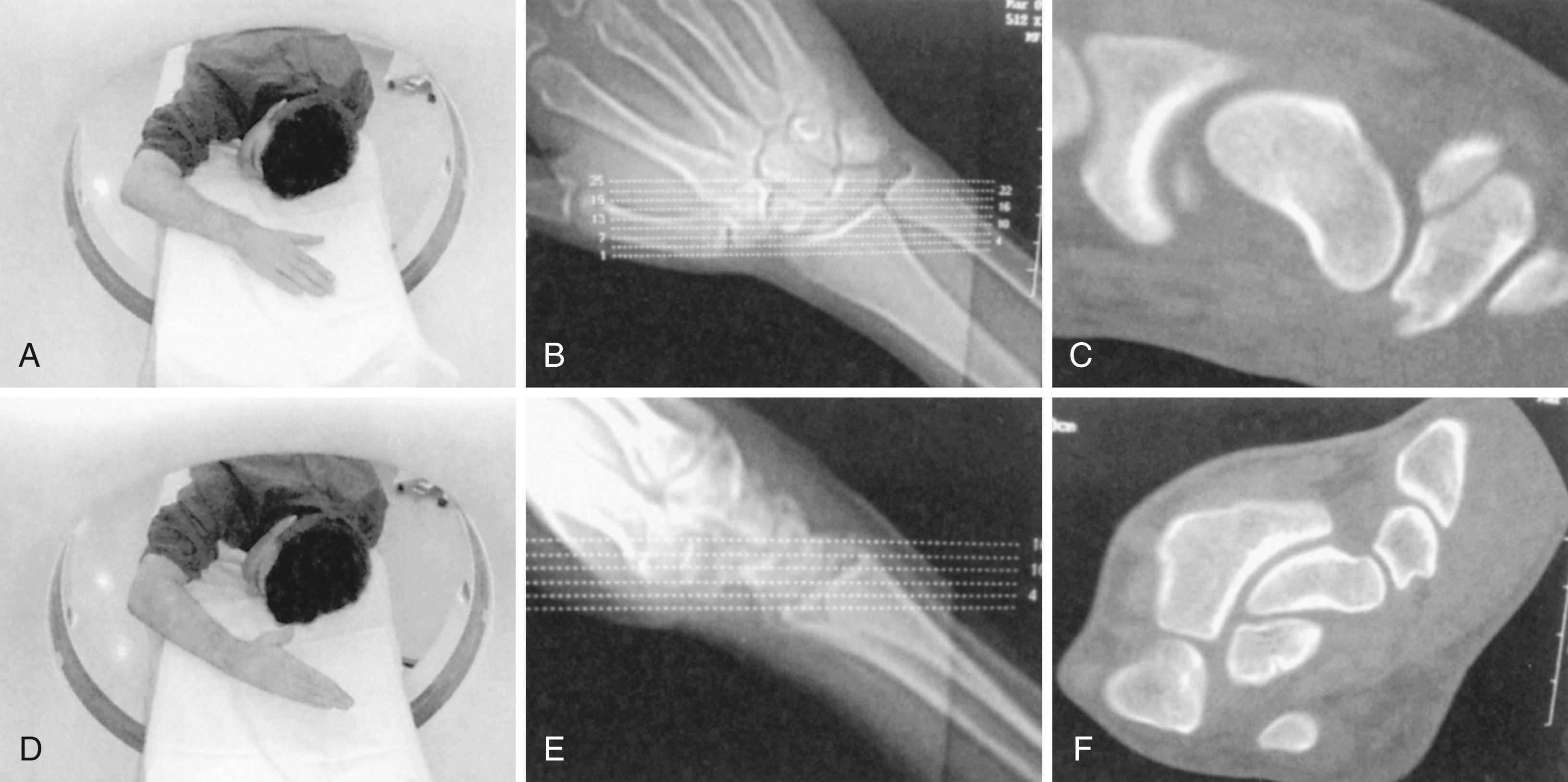
(FERNANDEZ)
Preoperatively, calculate the amount of resection, size of graft, and angular deformity on tracing paper by using the radiographic findings of the uninjured wrist as a guide ( Fig. 69.40 ).
Approach the scaphoid between the flexor carpi radialis and the radial artery according to the classic Russe procedure.
Incise the palmar capsule of the wrist longitudinally in line with the skin incision and extend it to the scaphoid tubercle for exposure of the nonunion, the proximal and distal fragments, and the scapholunate junction.
Using an oscillating saw, carry out resection according to the preoperative plan.
If signs of osteonecrosis of the proximal fragment are apparent, place multiple 1-mm drill holes within the sclerotic cancellous bone.
Correct the flexion deformity and shortening by distracting the osteotomy site on the palmar-radial aspect with two small bone hooks or a spreader clamp. As this is done, have an assistant simultaneously correct the dorsal rotation of the lunate by pushing the palmar pole toward the radius with a fine bone spike.
Shape the corticocancellous graft from the iliac crest to fit the defect with a saw, rongeur, or bone cutter. If considerable lengthening is necessary, the graft would need to be trapezoidal to bridge the defect that appears on the dorsal aspect of the navicular (see Fig. 69.40 ). Orient the graft so that its cortical part is palmar.
After insertion of the graft, shape the protruding edges flush with the proximal and distal fragments.
Use image intensification to control correction of lunate rotation.
Fix the scaphoid with two or three 0.05-in (1.2-mm) Kirschner wires, which are power driven percutaneously into the palmar aspect of the distal fragment across the graft into the dorsal aspect of the proximal fragment (see Fig. 69.37 ). Use image intensification to ensure correct placement of the internal fixation material.
Carefully close the palmar capsule and cut the Kirschner wires short, 3 mm below the palmar skin of the thenar area.
A palmar plaster splint that includes the thumb is applied for 2 weeks, at which time the sutures are removed. The wrist and thumb are immobilized in a short navicular cast for 6 weeks. Immobilization is discontinued after 8 weeks, and a palmar thermoplastic removable splint is applied with which the patient can perform active exercises of the wrist three times a day for 15 minutes. CT scans of the navicular are obtained at 12 weeks, and if bony union is confirmed, the internal fixation material is removed through a small incision under local anesthesia.
Defining union on CT scan is controversial. It has been defined as 50% to 75% bridging trabeculae. Sommerkamp et al. described a “cross-section trabeculation score” in scaphoid nonunions. This is calculated by estimating the percentage of cross-sectional trabecular bridging at the fracture site on a series of longitudinally oriented 1-mm CT scans along the scaphoid axis. This is done for both the coronal and sagittal planes, and the two percentages are averaged to provide an overall percentage or cross-section trabeculation score. The value of 50% scaphoid healing as being adequate is supported by a biomechanical model that showed the native failure strength of the scaphoid with cantilever bending applied was 610 N and the failure strength of the scaphoid with a compression screw and half of the scaphoid waist excised was 666 N.
(TOMAINO ET AL.)
With the patient supine and under appropriate anesthesia, and after preparation of the skin and one iliac crest, exsanguinate the limb with an elastic wrap and inflate the pneumatic tourniquet.
Make a palmar skin incision between the flexor carpi radialis and the radial artery, extending from about 2 cm proximal to the radial styloid to about 1 cm distal to the scaphoid tuberosity.
Incise the palmar capsule and radioscaphocapitate ligament longitudinally in line with the skin incision. Extend the incision distally, exposing the proximal trapezium and the scaphotrapezial joint.
Correct lunate extension by maximally flexing the wrist joint to derotate the extended lunate ( Fig. 69.41A ).


Fix the lunate in the flexed position by percutaneously passing a 0.045-in (1.1-mm) Kirschner wire through the radius from its lateral surface into the lunate fossa of the articular surface of the radius ( Figs. 69.41A and 69.42A,B ).
Protect the superficial radial nerve during the wire passage.
Use the C-arm fluoroscope to obtain a lateral image to ensure neutral alignment of the lunate ( Fig. 69.42C ).
Supinate the forearm and maximally extend the wrist to open up the scaphoid nonunion site ( Fig. 69.41B ).
Using a microsagittal saw or rongeur, resect the nonunion to viable bleeding bone proximally and distally.
Measure the gap in the scaphoid (length, width, and depth) to determine the dimensions of the wedge graft.
Distally, notch the trapezium with a rongeur to allow for placement of a cannulated screw (Herbert-Whipple).
Obtain a tricortical corticocancellous graft from the iliac crest using a microsagittal saw, irrigating with saline to avoid thermal bone injury ( Fig. 69.41C ).
Sculpt the graft to fit the defect.
Gently impact the graft into place with the inner (cancellous) surface facing the capitate ( Fig. 69.41D ). Avoid prominence of the graft on the dorsal and ulnar surfaces.
Pass a single 0.045-in (1.1-mm) Kirschner wire eccentrically down the long scaphoid axis to hold the scaphoid and graft in place.
Remove the radiolunate wire to allow movement of the wrist to obtain satisfactory images of guidewire placement.
Using C-arm fluoroscopic images, place the guidewire for the Herbert-Whipple screw. Ascertain with the fluoroscopic images that the guidewire is centrally placed.
Insert a screw of appropriate length. Anticipate that it might be necessary to reduce the screw length 4 to 6 mm from the length obtained from the guidewire.
Using the fluoroscope, ascertain central placement of the guidewire and screw.
Use a small burr to remove prominent graft on the radial and volar surfaces.
Assess wrist flexion and extension and radial and ulnar deviation to ensure that the graft is not impinging on the distal radius. If there is impingement, perform a limited radial styloidectomy.
Repair the palmar capsule, the radioscaphocapitate ligament, and the sheath of the flexor carpi radialis.
Deflate the pneumatic tourniquet, obtain hemostasis, and close the skin.
Apply a short arm thumb spica splint.
The splint and sutures are removed at 2 weeks. A removable short arm thumb spica splint is provided. Activities are limited and casting is continued until bone union has occurred, usually at 10 to 12 weeks.
(STARK ET AL.)
Expose the scaphoid through a straight or zigzag volar incision.
After the wrist capsule is incised longitudinally and the wrist is dorsiflexed, both parts of the scaphoid and the articular surface of the radius can be seen readily.
Remove a small, rectangular window of bone from the volar aspect of the distal fragment immediately adjacent to the fracture. Through this opening, clear fragments of fibrous tissue and dead bone using a low-speed power burr or curet.
Fashion a large cavity in the proximal and distal parts of the scaphoid.
Use a Chandler retractor to protect the articular cartilage of the radioscaphoid joint ( Fig. 69.43A ). It also helps to correct angulation, malrotation, and displacement of the fragments.

The volar part of the cortex of the scaphoid often is deficient, and this deficiency permits an exaggerated volar tilt of the distal fragment, creating the “humpback” deformity of the scaphoid.
Realignment and reduction of the fracture and restoration of the bone to the proper length are difficult parts of the procedure. Intraoperative radiographs usually are necessary.
Transfix the scaphoid with two 0.035-inch (0.9-mm) Kirschner wires by inserting them through the distal fragment into the proximal one; protect the articular cartilages of the scaphoid and radius with the retractor. Observe correct placement of the wires through the volar window.
Pack cancellous bone from the ilium into the cavity ( Fig. 69.43B ).
The wires can be inserted after packing the cavity with bone, but it is easier to verify their location before inserting the graft.
Often a cortical bone graft can be fashioned to fit snugly into the volar window; stabilize it with one additional 0.028-inch (0.7-mm) Kirschner wire ( Fig. 69.43C ).
Cut the wires off beneath the skin.
Approximate the capsule with absorbable sutures, close the skin, and immobilize the extremity in a long arm thumb spica splint with the forearm in supination, the wrist in neutral, and the thumb in abduction.
The sutures are removed at 2 weeks, and a long arm thumb spica cast is applied and is worn for 6 additional weeks. The Kirschner wires are removed after the fracture has united. When immobilization is discontinued, patients are permitted to use the wrist and hand for light activities, but strenuous and forceful activity is discouraged for an additional 2 months.
The use of vascularized bone grafts has proved to be an effective method for treating scaphoid nonunions, especially nonunions with an avascular proximal pole and those that have failed to heal after previous procedures. Since Braun’s 1983 report of success with a pronator quadratus pedicle graft from the distal radius, other sources of pedicle flaps from the distal radius and ulna and the metacarpals have been described, including an iliac crest free flap with microvascular techniques, a vascularized bone graft from the distal dorsolateral radius, and pedicle bone grafts based on the 1,2 intercompartmental supraretinacular artery. Although vascularized pedicle grafts are useful for promoting healing, the presence of established radiocarpal arthrosis may compromise the functional outcome. Additional studies have also shown success with the medial femoral condyle osteochondral free flap in scaphoid nonunions, with reported union rates of 89% at 16 weeks.
(KAWAI AND YAMAMOTO)
Make a volar zigzag incision over the scaphoid tuberosity and the distal radius to expose the site of nonunion.
Divide the radioscaphocapitate ligament complex but retain it for later repair to the muscle pedicle.
Excise the sclerotic bone ends and freshen them with a power burr to form an oval cavity 10 to 20 mm long and parallel to the axis of the scaphoid.
Identify the pronator quadratus and outline a block of bone graft 15 to 20 mm long at its distal insertion on the distal radius close to the abductor pollicis longus tendon ( Fig. 69.44 ). Outline the margin of the graft with Kirschner wire holes to facilitate separation with a fine osteotome.

Ensure that the pronator quadratus is not detached from the harvested bone graft; dissect the muscle toward the ulna to secure a pedicle 20 mm thick. The anterior interosseous vessels need not be identified.
If the muscle is too tight to allow easy transfer of the pedicled bone, dissect the ulnar origin of the pronator quadratus subperiosteally from the ulna through an additional incision over the distal ulna.
Align the proximal and distal scaphoid segments carefully as a traction force is applied to the thumb. This maneuver corrects any intercalated segment instability and allows the grafted bone to be inserted snugly into the cavity in the scaphoid.
Fix the proximal and distal scaphoid segments and the graft with two 0.045-inch (1.16-mm) Kirschner wires introduced at the scaphoid tuberosity. Do not cross the radiocarpal joint with a Kirschner wire.
Close the skin and apply a long arm thumb spica cast.
The arm is immobilized in a short arm cast until healing has occurred, usually at 10 to 12 weeks. When stable bony union is certain, the Kirschner wires are removed, usually about 3 to 4 months after surgery.
(ZAIDEMBERG ET AL.)
Place the patient supine on the operating table with the hand pronated on the hand table. Prepare the arm to use the pneumatic tourniquet.
After skin preparation, draping, limb exsanguination, and tourniquet inflation, with the forearm pronated, make an oblique skin incision on the dorsoradial side of the wrist, centered on the radiocarpal joint. Avoid injury to the branches of the superficial radial nerve.
Incise the extensor retinaculum of the first dorsal extensor compartment.
Retract the extensor pollicis brevis and the abductor pollicis longus in a palmar direction.
Retract the wrist and finger extensors toward the ulna.
On the distal radial periosteum, identify the longitudinal course of the ascending irrigating branch of the radial artery ( Fig. 69.45A ). Design a bone graft with the longitudinal vessel as its center.

Identify and protect the branches of the superficial branch of the radial nerve ( Fig. 69.45B ).
Expose the scaphoid nonunion and freshen the sclerotic bone ends with curets or a power burr.
Reduce the fracture. A Kirschner wire used as a “joystick” can be helpful.
If the fracture cannot be reduced, approach the scaphoid through a second, palmar incision over the distal flexor carpi radialis, retracting its tendon and entering the wrist through the volar capsule.
Make a 15- to 20-mm long trough in the scaphoid parallel to its long axis.
Use narrow osteotomes or a small gouge to harvest a bone graft from the distal radius, beneath the periosteal vessel ( Fig. 69.45C ). Avoid comminution of the cortex and injury to the vessel. Make the bone graft about the size of the defect in the scaphoid and transpose it to the defect in the scaphoid ( Fig. 69.45D ).
Stabilize the bone graft with Kirschner wires.
Obtain additional cancellous bone from the same radial donor site, if needed.
Deflate the tourniquet, ensure hemostasis, and close the capsule; avoid strangulating the vessel.
Close the skin and apply a bulky bandage supported by a long arm thumb spica cast.
The sutures are removed at 2 weeks, and the short arm thumb spica cast is worn until radiographic healing. Wrist motion and forearm rehabilitation are begun when union is established.
(SOMMERKAMP ET AL.)
Approach the wrist volarly through the flexor carpi radialis approach, as previously described (Technique 69.17), but extend it more proximally to complete a roughly 8-cm incision.
Take care not to extend the dissection in a radial direction when proximal or at the distal radial rim to preserve the proximal radiocarpal artery pedicle. Carefully dissect to expose the volar rim of the distal radius and the distal half of the pronator quadratus.
Debride the scaphoid nonunion site and assess the proximal pole bleeding with the tourniquet down for avascularity.
Use 0.0625 (1.5 mm) Kirschner wires as joysticks to correct the humpback deformity; measure the defect needed for the vascularized graft (maximum size obtainable: 12 mm long, 10 mm wide, 13 mm deep).
For harvest of the graft, carry out the dissection ulnar to the flexor carpi radialis. Retract the median nerve and flexor tendons ulnarly with a wide Penrose drain and slightly flex the wrist to relax the tendons and widen the view. The Penrose drain can be used to retract the carpal tunnel contents radial or ulnar, whichever provides better exposure of the donor site or pedicle.
The proximal radiocarpal artery (PRCA) pedicle can now be seen at the distal edge of the pronator quadratus, often surrounded by fat.
Identify the lunate fossa and place Kirschner wires to match the volar tilt of the articular surface to prevent penetration into the joint when harvesting.
Gently dissect the pronator from the PRCA pedicle along the ulnar side of the radius. Carefully avoid skeletonizing the pedicle in the mid to radial part of the distal radius.
Mark the desired graft size on the volar ulnar aspect of the exposed distal radius with the pedicle centered in the graft templating. Ligate the ulnar continuation of the PRCA pedicle as it crosses the distal radioulnar joint.
Complete distal, ulnar, and proximal cuts along the markings of the donor graft site with a 7-mm oscillating saw under continuous irrigation, avoiding penetration into the lunate fossa or distal radioulnar joint.
Complete the graft harvest with a radial osteotomy using 2-mm osteotomes on either side of the pedicle. Lift the graft out of the donor site with a Freer elevator.
Mobilize the PRCA radially by keeping a wide cuff of tissue and dissecting in a subperiosteal manner.
Rotate the pedicle 30 to 40 degrees to inset into the scaphoid nonunion defect. The proximodistal and radioulnar parts of the graft correspond identically to the scaphoid recipient site.
Complete fixation with either Kirschner wires or a cannulated compression screw in a retrograde manner, according to surgeon preference.
Take care when performing the radioscaphocapitate ligament repair to not compress the pedicle.
The sutures are removed at 2 weeks, and the short arm thumb spica cast is worn until radiographic healing, often confirmed on CT scanning at 3 months postoperatively. Wrist motion and forearm rehabilitation are begun when union is established.
Arthrodesis should be considered a salvage procedure for old ununited or malunited fractures of the scaphoid with associated radiocarpal traumatic arthritis. Wrist arthrodesis is discussed later in this chapter.
Become a Clinical Tree membership for Full access and enjoy Unlimited articles
If you are a member. Log in here
